This guide explains the types, characteristics, JIS standards, processing methods, and material selection of iron and iron alloys (steel) for mechanical designers. We address questions such as “What’s the difference between SS400 and S45C?”, “Why is SCM440 used for shafts?”, and “Does stainless steel really never rust?”, while comparing these materials to aluminum, copper, and titanium.
Introduction | Why Iron and Iron Alloys Are Chosen for Machine Parts
Iron (Fe) is the name of the element, and the “steel” used in machine parts is primarily an alloy containing iron and carbon. Generally, iron-based alloys with a carbon content of approximately 2% or less are treated as steel and distinguished from cast iron, which has a higher carbon content. The actual boundaries and classifications vary depending on standards and composition.
Steel offers an excellent balance of strength, rigidity, workability, availability, and cost, and is used in frames, bolts, gears, shafts, and molds. However, aluminum is lighter; stainless steel or titanium offer better corrosion resistance depending on the conditions; and copper is superior in terms of thermal and electrical conductivity.
| Material | Main Advantages | Design Considerations |
|---|---|---|
| Mild Steel・ Carbon Steel | High rigidity, low cost, wide range of welding and machining options | Heavy, prone to rust, performance varies depending on steel grade and heat treatment |
| Alloy Steel | Easier to enhance hardenability, strength, and wear resistance | Heat treatment control, material cost, cracking and deformation |
| Stainless Steel | Many grades offer excellent corrosion resistance | Pitting corrosion in chloride environments, work hardening, cost |
| Aluminum Alloys | Lightweight, relatively high thermal conductivity | Lower Young’s modulus and wear resistance than steel |
| Copper and Copper Alloys | High electrical and thermal conductivity | High density; cost; balance of strength and electrical conductivity |
| Titanium Alloys | Many offer excellent specific strength and corrosion resistance | Expensive; difficult to machine; galling during sliding |
Chemical and Physical Properties | Density, Electrical Conductivity, Thermal Conductivity, Corrosion
Density (Specific Gravity) | Steel is approximately 2.9 times heavier than aluminum
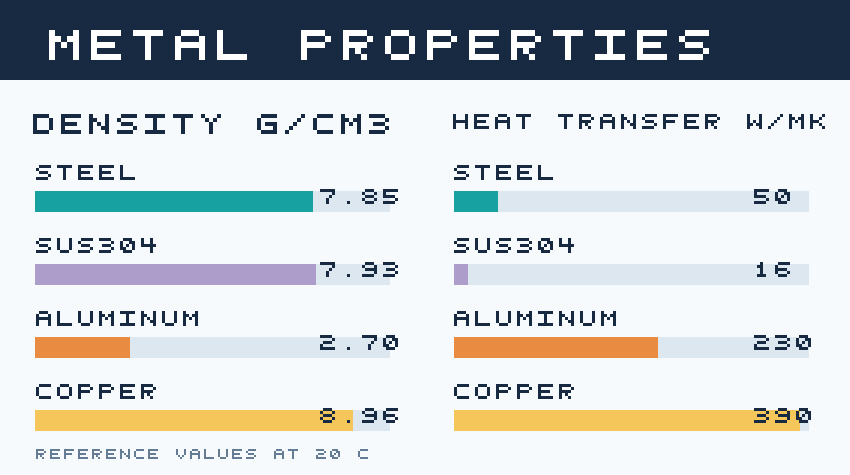
Typical values near room temperature are 7.85 g/cm³ for mild steel, approximately 7.93 g/cm³ for SUS304, approximately 2.70 g/cm³ for aluminum, approximately 8.96 g/cm³ for copper, and approximately 4.51 g/cm³ for titanium. For parts of the same volume, steel has approximately 2.9 times the mass of aluminum. However, since the required dimensions change when the rigidity and strength of the parts are matched, the weight ratio is not necessarily exactly 2.9 times.
Electrical Conductivity and Thermal Conductivity | Copper and Aluminum Have Advantages
Typical thermal conductivity values are approximately 45–60 W/(m·K) for mild steel, 15–17 W/(m·K) for SUS304, 200–240 W/(m·K) for aluminum, and 380–400 W/(m·K) for copper. These values vary depending on the type of alloy and temperature. As a general guideline, the electrical resistivity of mild steel is approximately 0.1–0.2 μΩ·m, that of SUS304 is approximately 0.72 μΩ·m, that of pure copper is approximately 0.017 μΩ·m, and that of pure aluminum is approximately 0.028 μΩ·m.
We consider the required functions separately: copper for terminals that efficiently conduct current, aluminum for heat sinks, and steel for structural materials that support loads.
Thermal Expansion and Magnetism | Factors That Cannot Be Overlooked in Precision Mechanisms
The linear expansion coefficient (near room temperature) is approximately 11–13 × 10⁻⁶/K for ordinary steel, approximately 17 × 10⁻⁶/K for SUS304, approximately 23 × 10⁻⁶/K for aluminum, and approximately 17 × 10⁻⁶/K for copper. For a 1-meter-long piece of mild steel subjected to a temperature difference of 50°C, assuming a coefficient of 12 × 10⁻⁶/K, it will expand by approximately 0.6 mm. The linear expansion can be roughly estimated using the formula ΔL = α × L × ΔT.
Mild steel and many martensitic stainless steels exhibit ferromagnetism. On the other hand, austenitic SUS304 is typically non-magnetic to weakly magnetic in the annealed state, but may become magnetic due to cold working.
Mechanism of Rusting and Corrosion Resistance
Iron corrodes electrochemically in environments containing moisture and oxygen, resulting in red rust. Salt tends to accelerate corrosion, and galvanic corrosion can occur when dissimilar metals are electrically connected and water is present. Countermeasures include painting, galvanizing, surface treatment, ensuring proper drainage, and inserting insulating materials.
Stainless steel generally contains at least 10.5% chromium and derives its corrosion resistance from a passive film on its surface. However, this does not mean it is “rust-proof.” Even SUS304 can be subject to pitting corrosion, crevice corrosion, and, under certain conditions, stress corrosion cracking caused by seawater or chlorides. SUS316 contains molybdenum, which improves resistance to chloride pitting corrosion; however, this does not mean it is unconditionally safe in seawater.
Mechanical Properties | Strength, Toughness, Elongation, Workability, Cost
Strength and Stiffness Are Different | Tensile Strength, Yield Strength, Young’s Modulus
“Strong” and “Resistant to Deflection” Are Different Concepts. Tensile strength is the maximum stress in a tensile test, while yield point and ultimate strength are indicators of the onset of plastic deformation. The modulus of elasticity (Young’s modulus) represents resistance to deformation in the elastic range; it is approximately 200–210 GPa for ordinary steel and approximately 69–72 GPa for aluminum alloys. Even if the strength of steel increases through heat treatment, the Young’s modulus does not change significantly.
For example, the axial elastic elongation of a rod can be expressed as ΔL = F L / (A E). In cases of axial deflection or buckling, the second moment of area and support conditions are also important.
Toughness and Ductility | Resistance to Fracture and Elongation
Toughness refers to the amount of energy that can be absorbed before fracture and is evaluated through impact tests (such as the Charpy test) and fracture toughness. Ductility is indicated by elongation at break or reduction of area. While higher hardness and strength are advantageous for wear resistance, they may also be accompanied by a decrease in toughness or an increased risk of cracking. Some steel grades become more prone to brittle fracture as the temperature drops, so special care is required in low-temperature equipment.
Workability | Machining, Bending, Welding, Heat Treatment
Low-carbon steels are generally suitable for welding and bending. Medium-carbon steels, such as S45C, are often used for machining and quenching, but have limitations regarding weldability. SCM440 incorporates chromium and molybdenum to improve hardenability, making it easier to select heat treatment conditions even for thick components. With SUS304, care must be taken regarding work hardening, low thermal conductivity, and tool sticking.
Price, Availability, and Recyclability
Generally, general-purpose carbon steel offers advantages in terms of unit material cost and availability. However, the actual total cost must be evaluated by considering material weight, machining time, heat treatment, surface treatment, inspection, inventory, and service life. Steel is easy to separate using magnetic separation, and scrap iron can be recycled in electric arc furnaces; however, alloy components and copper contamination pose challenges for quality control. Do not simply assume that “it circulates indefinitely at 100% consistent quality”; instead, verify scrap sorting procedures and quality requirements.
How to Read JIS Standards | SS400, S45C, SCM440, SUS304
JIS Numbers and Material Symbols Are Different
As in JIS G 3101, JIS + division symbol (G: steel) + standard number are used to identify standard documents. On the other hand, SS400, S45C, SUS304, and the like are designations for materials and steel grades. The numbers in the standard numbers do not simply correspond to strength in order, nor do the numbers in the material designations uniformly indicate carbon content or strength. Official definitions and specified values must be confirmed based on the applicable year of the standard, product shape, and dimensional classification.
| Material Designation | Representative JIS Standards | Pronunciation and General Applications | Points to Note Regarding Properties |
|---|---|---|---|
| SS400 | JIS G 3101 | Rolled steel for general structural use. “400” indicates the lower limit of the tensile strength range, 400 MPa | Tensile strength: 400–510 MPa (standard values for typical dimensions). The yield point varies depending on plate thickness, etc. |
| S45C | JIS G 4051 | Carbon steel for mechanical structures. “45” indicates a carbon content of approximately 0.45%. | Specifications for chemical composition. Strength varies depending on heat treatment and product conditions |
| SCM440 | JIS G 4053 | Alloy steel for mechanical structures (Cr-Mo steel). “40” generally denotes a series with a carbon content of 0.40% | Used for shafts, bolts, gears, etc., assuming tempering or quenching |
| SUS304 | JIS G 4303, etc. | Austenitic stainless steel. “304” is the steel grade identification number | Select the applicable JIS standard based on product form (bar, plate, etc.). Caution regarding chlorides |
| SUS316 | JIS G 4303, etc. | Mo-added austenitic stainless steel | Offers better pitting resistance than SUS304 but is not completely corrosion-resistant |
| FC250 | JIS G 5501 | Grey cast iron. “250” denotes the tensile strength grade | Excellent vibration damping and castability, but weak against tensile stress and impact |
| FCD450-10 | JIS G 5502 | Spheroidal graphite cast iron. “450” refers to tensile strength, and “10” refers to the nominal elongation value | Higher ductility and toughness than FC. Consider wall thickness and casting defects |
*The table above is an introductory overview. The official names of standards, current editions, and guaranteed values for tensile strength, yield strength, and elongation vary depending on shape, thickness, heat treatment, and test specimen conditions. In particular, it is incorrect to interpret SS400 as always having a yield strength of 400 MPa or S45C as always having a tensile strength of XX MPa.
Microstructures of Iron and Steel | Carbon Content and Heat Treatment Determine Performance
Depending on the carbon content and cooling rate, the microstructure—such as ferrite, pearlite, bainite, and martensite—changes, affecting hardness, strength, ductility, and toughness. Annealing is performed to soften the material or refine the microstructure; normalizing is performed to homogenize the microstructure; quenching is performed to harden the material; and tempering is performed to adjust toughness and dimensional stability. Heat treatment conditions must be tailored to the steel grade and product geometry.
Is a material designation alone sufficient when specifying materials in drawings?
For critical components, in addition to the material grade, the product standard, supply condition, heat treatment conditions, hardness, surface treatment, and required inspection conditions must be specified. Example: “S45C, normalized, hardness range, surface roughness and geometric tolerances of ground surfaces” should be clearly stated according to the component’s function. Numerical specifications are determined based on design calculations and testing.
Differences in Manufacturing Methods | Casting, Forging, Rolling, Machining

Casting | Suitable for complex shapes and large parts
In casting, metal is melted, poured into a mold, and allowed to solidify. It is easy to produce ribs, hollow sections, and complex monolithic shapes, making it suitable for pump casings, machine tool beds, and housings. Typical cast irons include FC and FCD. Considerations include shrinkage cavities, gas pores, segregation, dimensional variations, and machining allowances resulting from solidification shrinkage; non-destructive testing is performed as necessary.
Forging | Suitable for high-load components such as shafts and connecting parts
Forging is a method of shaping solid metal by applying compressive force during hot, warm, or cold processes. While improvements in fatigue strength and reliability can be expected through forging flow lines (material flow) and microstructural refinement, forged parts are not always stronger than castings. Evaluation is based on material, defects, heat treatment, shape, and the direction of the forging flow lines. It is used for crankshafts, gear blanks, connecting rods, and similar components.
Machined, Sheet Metal, and Welded Structures from Rolled Stock
For small-lot production or prototyping, machining from rolled bars or sheets eliminates the need for tooling costs and allows for easy design changes. Sheet metal and welded structures make it possible to manufacture large frames relatively inexpensively. However, care must be taken regarding welding distortion, heat-affected zones, fatigue cracks, and residual stresses. Even after casting or forging, machining and grinding finishes are often performed to achieve the required precision.
| Perspective | Casting | Forging | Rolled Material + Machining |
|---|---|---|---|
| Design Freedom | Advantageous for complex shapes and hollow structures | Constraints due to molds and plastic flow | Constrained by the reach of cutting tools |
| Economics of Mass Production | High depending on shape and lot size | Recoups mold investment through mass production | Suitable for prototyping and small batches |
| Major Quality Issues | Casting porosity, shrinkage, solidification defects | Cracks, forging defects, anisotropy | Material yield, residual stress |
| Typical Applications | Cases, beds, housings | Shafts, cranks, high-load components | Jigs, prototype shafts, brackets |
Material Selection Procedure | Which Steel Grade to Choose for Which Parts?
Step 1: Organize Loads, Environment, and Mass-Production Feasibility
Narrow down candidate materials in the following order: ① Loads (static, impact, cyclic, torsional) ② Required rigidity and weight ③ Temperature, water, salt, chemicals ④ Service life and safety ⑤ Welding, machining, heat treatment ⑥ Quantity, delivery time, and availability. For safety-critical components, separately verify fatigue, buckling, fracture, corrosion, and compliance with standards.
Step 2: Consider Actual Machine Components
| Application and Requirements | Candidate Materials | Reasons for Selection and Precautions |
|---|---|---|
| Machine Frames and Stands | SS400; SM series as needed | Easy to procure and suitable for welded structures. Verify plate thickness, rigidity, and weldability |
| Rotating shafts and general shafts | S45C | Select quenching and tempering, high-frequency hardening, or dimensional accuracy based on required strength |
| High-load shafts and high-strength bolts | SCM440 | Offers advantages in hardenability and strength. Caution regarding fatigue, heat treatment, and hydrogen embrittlement |
| Indoor and outdoor components in contact with water | SUS304, SUS316 | Prioritize corrosion resistance. Re-evaluate selection based on chloride environments and the presence of gaps |
| Machine beds for large machinery | FC250, FCD series | Utilize the integrated structure achieved through casting and its damping characteristics. Caution regarding brittleness and casting defects |
| Cast brackets subjected to loads | FCD450-10, etc. | Consider when toughness and ductility are required over gray cast iron |
| Electrical terminals and Heat-dissipating components | Copper and aluminum | Prioritize electrical and thermal conductivity over steel |
| Lightweight mobile frames | Aluminum alloys, thin-walled high-tensile steel, etc. | Compare not only strength but also rigidity, weight, joining methods, and total cost |
Step 3: Do not base decisions solely on material strength
For example, even if you change a load-bearing bracket to S45C, the deflection may not differ significantly from that of SS400 unless the plate thickness is changed. This is because their Young’s moduli are similar. On the other hand, yield strength, workability, weldability, heat treatment costs, and quality assurance will differ. It is important to first determine whether the design objective is “to prevent breakage,” “to prevent deflection,” or “to reduce weight.”
Frequently Asked Questions (FAQ)
What is the difference between SS400 and S45C?
SS400 is rolled steel for general structural use, while S45C is carbon steel for mechanical structures. Typical examples include structural frames for SS400 and heat-treatable shafts and machine parts for S45C. However, strength must be verified based on dimensions, supply condition, and heat treatment conditions.
Is SUS304 absolutely rust-proof?
No. It is susceptible to corrosion depending on salt content, gaps, standing water, temperature, and surface condition. Even SUS316 does not eliminate the risk of corrosion.
Which is stronger: casting or forging?
While forging may be advantageous in certain applications when using the same material, similar defect levels, and appropriate processing conditions, this cannot be generalized. The required properties are evaluated through drawings, material certificates, heat treatment, strength testing, and non-destructive testing.
Summary | Select Based on “Steel Grade + Process + Operating Environment”
Iron and iron alloys are a group of materials that offer broad design flexibility in terms of strength, rigidity, cost, and machinability. Start by understanding the applications of SS400, S45C, SCM440, SUS304, FC250, and FCD, and then refine your selection based on conditions such as yield strength, fatigue resistance, corrosion resistance, heat treatment, and casting/forging methods. Material designations serve as a starting point for design but do not in themselves guarantee the performance of the finished part.
Reference Materials and Related Articles
- Japan Industrial Standards Committee (JISC) : Search for JIS standards and check the latest versions
- worldsteel (World Steel Association): Steel properties and recycling
- Machine Design 1 | Properties and Selection of Aluminum Alloys
- Machine Design 2 | Properties and Selection of Copper and Copper Alloys
The physical property values in this article are primarily representative reference values at room temperature. For guaranteed values specified in standards and final selection, be sure to cross-reference the latest version of the original JIS standard, the manufacturer’s data sheet, and actual usage conditions.