This article compares wood and plywood used in factory automation (FA) equipment and industrial process design in terms of materials, manufacturing methods, durability, and safety. It also provides practical design and machining tips for fixtures, machine covers, workpiece supports, worktables, carts, conveyor guides, shipping crates, and other applications on the factory floor.
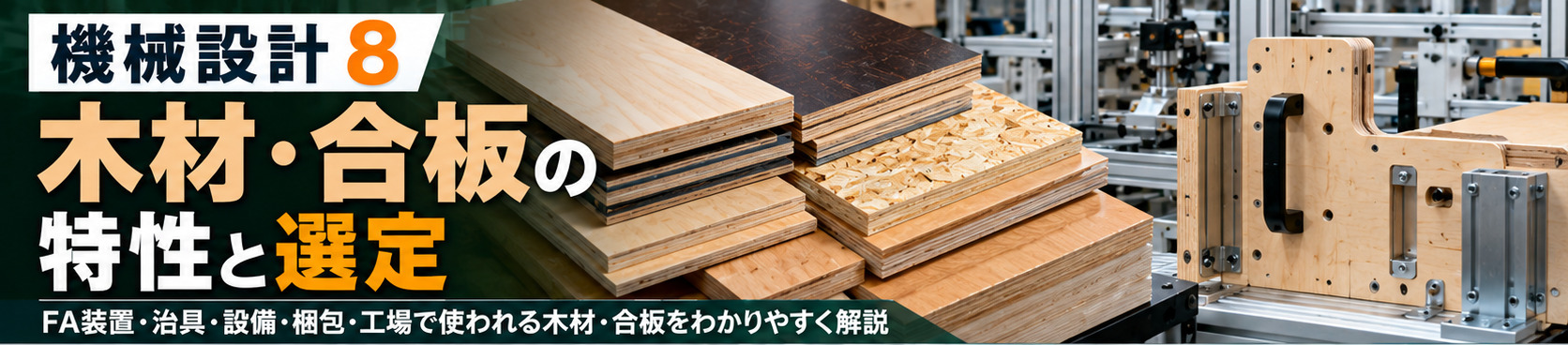
Introduction | How Wood and Plywood Differ from Metals and Plastics
Plywood, Solid Wood, LVL, and OSB Are Different Materials
Solid wood is an anisotropic material whose properties depend on the natural grain direction. Plywood consists of thin veneers bonded together, usually with the grain of adjacent layers at right angles to reduce directional differences within the panel. LVL (laminated veneer lumber) has veneers aligned mainly in the same grain direction to take advantage of longitudinal strength. OSB (oriented strand board) is a panel made by bonding long, thin wood strands arranged in specific directions in each layer. MDF and particleboard are different products made from bonded wood fibers or particles.
Key advantages over metal include easier machining, lower weight, and straightforward replacement. However, designers must account for moisture absorption and warping, directional strength differences, creep, flammability, dust generation, and limited durability under repeated screw fastening. For permanent equipment requiring high precision or high load capacity, comparisons with aluminum, steel, and engineering plastics are essential.
Chemical and Physical Properties | Weight, Heat, Moisture, Chemical Resistance, and Electrical Properties
Weight and Density
As general reference ranges, conventional plywood has a density of approximately 0.4–0.75 g/cm³, depending on wood species and moisture content; LVL is approximately 0.45–0.7 g/cm³, and OSB approximately 0.55–0.7 g/cm³. A 900 × 600 × 18 mm panel with a density of 0.60 g/cm³ weighs approximately 5.83 kg. Dimensions and thickness alone are not enough to determine weight; check the density of the actual product.
Heat Resistance, Weather Resistance, and Moisture-Related Dimensional Changes
Wood has lower thermal conductivity than metals, but exposure to high temperatures can cause drying, thermal degradation, charring, and combustion. Even when phenolic resin is used, the product is not necessarily noncombustible or fire-resistant. Wood absorbs and releases moisture as ambient humidity changes, affecting panel thickness, in-plane dimensions, and warpage. Allow the material to acclimate to its service environment before final machining and dimensional inspection, and apply coatings or edge sealing consistently to both faces and all edges.
Resistance to Solvents, Oils, and Cleaning Agents
Wood can absorb liquids. Assess compatibility with cutting oils, coolants, alcohols, and detergents not only for the wood itself but also for adhesives, coatings, and bonded rubber or urethane layers. For equipment that requires repeated cleaning with chemicals, compare plastic sheets and metals as priority alternatives.
Electrical Properties and Static Dissipation
The electrical resistance of wood varies greatly with moisture content, contamination, and surface finish, so it cannot always be regarded as an insulating material. For antistatic or conductive plywood, verify surface resistance, resistance to ground, grounding paths, and resistance after wear against the product specifications. In electrostatic discharge (ESD) protected areas, combine a control program based on standards such as IEC 61340-5-1 with personnel grounding and periodic inspections.
Mechanical Properties | Strength, Toughness, Creep, Wear, and Cost
Flexural Strength and Anisotropy
The flexural strength and flexural modulus of plywood vary with wood species, thickness, veneer layup, bond quality, and loading direction. Pay particular attention to the strong and weak axes of LVL and OSB. For safety-related components, use manufacturers’ guaranteed values, JAS classifications, and test results.
Localized Compression, Splitting, and Toughness
Wood is useful for fixture supports that distribute loads over an area, but splitting, delamination, and localized crushing can occur around holes, at edges, under bolt bearing surfaces, and in narrow battens. Consider through-bolts with large-diameter washers, backing plates, and metal sleeves.
Creep, Friction, and Wear
Deflection can increase under sustained loads or repeated humidity changes. Friction and wear during conveying depend on surface roughness, wood species, films, counterface materials, and contact pressure. Some phenolic film-faced plywood products offer excellent cleanability and wear resistance, although their slip characteristics vary by specification. Rubber- or urethane-faced panels help prevent damage to products, but the bonded layer must be monitored for peeling, contamination, and foreign-particle generation.
Material and Processing Costs
Standard plywood is generally economical for prototypes, fixtures, and packaging, but specialty finishes such as surface films and conductive, flame-retardant, or wear-resistant specifications increase material and processing costs. Evaluate replacement frequency, cleaning time, and local availability in addition to purchase price.
Wood-Based Material Types and Performance Comparison
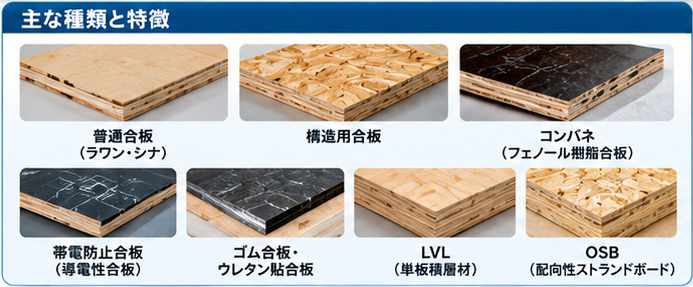
High-Performance and Durable Plywood
Shina (basswood-faced) plywood is valued for its attractive surface and ease of machining and finishing, while lauan plywood is used for general-purpose applications. However, the face veneer species alone does not determine core construction or bond strength. Concrete formwork plywood (commonly called ‘conpane’ in Japan) is available with or without a surface film; phenolic resin may be used in either the adhesive or the surface film. The informal name ‘conpane’ does not itself indicate any particular strength or water-resistance grade.
Specially Processed Wood Products
For conductive and antistatic plywood, verify product-specific resistance values and grounding requirements. Rubber- and urethane-faced plywood can provide slip resistance, workpiece protection, and impact absorption, but friction, compression set, oil resistance, delamination, and static electricity must be evaluated for the specific facing material.
Materials for Logistics and Packaging
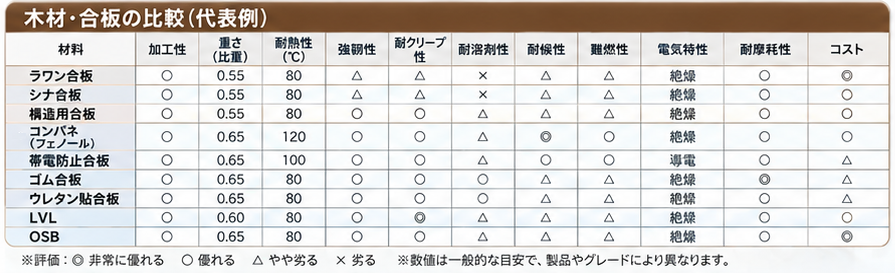
LVL is a candidate for longitudinal battens, beams, and crate members, while OSB is suitable for consideration as crate panels or sheet material. For wood packaging used in international shipments, check whether each material is covered by or exempt from ISPM 15, and take care when combining engineered wood with solid-wood battens or feet.
| Material | Machinability | Weight | Strength and Toughness | Creep Resistance | Weather and Solvent Resistance | Flame Retardancy | Electrical Properties | Wear Resistance | Cost |
|---|---|---|---|---|---|---|---|---|---|
| Standard / Lauan Plywood | Good | Light to Medium | Depends on grade and direction | Watch for long-term deformation | Sensitive to water and chemicals | Combustible | Varies with humidity | Depends on surface | Low to Medium |
| Shina (Basswood-Faced) Plywood | Good | Light to Medium | Depends on core | Caution required | Surface protection needed | Combustible | Varies with humidity | Good surface finish | Medium |
| Structural Plywood | Good | Light to Medium | Evaluate by JAS grade and direction | Caution required | Depends on bonding specification | Combustible | Check guaranteed values | Depends on surface | Low to Medium |
| Film-Faced Formwork Plywood | Good | Medium | Depends on substrate | Caution required | Depends on surface coating | Combustible | No guaranteed conductivity | Some grades perform relatively well | Medium |
| Conductive / Antistatic Plywood | Good | Medium | Depends on substrate | Caution required | Depends on surface specification | Verify separately | Measure resistance and grounding | Assess coating service life | Medium to High |
| Rubber- / Urethane-Faced Plywood | Good | Medium to Heavy | Depends on substrate | Facing may deform | Evaluate oil resistance and adhesion | Verify separately | Depends on facing specification | Effective for scratch protection | Medium to High |
| LVL | Good | Medium | Advantageous along the length | Caution required | Evaluate adhesion and moisture uptake | Combustible | Humidity-dependent | Depends on surface | Medium |
| OSB | Good | Medium | Evaluate along principal axis | Caution required | Watch for moisture absorption at edges | Combustible | Humidity-dependent | Depends on surface | Low to Medium |
* This table summarizes general trends and does not guarantee the performance of any specific product. As with other wood-based materials, heat exposure and combustion must be considered; flame-retardant or noncombustible performance requires separate testing and certification.
For a more detailed introduction to wood species and their properties, see this reference book.Revised Full-Color Encyclopedia of 200 Wood Species: A Comprehensive Guide to Wood Available in Japan (Japanese-language book)
Standards | JAS, JIS, and ISPM 15
Understanding JAS Classifications
Check the applicable Japanese Agricultural Standards (JAS) for general-purpose plywood, structural plywood, concrete formwork plywood, specially processed decorative plywood, laminated veneer lumber (LVL), and structural panels such as OSB. Do not assume water resistance or strength from the material name alone. Specify bond performance, strong/weak axis orientation, moisture content, formaldehyde emission class, thickness, and dimensional tolerances.
What to Specify on Engineering Drawings
Rather than specifying only ‘plywood t18’, include the product name, manufacturer’s part number or JAS classification, panel thickness and tolerances, grain direction, moisture content, face and edge treatments, hardware and fastening methods, replaceable components, and inspection requirements. For ESD-control materials, also state resistance limits, grounding methods, and measurement conditions.
Manufacturing Processes | Plywood, LVL, and OSB
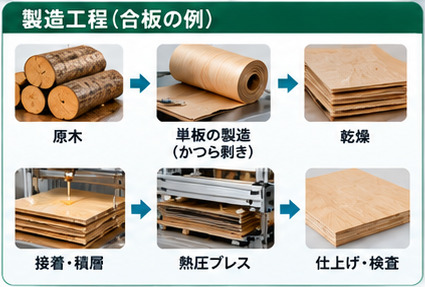
Plywood Manufacturing
A typical process is: (1) log selection → (2) heating or steaming → (3) veneer production using a rotary lathe or other equipment → (4) veneer drying → (5) grading and repair → (6) adhesive application → (7) layup with generally perpendicular grain directions → (8) cold and hot pressing → (9) trimming, sanding, and inspection. Adhesive type, veneer thickness, and pressing conditions affect performance.
LVL
Dried veneers are stacked with their grain mainly parallel, bonded, and hot-pressed, making LVL well suited to longitudinal structural members. Confirm direction-dependent properties and performance under changing humidity.
OSB
Long, thin wood strands are produced from logs, then dried, mixed with resin, oriented, layered, hot-pressed, and trimmed. Different strand orientations in the face and core layers create strong and weak axes.
Surface Finishing
For phenolic film-faced, decorative, conductive-sheet-faced, rubber-faced, and urethane-faced plywood, quality depends not only on the base panel but also on the facing and adhesive layers: evaluate chemical resistance, wear, delamination, and sealing of machined edges.
How to Select Materials | Practical Examples for FA Equipment and Process Design
Application-Based Selection
| Application | Candidate Materials | Key Design Considerations |
|---|---|---|
| Temporary Assembly Fixtures | Shina or lauan plywood | Machinability, moisture content, repeatability, replaceability |
| Equipment and Worktable Tops | Structural or film-faced plywood | Support span, contact pressure, cleaning, slip, water absorption |
| Protective Pads to Prevent Product Scratches | Rubber- or urethane-faced plywood | Hardness, foreign-particle contamination, delamination, oil resistance |
| Supports for Electronic Components | Plywood verified to meet ESD requirements | Grounding, surface resistance, periodic measurements |
| Shipping Crates and Carts | LVL, OSB, plywood | Transport vibration, loads, humidity, ISPM 15 |
| Permanent Precision Positioning | Metal body with replaceable wood-based contact pads | Use metal for accuracy and make contact surfaces replaceable |
Design Tips | Deflection, Fastening, Temperature, and Humidity
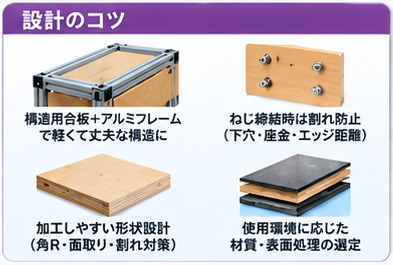
For a simplified beam model with a concentrated load at midspan, deflection is δ = PL³/(48EI). Reducing the support span L and adding reinforcing battens are effective ways to control deflection. Use an elastic modulus E appropriate to the panel’s grain direction and moisture content. Because screw holes and edges are prone to splitting, consider pilot holes, sufficient edge distances, large-diameter washers, through-bolts, and metal inserts. Seal both faces and edges consistently to reduce warping, and verify dimensions after acclimatization to the humidity at the installation site.
Machining and Processing Precautions
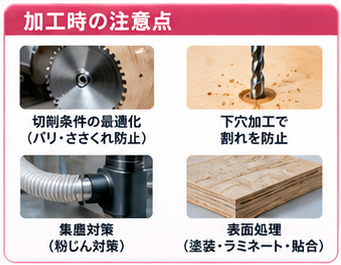
When cutting and drilling, use backing boards, clamps, and sharp woodworking tools to minimize splintering and delamination. Dust extraction, prevention of dust explosions and fires, personal protective equipment, ventilation, and review of safety data sheets (SDS) for paints and adhesives are important. Inspect repeated sliding-contact areas for wear debris and detached fragments, and design them for easy replacement.
Application Examples by Wood and Plywood Type
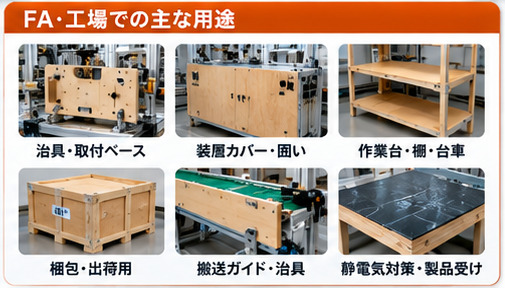
Wood and plywood can be used in a wide range of applications, from prototype fixtures to conveying and packaging. However, strength, water resistance, and electrical conductivity depend on the product grade, core material, adhesive, and surface treatment. The following arepractical application examples for consideration in FA equipment and factories; they do not guarantee suitability for a particular application.
1. General-Purpose Plywood | Temporary Fixtures, Prototypes, and General Wood Components
- Prototype Fixture Base Plates:Temporary fixtures for checking mechanism layouts and dimensions, or provisional sensor mounting platforms.
- Partitions and Protective Panels During Transport:Internal dividers and workpiece supports that separate products and prevent contact.
- Replaceable Protective Boards:Replaceable boards that protect assembly worktables from dirt and scratches, and simple tool-storage shelves.
Design and Machining Precautions:Best suited to applications that benefit from low cost and easy machining. It may be unsuitable for high-precision positioning; check moisture content, warpage, edge splintering, and bonding performance.
2. Structural Plywood | Load-Bearing Worktables and Fixture Bases
- Fixture Stand Top Panels:Working surfaces mounted on aluminum-profile or steel frames.
- Assembly and Inspection Tables:Base panels that support distributed loads, and support boards for component trays.
- Factory Transport Cart Decks:Decking for platform carts that support loads across a broad area.
Design and Machining Precautions:The term ‘structural’ does not automatically guarantee the allowable load for machine-equipment applications. Evaluate JAS grade, strong-axis orientation, support span, concentrated loads, screw withdrawal resistance, and long-term creep.
3. Concrete Formwork Plywood (Conpane) | Replaceable Work and Protective Boards
- Temporary Worktable Tops:Temporary working surfaces in areas free of welding sparks and other heat sources.
- Protective Boards Inside Factories:Temporary floor and wall protection during equipment installation, and temporary partitions.
- Side Panels for Transport Boxes and Packaging:Short-term applications where panel thickness and bonding performance meet the requirements.
Design and Machining Precautions:‘Conpane’ is a colloquial application name, and not every product has a film-faced surface. Verify the surface and bonding specifications. Remember that the material is combustible, and check edge moisture absorption and surface slipperiness.
4. Phenolic Film-Faced Plywood | Easy-to-Clean and Wear-Resistant Surfaces
- Replaceable Worktable Tops:Workpiece-support and assembly surfaces from which dirt can be wiped away easily.
- Bases for Conveying and Sliding Surfaces:Short-term conveyor guides and chutes where the surface’s sliding characteristics are suitable.
- Liners for Carts and Product Packaging:Bottom and side panels of transport containers with easy-to-clean surfaces.
Design and Machining Precautions:Plywood bonded with phenolic resin adhesive and plywood covered with a phenolic surface film are different specifications. Verify required surface wear resistance, friction, and water resistance for each product, and seal cut edges. Phenolic-based products are not necessarily noncombustible.
5. Shina (Basswood-Faced) Plywood | Inspection Fixtures and Covers Where Appearance and Feel Matter
- Workpiece Supports in Inspection Processes:Smooth-surfaced support panels for visual inspection and assembly checks.
- Exterior Covers for Prototype Equipment:Easy-to-machine, non-safety-related covers for prototype machines where an attractive finish is desired.
- Tool and Component Organizer Trays:Simple storage components frequently handled by operators.
Design and Machining Precautions:Although many grades offer an attractive surface finish, the core material, adhesive, and strength depend on the specification. If products are placed directly on the panel, check for surface scratches, wood dust, and humidity-related dimensional changes.
6. Lauan Plywood | General-Purpose Fixtures, Dividers, and Shipping Crates
- Simple Positioning Fixtures for Manufacturing Processes:Short-term base materials for evaluating hole locations and workpiece orientations.
- Shipping Boxes and Wooden Cases:Side panels, dividers, and protective covers for products.
- Factory Component Shelves and Auxiliary Worktables:Panel material used in combination with metal frames.
Design and Machining Precautions:Lauan is a general name for a group of wood species, which do not all have the same density or performance. Check thickness, ply construction, bonding grade, and splitting or chipping at edges.
7. Antistatic and Conductive Plywood | ESD-Controlled Areas for Electronic Components
- Temporary Supports for Circuit Boards and Electronic Components:Work surfaces and workpiece supports that meet the required ESD-control conditions.
- Base Panels for Electronic Component Transport Trays:Auxiliary transport panels with verified surface resistance and grounding connections.
- Fixture Bases for Inspection Processes:Assembly and inspection stations for electrostatic-sensitive electronic devices.
Design and Machining Precautions:‘Antistatic’ and ‘conductive’ do not mean the same thing, and acceptable resistance ranges depend on the application. Check surface resistance, point-to-point resistance, resistance to ground, humidity dependence, and post-wear properties against the product specifications. Implement ESD controls covering grounding, personnel, and equipment.
8. Rubber-Faced Plywood | Slip Prevention, Vibration, and Impact Control
- Non-Slip Product Supports:Contact pads that reduce workpiece movement during inspection or transport.
- Temporary Supports for Machine Components:Supports that reduce dents and contact scratches on metal parts.
- Cushioned Supports for Conveying and Packaging:Replaceable pads intended to absorb impacts and reduce looseness or rattling.
Design and Machining Precautions:Verify rubber hardness, coefficient of friction, compression set, and resistance to oils and cleaning agents. Also watch for adhesive-layer delamination and product contamination from rubber particles or material transfer.
9. Urethane-Faced Plywood | Scratch Prevention and Replaceable Contact Pads
- Workpiece Supports for Painted and Molded Plastic Products:Compliant contact pads that protect product surfaces.
- Supports and Stop Pads Around Robots:Pads intended to reduce light contact impacts and contact noise.
- Protective Linings for Boxes and Pallets:Linings that reduce contact and rubbing between products during transport.
Design and Machining Precautions:Wear resistance, oil resistance, and hydrolysis resistance vary considerably among urethane formulations. Select the appropriate thickness, hardness, and compression set, and design the assembly so that only worn sections need replacement for easier maintenance.
10. LVL (Laminated Veneer Lumber) | Long Reinforcing Members and Shipping Supports
- Reinforcing Battens for Large Crates:Long beams and supporting members at the base of shipping boxes.
- Supports for Pallets and Shipping Frames:Longitudinal battens and spacers carrying payload loads.
- Reinforcements for Worktables and Temporary Stands:Beams and columns combined with sheet materials.
Design and Machining Precautions:Because veneer grain directions are mainly aligned, distinguish between properties in the primary and perpendicular directions. Verify flexural strength, bond durability, moisture content, and end splitting, and allow for creep under sustained loads.
11. OSB (Oriented Strand Board) | Shipping Crates and Transport Panels
- Wooden Shipping Crates for Machines and Equipment:Crate side panels, top panels, and dividers.
- Deck Panels for Shipping Pallets:Load-supporting decks designed with strong-axis orientation in mind.
- Temporary Partitions Inside Factories:Short-term protective walls and temporary enclosures around equipment.
Design and Machining Precautions:Strand orientation produces different strengths along the principal and perpendicular directions. Watch for swelling from moisture absorption at cut edges, dust generation, surface roughness, and repeated screw fastening.
12. Natural Wood Veneer-Faced Plywood | Appearance-Critical Components
- Exterior Panels for Demo Machines and Exhibition Equipment:Decorative covers that showcase natural wood grain.
- Display Stands for Factory Tours and Showrooms:Bases for informational panels and storage doors.
- Interior Finishes for Workspaces:Decorative panels installed separately from the main equipment structure.
Design and Machining Precautions:This is a decorative finish material, and an attractive appearance does not guarantee structural strength. Consider chipping of the decorative veneer, surface scratches, warping due to humidity, and degradation from repeated cleaning.
13. Specially Finished Decorative Plywood | Cleanable, Stain-Resistant, and Functional Surfaces
- Worktable and Inspection Table Surfaces:Finished surfaces selected for stain resistance and ease of wiping clean.
- Nonstructural Covers for Factory Equipment:Panels with surface treatments such as paint, decorative films, or resin overlays.
- Reception and Product Inspection Counters:Auxiliary work counters that combine appearance with cleanability.
Design and Machining Precautions:A ‘special finish’ designation alone does not guarantee chemical resistance, fire resistance, or antistatic performance. Check the specifications of the surface material, adhesive layer, and core separately, and specify protection for cut edges and the areas around holes.
Quick Selection Guide by Application
| Objective | Candidate Materials | Items to Verify |
|---|---|---|
| Low-Cost Prototypes and Temporary Fixtures | General-purpose, lauan, or shina plywood | Warpage, dimensional repeatability, bonding performance |
| Load-Bearing Panels and Carts | Structural plywood or LVL with sheet decking | Grade, support span, concentrated loads |
| Easy Cleaning and Surface Wear Resistance | Phenolic film-faced or specially finished decorative plywood | Surface specification, edge protection, chemicals |
| ESD Control for Electronic Components | Conductive or antistatic plywood with verified performance | Resistance, grounding, periodic inspection |
| Slip Prevention and Product Scratch Protection | Rubber- or urethane-faced plywood | Hardness, wear, delamination, foreign-particle contamination |
| Shipping Packaging and Large Crates | LVL, OSB, general-purpose plywood | Transport loads, humidity, applicability of ISPM 15 |
| Appearance and Display Applications | Shina plywood or natural wood veneer-faced plywood | Surface scratches, stains, warpage |
General Design Checklist:Check JAS grade, strength orientation, moisture content, bonding, edge sealing, fastening methods, wear, dust, flame retardancy, and the equipment’s operating environment. For primary members of safety equipment or highly repeatable precision positioning, compare alternatives such as aluminum, steel, and engineering plastics.
This is a useful introductory book on the fundamentals of wood.Illustrated Introduction: Understanding the Latest Fundamentals and Structure of Wood (How-nual Visual Guide Book; Japanese-language book)
Frequently Asked Questions (FAQ)
Are Concrete Formwork Plywood and Structural Plywood the Same?
No. ‘Conpane’ is a common Japanese term for concrete formwork plywood, while structural plywood belongs to a separate JAS category. Check the intended use, applicable standards, and strength requirements.
Is Phenolic Resin Plywood Waterproof and Noncombustible?
No. The use of phenolic resin in the adhesive or surface film does not guarantee complete waterproofing or noncombustibility.
Is Antistatic Plywood Alone Enough for ESD Protection?
No. Resistance measurements, grounding, personnel and equipment controls, and periodic inspection are also necessary.
What Is the Difference Between LVL and OSB?
LVL consists mainly of veneers laminated with their grain aligned in the same direction. OSB is a panel made from oriented and bonded wood strands. Consider the longitudinal or strong-axis properties of each material.
Conclusion
Wood and plywood offer advantages in machinability, availability, low weight, and replaceability when used for fixtures, temporary components, and packaging in FA equipment. However, limitations such as directional strength differences, moisture absorption and warping, creep, flammability, dust, solvent resistance, and static electricity control must be considered. Select products suited to the application and operating environment, and consider hybrid designs that combine wood-based components with metal structures.
References and Related Articles
- Ministry of Agriculture, Forestry and Fisheries (MAFF) | JAS Standards
- JISC
- IPPC (ISPM 15)
- Mechanical Design 7 | Plastics and Engineering Plastics
Numerical values are representative examples. For engineering specifications, prioritize product-specific JAS conformity, manufacturers’ documentation, and testing under actual loads and operating conditions.