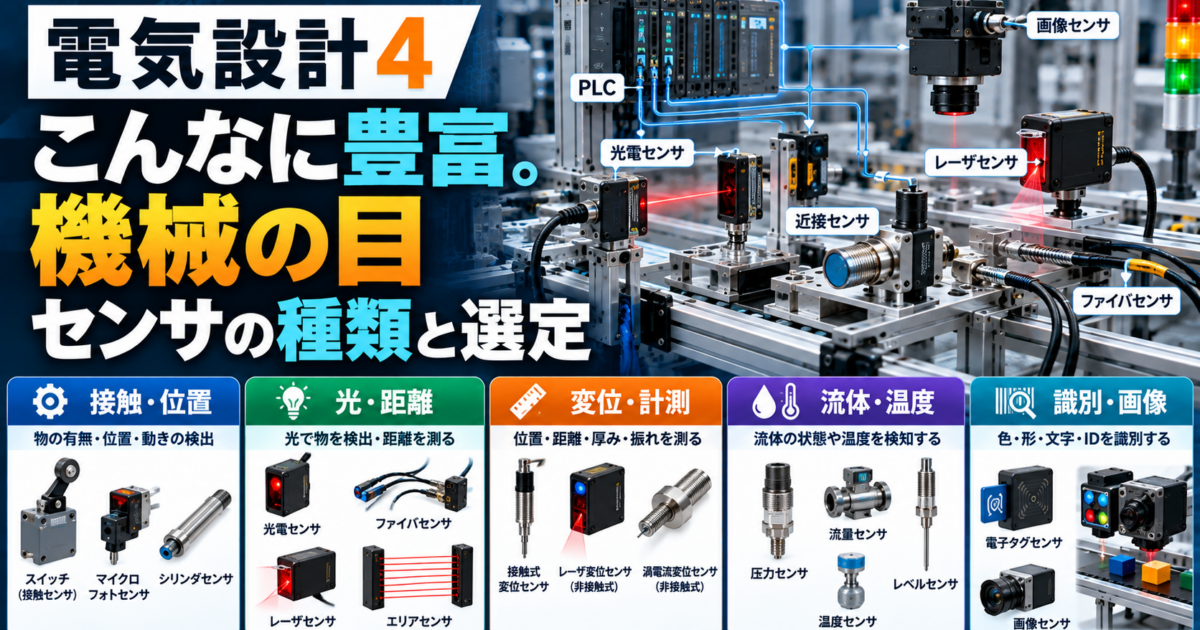
For machinery, sensors act as the “eyes,” “sense of touch,” and “temperature sense” of the system. However, factory automation (FA) equipment uses numerous sensing technologies, including contact, photoelectric, fiber-optic, laser, proximity, displacement, pressure, flow, RFID, and vision sensors. Choosing the wrong type can cause false detections and equipment downtime. This article compares the19 sensor types in terms of their applications, classifications, detection ranges, operating voltages, response times, repeatability, sizes, and mounting positions, providing an accessible guide for students and engineers new to electrical, control, and mechanical design. Individual sensing principles and circuits will be explained in separate articles; here, the focus is on practical sensor selection.
Introduction | How Should We Classify the “Eyes” of a Machine?
Classifying sensors by what they detect makes selection easier: (1) position and presence, (2) light and distance, (3) displacement and dimensions, (4) areas and zones, (5) fluids and temperature, and (6) identification, color, and images. Even when simply checking whether a workpiece is present, the best sensor depends on whether contact is allowed, whether the target is metallic or transparent, and the required response time and accuracy.
Distinguishing Detection (ON/OFF) from Measurement (Analog/Numerical)
If the PLC only needs an indication of workpiece presence or absence, a switch or photoelectric sensor may be suitable. If numerical values such as thickness, height, pressure, or flow rate are needed, choose a displacement or process sensor. Repeatability and absolute accuracy are different specifications, as are resolution, linearity, and hysteresis.
Chemical and Physical Properties and Operating Conditions | What to Check Before Selection
Target Material, Reflectivity, Color, Transparency, and Shape
Photoelectric and laser sensors may have difficulty detecting transparent, glossy, or black targets. Proximity sensors have different capabilities for metallic and nonmetallic objects. Ultrasonic sensing is relatively insensitive to color, but is affected by airflow, temperature, geometry, and sound-absorbing materials. Also check the sensor’s chemical and cutting-fluid resistance, enclosure protection, and operating temperature.
Vibration, Dust, Water, Oil, and Electromagnetic Interference
For machine tools and material-handling equipment, important specifications include IP protection ratings, oil-resistant construction, operating temperature range, vibration and shock resistance, EMC performance, and cable flex life. If dust obstructs optical surfaces, consider air purging, accessible cleaning openings, or an alternative mounting location.
Mechanical and Electrical Selection Criteria | Response, Repeatability, and Mounting
Power and Output Basics | NPN, PNP, Analog, and IO-Link
Many industrial FA sensors operate on 12–24 V DC or a nominal 24 V DC supply, although compact 5 V DC devices and switches or measuring instruments rated for 100–240 V AC are also available. Match the PLC input to NPN/PNP outputs, two-wire or three-wire connections, relays, 0–10 V, 4–20 mA, pulse outputs, IO-Link, Ethernet, or other interfaces. Check current consumption, load current, short-circuit protection, and residual voltage as well as supply voltage.
How Response Speed, Accuracy, and Size Relate
Photoelectric, fiber-optic, and laser sensors can suit high-speed detection, but actual response times depend on amplifier settings, filters, and measurement modes. Evaluate vision sensors over the full cycle, including illumination, exposure, processing, and communication. For pressure and temperature measurements, also account for the response lag of the medium. Smaller sensors offer more mounting flexibility but may make optical alignment and maintenance more difficult.
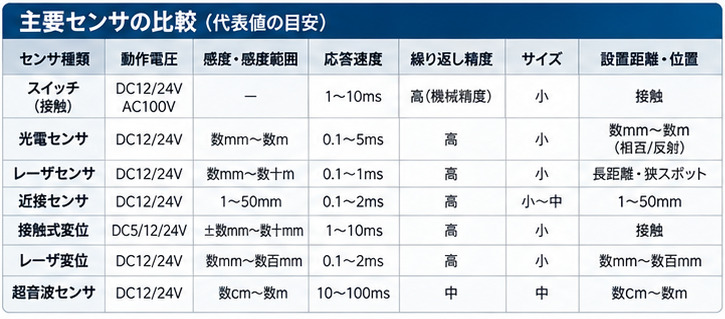
Overview and Performance Comparison of 19 Sensor Types
The following values aretypical preliminary-design guidelines for common industrial products, not guaranteed specifications for every model. Supply voltage, measurement accuracy, and repeatability vary considerably by manufacturer, model, and measurement conditions. “Model-dependent” means that no single representative value applies.
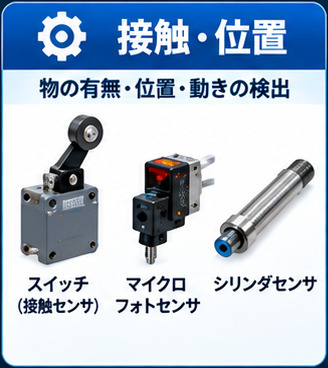
Contact and Position Detection
| Sensor | Overview / Applications | Typical Supply | Sensitivity / Detection Range | Typical Response Time | Repeatability / Accuracy | Size | Mounting Distance / Position Considerations |
|---|---|---|---|---|---|---|---|
| Switch (Contact Sensor) | Mechanical contacts and limit switches detect position, travel endpoints, and physical contact | Passive contacts (observe the connected circuit’s AC/DC ratings) | Contact detection; operating travel typically a few millimeters | Milliseconds to tens of milliseconds for mechanical actuation | Operating-point repeatability depends on the model | Small to medium | Contact point, actuation travel, and overtravel |
| Micro Photoelectric Sensor | Compact through-beam or reflective photointerrupters for part-presence detection | 5–24 V DC and similar supplies | Several millimeters to several tens of millimeters; wider ranges for some models | Microseconds to milliseconds | Positional repeatability depends on optical arrangement and specifications | Very small to small | Slot-type detection or very short working distances |
| Proximity Sensor | Detects nearby metal or other materials using inductive, capacitive, or other methods | 10–30 V DC / nominal 24 V DC, etc. | Often approximately 1–40 mm for metal-detecting types | Approximately 0.1 ms to several milliseconds | Repeatability depends on the model, including its rated sensing distance | Small to medium | Target metal, flush/non-flush mounting, and clearance from surrounding metal |
| Cylinder Sensor | Detects piston position in pneumatic cylinders and similar actuators | 5–24 V DC / 10–30 V DC, etc. | Depends on piston magnet, specified mounting slot, and sensor position | Approximately milliseconds to tens of milliseconds | Operating point and hysteresis are model-dependent | Very small to small | Cylinder slot, magnet location, and stroke endpoints |
Light, Distance, and Color
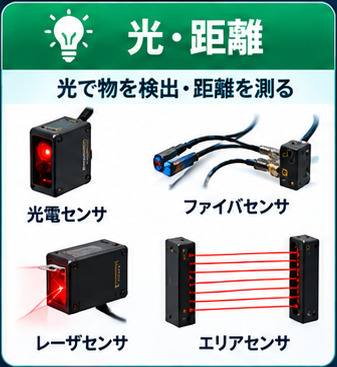
| Sensor | Overview / Applications | Typical Supply | Sensitivity / Detection Range | Typical Response Time | Repeatability / Accuracy | Size | Mounting Distance / Position Considerations |
|---|---|---|---|---|---|---|---|
| Photoelectric Sensor | Through-beam, retroreflective, or diffuse-reflective detection of workpiece presence | 10–30 V DC / nominal 24 V DC, etc. | Millimeters to tens of meters, depending on the sensing method | Approximately 0.1 ms to several milliseconds | Repeatable switching position and hysteresis are model-dependent | Small to medium | Transmitter/receiver alignment, background, and reflective surfaces |
| Fiber-Optic Sensor | Detects tiny objects or presence/absence in very confined spaces | Amplifier typically 12–24 V DC, etc. | From the fiber tip to hundreds of millimeters; meters for some models | Tens of microseconds to several milliseconds in high-speed settings | Depends on sensitivity settings, mounting rigidity, and light-intensity changes | Very small sensing head; separate amplifier | Secure the fiber tip; observe minimum bend radius and keep optics clean |
| Laser Sensor | Detects presence and position using a narrow laser spot | 12–24 V DC / 10–30 V DC, etc. | Tens of millimeters to several meters or more, depending on the application | Tens of microseconds to several milliseconds | Depends on spot size, received-light conditions, and model | Small to medium | Optical axis, spot diameter, reflections, and laser safety classification |
| Ultrasonic Sensor | Uses sound waves to detect distance, presence, or liquid level | 12–24 V DC / 10–30 V DC, etc. | Several centimeters to several meters | Several milliseconds to several hundred milliseconds | Millimeter-level performance on some models; depends on range and model | Medium | Blind zone, acoustic beam cone, temperature, and reflection angle |
| Color Sensor | Identifies colors, marks, and color differences from optical components | 12–24 V DC, etc. | Typically several to several tens of millimeters | Approximately 0.1 ms to several milliseconds, depending on processing | Color-difference repeatability depends on lighting, calibration, and model | Small to medium | Stable illumination, workpiece angle, and background |
Dimensional and Displacement Measurement
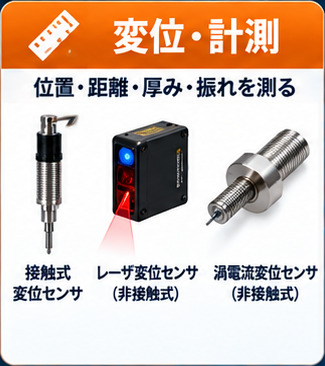
| Sensor | Overview / Applications | Typical Supply | Sensitivity / Detection Range | Typical Response Time | Repeatability / Accuracy | Size | Mounting Distance / Position Considerations |
|---|---|---|---|---|---|---|---|
| Contact Displacement Sensor | Measures height, steps, and displacement using a contact probe | 5 / 12 / 24 V DC; depends on controller specifications | Measurement travel of several to several tens of millimeters | Milliseconds to tens of milliseconds (also affected by mechanical tracking) | Some products offer micrometer-level performance (under specified conditions) | Small to medium | Contact force, axial alignment, lateral loads, and wear |
| Laser Displacement Sensor (Noncontact) | Measures height, steps, thickness, and other dimensions using laser light | 12–24 V DC, nominal 24 V DC, etc. | Several millimeters to several meters (reference distance and measuring range are separate) | Sampling intervals from tens of microseconds to milliseconds | Varies widely, from submicrometer to millimeter-level specifications | Small to medium | Reference distance, measurement angle, target material, and spot diameter |
| Eddy-Current Displacement Sensor (Noncontact) | Measures minute displacement and runout of conductive metal targets | Controller typically 24 V DC, etc. | Hundreds of micrometers to several millimeters; product-dependent | Some products offer kilohertz-range bandwidth | Some offer nanometer- to micrometer-level resolution (distinct from accuracy) | Small to medium probe | Conductive target, material-specific calibration, gap, and nearby metal |
Area and Process Detection
| Sensor | Overview / Applications | Typical Supply | Sensitivity / Detection Range | Typical Response Time | Repeatability / Accuracy | Size | Mounting Distance / Position Considerations |
|---|---|---|---|---|---|---|---|
| Area Sensor | Detects presence across a broad zone with multiple optical beams | 12–24 V DC / nominal 24 V DC | Determined by detection height, beam pitch, and transmitter-to-receiver distance | Several milliseconds to tens of milliseconds | Evaluate by beam spacing and minimum detectable object size | Bar-shaped; medium to large | Opposing transmitter and receiver, obstructions, and beam pitch |
| Pressure Sensor | Monitors pneumatic, hydraulic, vacuum, and other pressures | 12–24 V DC / nominal 24 V DC | From negative gauge pressure to several MPa or more, depending on the model | Milliseconds to tens of milliseconds; filter-dependent | Check repeatability specifications, such as %FS | Small to medium | Port location, pressure pulsation, process medium, and sealing |
| Flow Sensor | Monitors flow rate or leakage of air, water, oil, and other media | 12–24 V DC / nominal 24 V DC | From mL/min to m³/h, depending on pipe diameter and medium | Tens of milliseconds to seconds | Model-dependent specifications, such as %RD or %FS | Medium to large | Required straight pipe runs, flow direction, air bubbles, and temperature |
| Temperature Sensor | Measures contact temperature or object temperature | Passive element (thermocouple / resistance temperature detector) or transmitter typically 24 V DC | From −200 °C to over 1,000 °C, depending on the sensing method | Seconds to minutes (depending on construction and thermal contact) | Element standards and transmitter specifications, in °C, %, etc. | Very small to medium | Thermal contact at the measurement point, response lag, and wiring |
| Level Sensor | Detects high/low levels or continuously measures liquid/powder level | 12–24 V DC, AC, passive contacts, etc. | Point detection to continuous measurement over several meters or more | Milliseconds to seconds, depending on the medium | Switching point and level accuracy are model-dependent | Small to large | Liquid surface, tank geometry, deposits, and foam |
Identification and Vision
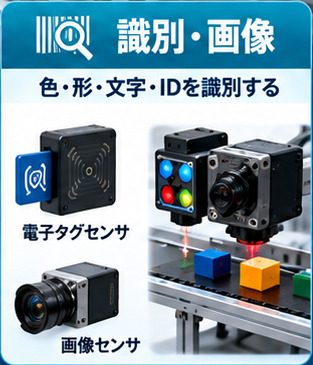
| Sensor | Overview / Applications | Typical Supply | Sensitivity / Detection Range | Typical Response Time | Repeatability / Accuracy | Size | Mounting Distance / Position Considerations |
|---|---|---|---|---|---|---|---|
| Electronic Tag Sensor (RFID) | Reads and verifies tag IDs and associated process information | Reader typically 24 V DC, USB / PoE, etc. | Several millimeters to several meters or more, depending on frequency and tag | Milliseconds to seconds, including read cycle and communication | Evaluate read success rate, not positional accuracy | Small to medium | Antenna distance, orientation, metal, and interference |
| Vision Sensor | Uses images to inspect presence, position, dimensions, appearance, characters, etc. | 24 V DC, PoE, etc. | Determined by field of view, lens, lighting, and pixel count | Milliseconds to seconds for exposure + processing + communication | Depends on pixel scale, calibration, and algorithms | Small to medium camera; separate lighting | Working distance (WD), field of view, focus, illumination, and vibration |
Application-Based Selection | Which Sensor Should You Choose for FA Equipment?
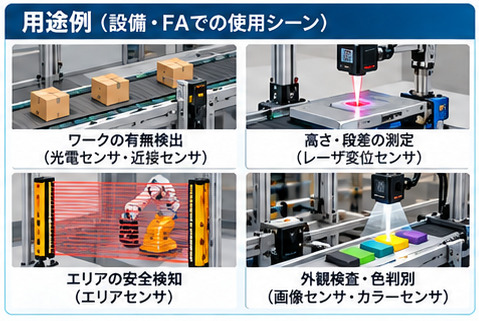
| FA Application | Primary Candidates | Design Considerations |
|---|---|---|
| Workpiece Presence on a Conveyor | Photoelectric / fiber-optic | Check transparent, black, or reflective targets; background distance; and vibration |
| Position or Passage of Tiny Parts | Micro photoelectric / fiber-optic / laser | Minimum detectable size, required response, and optical alignment |
| Proper Seating of Metal Workpieces | Proximity / contact displacement | Check metal type, misalignment, and machining tolerances |
| Extended/Retracted Position of Pneumatic Cylinders | Cylinder sensor | Magnet compatibility, slot type, and cable restraint |
| Height Inspection on Presses and Fixtures | Laser displacement / contact displacement | Accuracy, tilt, surface condition, and contact force |
| Rotating Shaft Runout Measurement | Eddy-current displacement | Target-material calibration, rotational speed, and required bandwidth |
| Height of Stacked Items or Boxes | Ultrasonic / laser | Sensing distance, blind zone, reflection angle, and temperature |
| Passage Detection Across a Wide Area | General-purpose area sensor | Beam pitch and minimum workpiece dimensions |
| Personnel Detection in Hazardous Areas | Safety light curtains, etc. | General-purpose area sensors are unsuitable; design for the required safety category, Performance Level (PL), and stopping distance |
| Verification of Air Grippers and Vacuum Holding | Pressure sensor | Pressure trends, leakage, and thresholds |
| Cooling-Water Presence and Flow | Flow sensor | Pipe diameter, contamination, flow direction, and medium temperature |
| Heater or Bearing Temperature | Temperature sensor | Response, measurement point, temperature range, and noise |
| Full or Empty Tank Detection | Level sensor | Liquid properties, foam, buildup, and cleanability |
| Part Identification and Process Traceability | RFID | Tag orientation, read success rate, and consistency with equipment data |
| Detection of Incorrect Product Colors | Color / vision sensor | Lighting, color differences, and management of color references |
| Appearance, Orientation, and Print Inspection | Vision sensor | Resolution, field of view, illumination, cycle time, and rejection criteria |
Standards and Safety | JIS, IEC, and Sensor Protection Requirements
Applicable product standards include IEC 60947-5-2 (proximity switches, etc.), IEC 60947-5-1 (control-circuit devices), IEC 60529 (IP ratings), IEC 61131-2 (PLC inputs, etc.), and IEC 62471 / IEC 60825-1 (light-source and laser safety). Determine which standards apply to the specific product. EMC, electrical safety, and machinery safety must also be assessed against the requirements of the complete equipment.
General-Purpose Area Sensors Are Not Safety Light Curtains
General-purpose area sensors are intended for workpiece presence and passage detection. By themselves, they cannot serve as safety-related protective devices against personnel entering hazardous areas. To protect people from hazards, select safety light curtains or equivalent devices conforming to applicable standards such as the IEC 61496 series, and design the safety functions, safety distances, stopping times, and fault detection in accordance with ISO 13849-1 or IEC 62061.Simply connecting the output of an ordinary sensor to a safety PLC does not turn it into safety-rated equipment.
Manufacturing and Integration Workflow | From Selection to Installation, Adjustment, and Maintenance
Industrial sensor manufacturing involves sensing elements, electronic circuits, optical assemblies, housings, sealing, calibration, and final inspection. When integrating a sensor into machinery, a practical workflow is: (1) define requirements → (2) compare candidate models → (3) verify with actual workpieces → (4) design mounting fixtures and wiring → (5) configure the PLC and verify I/O → (6) commission the system → (7) test environmental conditions and faults → (8) establish maintenance criteria. Internal designs for individual sensing methods will be covered in separate articles.
Practical Tips for Design, Selection, Fabrication, and Installation
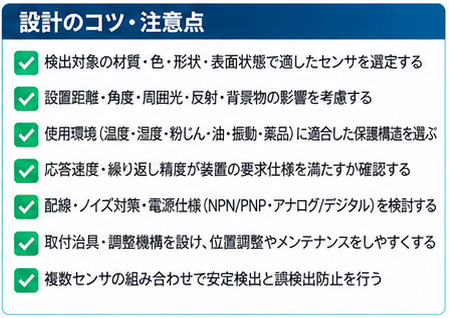
Sheet-Metal Mounts and Brackets: Allow for Sensor Alignment and Adjustment
- Provide slotted mounting holes, locating pins, and adjustment fixtures to make the detection position reproducible.
- Allow sufficient sensor-to-target clearance for part and assembly tolerances, vibration, and temperature changes.
- For proximity sensors, follow requirements for metal interference, flush/non-flush mounting, and spacing between adjacent sensors.
- For laser, fiber-optic, and vision sensors, provide suitable optical alignment, reflection angles, background clearance, and room to clean lenses.
- Design reference surfaces, scales, and connector locations to simplify readjustment after sensor replacement.
Wiring, PLCs, and Noise: Electrical Design Pitfalls
- Match sensor supply voltage, NPN/PNP configuration, two-/three-wire connections, and contact ratings to the PLC input specifications.
- Separate signal cables from power and inverter cables; use shielding, grounding, and surge protection where necessary.
- Do not confuse analog-input resolution with sensor measurement accuracy; perform calibration and scaling.
- Check minimum cable bend radius, flex life in moving sections, connector ingress protection, and tensile loads.
- Account for IO-Link, RFID, and vision communication latency when assessing machine cycle time and fault behavior.
Detection Calculation Example | Speed and Response Time
If a workpiece moves at 1 m/s and the combined delay of the detection circuit and PLC input acquisition is 5 ms, the workpiece moves approximately 5 mm (distance = speed × time). For real machinery, add sensor response, PLC scan, communication, control, and actuator delays to calculate stopping distance and detection margins. As line speed increases, adjustment allowance and response-time margin become increasingly important.
Repeatability vs. Resolution
Even if a sensor specifies 0.1 μm resolution, its measurement accuracy may not be 0.1 μm because of temperature drift, linearity errors, or target-material effects. For quality inspection, check resolution, repeatability, linearity, temperature characteristics, and measuring range separately, and perform measurement system analysis (MSA), such as a Gage R&R study, against the required tolerances.
Frequently Asked Questions (FAQ)
What Is the Difference Between a Photoelectric Sensor and a Fiber-Optic Sensor?
A fiber-optic sensor can place a very small sensing head in a confined space while keeping its amplifier elsewhere. Photoelectric sensors also offer a wide range of integrated designs.
Are Laser Sensors and Laser Displacement Sensors the Same?
“Laser sensor” is a broad term covering ON/OFF and position detection, whereas laser displacement sensors are specialized for continuous measurement of distance or height.
Can Proximity Sensors Detect Plastic?
Standard inductive proximity sensors are mainly intended for metals, but other technologies, such as capacitive proximity sensing, can detect nonmetallic materials.
Can Ultrasonic Sensors Detect Transparent Workpieces?
They can be a strong option for some applications, but check the blind zone, target shape and tilt, sound absorption, and temperature.
When Should I Use RFID Instead of a Vision Sensor?
RFID reads tag IDs and associated data; vision systems inspect features such as shape, color, markings, and position.
Does High Repeatability Mean High Absolute Accuracy?
No. Repeatability, absolute accuracy, and resolution are different metrics. Calibration and temperature drift must also be checked.
Can an Area Sensor Monitor Operator Safety?
A general-purpose area sensor alone cannot implement a safety function. Use appropriately certified safety light curtains or equivalent equipment within a properly engineered safety system.