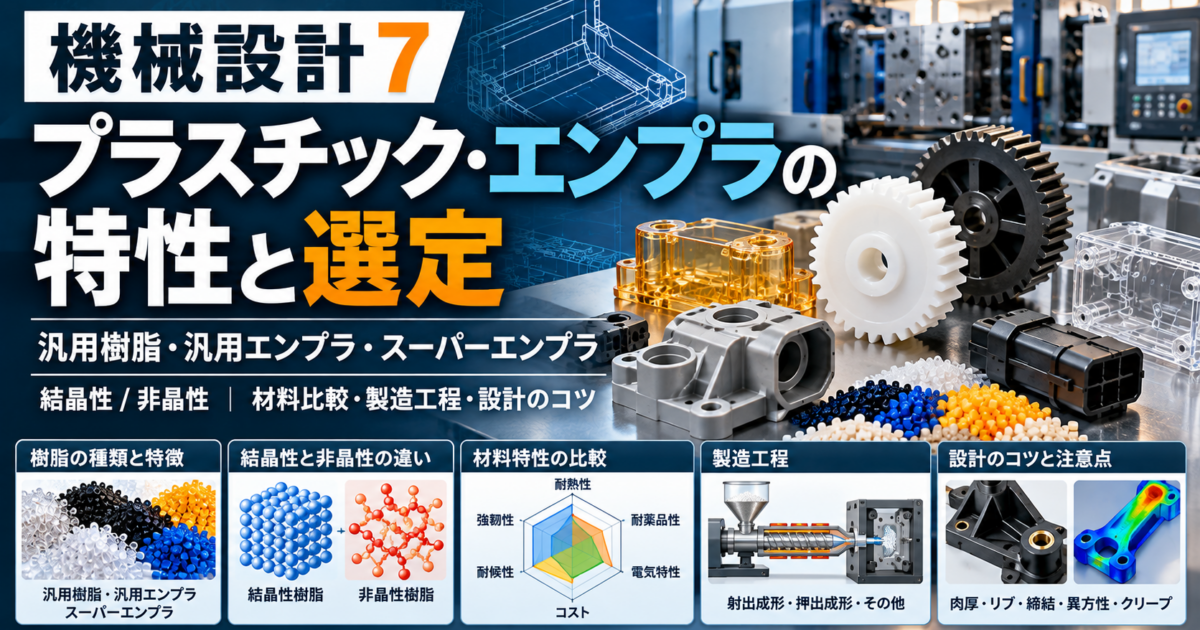
Do you tend to make sweeping generalizations, such as “Plastics are lightweight but weak” or “Engineering plastics can be used even at high temperatures”? Plastics used in mechanical design are broadly categorized into general-purpose resins such as PE, PP, and ABS; general-purpose engineering plastics (engineering plastics) such as POM, PA, PC, and PBT; and super engineering plastics such as PPS, PEEK, PEI, and LCP. In this article, we’ll compare the differences between crystalline and amorphous plastics, as well as their weight, heat resistance, strength, creep, chemical resistance, flame retardancy, electrical properties, friction and wear, and cost. We’ll also explain everything from manufacturing processes to specific design tips.

Introduction | The Difference Between Plastics and Engineering Plastics

Classification of General-Purpose Resins, General-Purpose Engineering Plastics, and Super Engineering Plastics
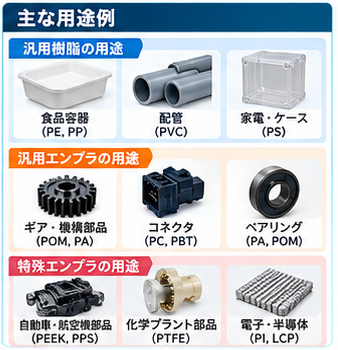
Generally, general-purpose resins are mass-produced products that prioritize price and moldability, while general-purpose engineering plastics are used for mechanical parts that require strength, heat resistance, and dimensional stability. “Super engineering plastics” (high-performance engineering plastics) is a general term for materials used in applications requiring even higher levels of heat resistance and chemical resistance. The boundaries between these classifications are not strictly defined by law or standardized across all manufacturers. Representative examples include PPS, PEEK, and PEI, while fluorinated resins such as PTFE and PVDF are also considered high-performance resins for comparison purposes.
| Category | Representative Materials | Common Applications | Key Considerations |
|---|---|---|---|
| General-Purpose Plastics | PE, PP, PVC, PS, ABS, PMMA | Containers, covers, piping, transparent parts, general enclosures | Significant variations in heat resistance, load-bearing capacity, solvent resistance, and UV resistance depending on the material |
| General-Purpose Engineering Plastics | PA6, PA66, POM, PC, PBT, PET, PPE-based | Gears, bearings, connectors, mechanical components | Water absorption, creep, dimensional tolerances, molding shrinkage |
| Super Engineering Plastics | PPS, PEEK, PEI, PSU/PPSU, LCP, PI | High-temperature components, precision mechanisms, electronics and medical applications | Material cost, processing and molding temperatures, embrittlement, and quality control |
| High-performance fluoropolymers | PTFE, PVDF, PFA, etc. | Sliding applications, seals, chemical-resistant piping | Strength, creep, and joining methods evaluated separately |
Differences between thermoplastic and thermosetting resins
Thermoplastic resins utilize the property of softening and melting when heated, then solidifying upon cooling. Injection molding, extrusion, and machining are widely used. Thermosetting resins (such as epoxy and phenolic) form a three-dimensional cross-linked structure through a curing reaction and generally cannot be remelted and reshaped after curing. Thermosetting properties are also important for FRP matrix materials and electrical insulation components.
Comparison with Metals: While Weight Reduction Is Easy, Caution Is Needed Regarding Rigidity and Thermal Deformation
The density of many unfilled resins ranges from approximately 0.9 to 1.5 g/cm³, making them lighter than aluminum (approximately 2.7) and steel (approximately 7.85). However, there are significant differences in elastic modulus, thermal expansion, and creep characteristics; therefore, replacing steel or aluminum with FRP for parts of the same shape and dimensions is risky. Recalculate stress, deflection, operating temperature, long-term loading, and fastening.
Chemical and Physical Properties | Crystalline/Amorphous, Density, Thermal/Electrical, Corrosion
Differences Between Crystalline (Semi-Crystalline) Resins and Amorphous Resins
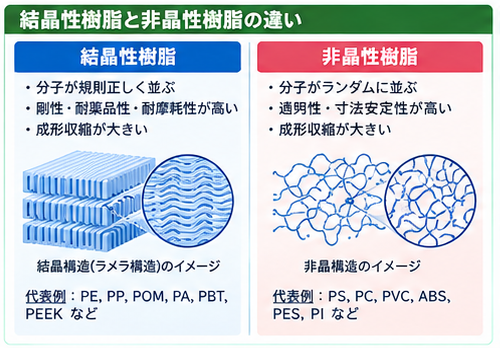
Thermoplastic resins generally referred to as “crystalline resins” are, in fact, semi-crystalline resins that contain a mixture of crystalline and amorphous regions. Typical examples include PE, PP, PA, POM, PBT, PPS, PEEK, and PTFE. Amorphous resins do not form long-range crystalline arrangements of molecular chains; typical examples include PS, ABS, PC, PMMA, PEI, and PSU/PPSU. PET transitions from an amorphous state to a crystalline state depending on molding conditions, resulting in changes in appearance and performance.
| Item | Semi-crystalline resins | Amorphous resins |
|---|---|---|
| Molecular Arrangement | Contains some regular crystalline regions | Virtually no long-range regular arrangement |
| Thermal Properties | Has a melting point (Tm) in addition to Tg | Does not have a distinct crystalline melting point (Tm); Tg is important |
| Molding Shrinkage and Warpage | Tends to be relatively large | Tends to be relatively small, making dimensional control easier |
| Solvent Resistance and Friction and Wear | Many grades exhibit excellent performance | Caution required regarding swelling and cracking in certain solvents |
| Appearance | Tends to become opaque due to crystallization | Many grades can be made transparent |
| Precautions | Dimensional changes occur due to degree of crystallization, Dimensional changes due to cooling rate and orientation | Caution regarding stress cracking, heat resistance, and chemical effects |
Thermal Properties | Tg, Tm, HDT, and RTI are not the same temperatures
Tg (glass transition temperature) is an indicator of increased molecular motion in the amorphous region; Tm (melting point) is the temperature at which the crystalline region melts; HDT (heat deflection temperature) is the temperature at which deformation occurs under specified load and test conditions; and RTI is a temperature indicator related to material certification and long-term thermal aging. You must not assume that any single one of these represents the “maximum operating temperature” for a given part. The maximum operating temperature must be determined in conjunction with the operating load, duration, humidity, continuous/intermittent use, dimensional accuracy, and certification requirements such as UL.
Thermal Conductivity, Thermal Expansion, Water Absorption, and Weather Resistance
The thermal conductivity of typical unfilled resins generally falls within the range of approximately 0.1 to 0.5 W/(m·K), which is significantly lower than that of metals. If heat dissipation is required, consider using high-thermal-conductivity filler-reinforced materials or composite designs incorporating metal. Thermal expansion is also often greater than that of metals, so it is important to evaluate temperature differences in metal inserts, screws, and mating parts. PA is prone to changes in dimensions, elastic modulus, and strength due to water absorption, so comparison with materials such as POM, PBT, and PPS is necessary. Weather resistance outdoors varies significantly depending on UV stabilizers, coatings, coloring, and resin grade.
Chemical and Solvent Resistance and Environmental Stress Cracking
Materials such as PE, PP, PVDF, and PTFE are candidates for applications requiring chemical resistance, but their performance varies depending on the oxidizing chemical, temperature, solvent, and concentration conditions. For materials such as PC, ABS, and PMMA, be mindful of environmental stress cracking (ESC) caused by chemicals, oils, and cleaning agents. Do not rely solely on chemical resistance tables; verify performance by replicating actual conditions, including temperature, concentration, stress, immersion time, and stress concentration.
Flame Retardancy and Electrical Properties | Understanding UL94 Ratings
A resin’s volume resistivity, surface resistance, dielectric constant, dielectric loss tangent, dielectric breakdown, and CTI (Comparative Tracking Index) vary depending on the material, moisture content, temperature, and frequency. For electrical components, these properties must be evaluated in conjunction with product standards, such as creepage distance and clearance. UL 94 ratings such as HB, V-2, V-1, and V-0 classify combustion behavior based on specified test specimens, thicknesses, and test conditions; however, a flame-retardant rating alone does not guarantee fire safety in actual equipment or compliance with component standards. Verify certification information for each part number and sheet thickness.
Mechanical Properties | Strength, Toughness, Elongation, Creep, Friction and Wear, Cost
Tensile strength, Young’s modulus, and toughness vary with temperature and humidity
The Young’s modulus of typical unreinforced engineering plastics is generally in the range of approximately 1.5 to 4 GPa, which is lower than that of steel (approximately 200 GPa). Many grades of PC offer high impact toughness; POM is noted for its balance of rigidity, sliding properties, and dimensional stability; and PA is valued for its mechanical strength and wear resistance. However, performance varies significantly depending on notching, temperature, moisture absorption, strain rate, and fiber reinforcement.
Creep and Stress Relaxation | Overlooked Issues with Long-Term Loading
Creep is time-dependent deformation that occurs when a material is subjected to a continuous load, while stress relaxation is the phenomenon in which stress decreases when a constant amount of deformation is maintained. This becomes a major issue in applications involving plastic screws, press-fit assemblies, inserts, spring clips, and snap-fits. Materials such as POM, PBT, PPS, and PEEK are not inherently “creep-free”; their performance must be evaluated based on resin grade, temperature, and load duration. Long-term deflection should not be judged solely by the initial Young’s modulus; refer to the creep modulus and isochronous stress-strain curves, among other factors.
Friction, Wear, and Sliding | Proper Selection of POM, PA, PTFE, and PEEK
POM is widely used in gears and bearings. PA also has applications requiring excellent wear resistance, but care must be taken regarding moisture absorption and dimensional changes. PTFE offers the advantage of low friction, but when used alone, it has limitations in terms of rigidity and creep; therefore, fillers and backing materials should be considered. PEEK is a candidate for high-temperature sliding applications but is expensive. The coefficient of friction and wear rate vary depending on the mating material, load, speed, lubrication, and temperature; comparisons should be made based on the PV value (contact pressure × speed), frictional heat, continuous vs. intermittent operation, and service life.
Processability, Price, and Recyclability
General-purpose materials such as PE, PP, PS, and ABS are often relatively inexpensive, while POM, PA, PBT, and PC tend to fall in the mid-price range, and PPS, PEEK, PEI, and PI tend to be in the high-price range. Custom flame-retardant, glass-fiber-reinforced, sliding, and food-contact grades incur higher costs. While thermoplastics can sometimes be remelted, factors such as coloring, additives, contamination, molecular weight degradation, and contamination with foreign materials affect the quality of recycled material.
Main Resin Types and Performance Comparison | General-Purpose, Engineering Plastics, and Super Engineering Plastics
The following is a comparison table for the early design phase, focusing primarily on representative unfilled grades. Heat resistance values are rough guidelines for long-term operating temperatures based on usage conditions and are not necessarily manufacturer-guaranteed values. Please verify density and temperature for each specific product.
| Resin | Classification/Structure | Density g/cm³ (Approx.) | Reference Heat Resistance (°C) | Main Applications |
|---|---|---|---|---|
| PE (Polyethylene) | General-purpose/ Crystalline | 0.91–0.96 | Approx. 60–90 | Containers, sliding parts, chemical tanks |
| PP (Polypropylene) | General-purpose / Crystalline | Approx. 0.90–0.91 | Approx. 80–110 | Hinges, containers, equipment covers |
| PVC (Rigid) | General-purpose / Amorphous | Approx. 1.35–1.45 | Approx. 50–70 | Piping, chemical-resistant covers |
| PS | General-purpose / Amorphous | Approx. 1.04–1.06 | Approx. 60–80 | General enclosures, Packaging |
| ABS | General-purpose / Amorphous | Approx. 1.04–1.07 | Approx. 70–95 | Electrical Enclosures / Control Panels |
| PMMA (Acrylic) | General-purpose / Amorphous | Approx. 1.18–1.20 | Approx. 70–90 | Transparent Windows and Lighting Covers |
| PA6/PA66 | General-Purpose Engineering Plastics/ Crystalline | Approx. 1.12–1.15 | Approx. 80–130 | Gears, Bearings, and Mechanical Components |
| POM | General-purpose engineering plastics / Crystalline | Approx. 1.40–1.43 | Approx. 90–110 | Precision gears, sliding parts |
| PC | General-purpose engineering plastics/ Amorphous | Approx. 1.20 | Approx. 100–125 | Transparent covers, high-impact parts |
| PBT | General-purpose engineering plastics / Crystalline | Approx. 1.30–1.32 | Approx. 100–140 | Connectors, Electrical Components |
| PET (for Molding) | General-Purpose Engineering Plastics / Crystallizable | Approx. 1.33–1.40 | Depends on Grade | Precision Molding & Electrical Components |
| PPS | Super Engineering Plastics / Crystalline | Approx. 1.34–1.36 | Approx. 180–220 | Heat-resistant connectors and pump parts |
| PEEK | Super engineering plastics / Crystalline | Approx. 1.30–1.32 | Approx. 230–260 | High-temperature sliding applications, medical / equipment parts |
| PEI | Super Engineering Plastics / Amorphous | Approx. 1.27 | Approx. 160–180 | Heat-resistant insulation and Sterilization-Related Parts |
| PSU/PPSU | Super Engineering Plastics / Amorphous | Approx. 1.24–1.30 | Approx. 140–180 | Heat-Resistant Transparent and Steam-Resistant Parts |
| LCP | Super Engineering Plastics / Anisotropic crystalline structure | Approx. 1.4–1.7 | Depends on grade | Microconnectors and precision electronic components |
| PTFE | High-performance fluoropolymer / Crystalline | Approx. 2.1–2.3 | Approx. 200–260 | Seals, sliding, chemical resistance |
| PVDF | High-performance fluoropolymer / Crystalline | Approx. 1.75–1.8 | Approx. 120–150 | Chemical-resistant piping and valves |
Multi-Item Comparison | Toughness, Creep, Chemical Resistance, Weather Resistance, Flame Retardancy, Electrical Properties, Wear Resistance, Cost
Comparison Symbols: ◎ = Tends to be an excellent candidate; ○ = Relatively good; △ = Conditions must be verified; × = Disadvantageous if that performance is the primary objective. These represent general trends based on material type, additives, and operating environment; they do not constitute a guarantee or ranking. The “Flame Retardancy” column does not indicate the certification grade of standard materials.
Chemical and Solvent Resistance: Environmental Stress Cracking
PE, PP, PVDF, and PTFE are potential choices for applications requiring chemical resistance, but their suitability depends on factors such as oxidizing chemicals, high temperatures, solvents, and concentration. PC, ABS, and PMMA may be susceptible to environmental stress cracking (ESC) caused by chemicals, oils, greases, or cleaning agents. Do not rely solely on chemical-resistance charts; verify performance under representative conditions of temperature, concentration, mechanical stress, immersion time, and stress concentration.
Flame Retardancy and Electrical Properties: Understanding UL 94 Ratings
Volume resistivity, surface resistance, dielectric constant, dissipation factor, dielectric breakdown strength, and the comparative tracking index (CTI) vary with the material, moisture, temperature, and frequency. For electrical components, assess these properties together with the clearance and creepage requirements of applicable product standards. UL 94 classifications such as HB, V-2, V-1, and V-0 describe burning behavior under specified specimen dimensions, thicknesses, and test conditions; a flame rating alone does not guarantee fire safety in the finished equipment or compliance with component standards. Check the certification details for each material grade and thickness.
Mechanical Properties: Strength, Toughness, Elongation, Creep, Friction, Wear, and Cost
Tensile Strength, Elastic Modulus, and Toughness Vary with Temperature and Humidity
Many representative unreinforced engineering plastics have tensile moduli of approximately 1.5–4 GPa, much lower than the roughly 200 GPa of steel. Many PC grades offer high impact toughness; POM provides a useful balance of stiffness, sliding performance, and dimensional stability; and PA is valued for mechanical strength and wear resistance. However, notches, temperature, moisture absorption, strain rate, and fiber reinforcement can substantially change these properties.
Creep and Stress Relaxation: Long-Term Loading Risks
Creep is time-dependent deformation under sustained loading, whereas stress relaxation is the reduction in stress under a constant imposed deformation. Both can be critical for plastic screws, press fits, inserts, spring tabs, and snap-fit joints. Materials such as POM, PBT, PPS, and PEEK are not creep-free; evaluate them according to the specific grade, temperature, and loading duration. Do not predict long-term deflection using only the initial Young’s modulus. Refer to creep modulus data, isochronous stress–strain curves, and similar material information.
Friction, Wear, and Sliding Applications: Choosing Between POM, PA, PTFE, and PEEK
POM is widely used for gears and bearings. PA also performs well in many wear-resistant applications, although moisture absorption and dimensional changes must be considered. PTFE offers low friction, but its stiffness and creep resistance can be limiting when used alone; consider filled grades or supporting materials. PEEK is an option for high-temperature sliding components, but it is expensive. Friction coefficients and wear rates depend on the mating material, load, speed, lubrication, and temperature. Compare materials using the PV value (contact pressure × sliding velocity), frictional heating, continuous or intermittent duty, and required service life.
Processability, Price, and Recycling
Commodity plastics such as PE, PP, PS, and ABS are often relatively inexpensive. POM, PA, PBT, and PC generally fall into a mid-range price category, while PPS, PEEK, PEI, and PI tend to be more expensive. Specialized flame-retardant, glass-fiber-reinforced, low-friction, and food-contact grades may cost more. Thermoplastics can sometimes be remelted, but pigments, additives, contamination, molecular-weight degradation, and mixing with other materials can affect recycled-material quality.
Types of Plastics and Performance Comparison: Commodity, Engineering, and High-Performance Plastics
The following is an initial design comparison based mainly on representative unfilled grades. The heat-resistance values are approximate guides to long-term service temperature under application-dependent conditions and are not necessarily manufacturer-guaranteed ratings. Verify density and temperature limits for each specific product.
| Plastic | Category / Structure | Density, g/cm³ (approx.) | Indicative Heat Resistance (°C) | Typical Applications |
|---|---|---|---|---|
| PE (polyethylene) | Commodity / Semi-crystalline | 0.91–0.96 | Approx. 60–90 | Containers, sliding parts, chemical tanks |
| PP (polypropylene) | Commodity / Semi-crystalline | Approx. 0.90–0.91 | Approx. 80–110 | Hinges, containers, equipment covers |
| PVC (rigid) | Commodity / Amorphous | Approx. 1.35–1.45 | Approx. 50–70 | Piping, chemical-resistant covers |
| PS | Commodity / Amorphous | Approx. 1.04–1.06 | Approx. 60–80 | General housings, packaging |
| ABS | Commodity / Amorphous | Approx. 1.04–1.07 | Approx. 70–95 | Electrical enclosures, control panels |
| PMMA (acrylic) | Commodity / Amorphous | Approx. 1.18–1.20 | Approx. 70–90 | Transparent windows, light covers |
| PA6 / PA66 | Engineering / Semi-crystalline | Approx. 1.12–1.15 | Approx. 80–130 | Gears, bearings, mechanical components |
| POM | Engineering / Semi-crystalline | Approx. 1.40–1.43 | Approx. 90–110 | Precision gears, sliding components |
| PC | Engineering / Amorphous | Approx. 1.20 | Approx. 100–125 | Transparent covers, impact-resistant parts |
| PBT | Engineering / Semi-crystalline | Approx. 1.30–1.32 | Approx. 100–140 | Connectors, electrical components |
| PET (molding grade) | Engineering / Capable of crystallization | Approx. 1.33–1.40 | Grade-dependent | Precision moldings, electrical parts |
| PPS | High-performance / Semi-crystalline | Approx. 1.34–1.36 | Approx. 180–220 | Heat-resistant connectors, pump parts |
| PEEK | High-performance / Semi-crystalline | Approx. 1.30–1.32 | Approx. 230–260 | High-temperature sliding parts, medical/equipment components |
| PEI | High-performance / Amorphous | Approx. 1.27 | Approx. 160–180 | Heat-resistant insulation, sterilization-related parts |
| PSU / PPSU | High-performance / Amorphous | Approx. 1.24–1.30 | Approx. 140–180 | Heat-resistant transparent parts, steam-resistant components |
| LCP | High-performance / Anisotropic crystalline structure | Approx. 1.4–1.7 | Grade-dependent | Miniature connectors, precision electronic parts |
| PTFE | High-performance fluoropolymer / Semi-crystalline | Approx. 2.1–2.3 | Approx. 200–260 | Seals, sliding parts, chemical-resistant components |
| PVDF | High-performance fluoropolymer / Semi-crystalline | Approx. 1.75–1.8 | Approx. 120–150 | Chemical-resistant piping and valves |
Multi-Property Comparison: Toughness, Creep, Chemicals, Weathering, Flame Retardancy, Electrical Performance, Wear, and Cost
Rating symbols: ◎ = generally excellent potential; ○ = generally good; △ = conditions require careful verification; × = generally unsuitable when this property is the primary requirement. These are broad tendencies that depend on grade, additives, and service environment—not guaranteed values or rankings. The flame-retardancy column does not indicate certified ratings for standard grades.
| Material | Impact Toughness | Creep Resistance | Solvent / Chemical Resistance | Outdoor Weatherability | Flame-Retardant Options | Electrical Applications | Friction / Wear | Material Cost |
|---|---|---|---|---|---|---|---|---|
| PE | ○ | △ | ◎ | △ | △ | ○ | ○ | Low |
| PP | ○ | △ | ○ | △ | △ | ○ | △ | Low |
| ABS | ○ | △ | △ | △ | ○ (FR grade) | ○ | △ | Low–medium |
| PMMA | △ | △ | △ | ◎ (suitable grade) | △ | ○ | △ | Medium |
| PC | ◎ | △ | △ (ESC risk) | △ | ○ (FR grade) | ◎ | △ | Medium |
| PA6/66 | ○ | ○ | ○ | △ | ○ (FR grade) | ○ (check moisture) | ◎ | Medium |
| POM | ○ | ○ | ○ | △ | △ | ○ | ◎ | Medium |
| PBT | ○ | ○ | ○ | △ | ◎ (FR grade) | ◎ | ○ | Medium |
| PPS | △ | ◎ | ◎ | ○ | ◎ (verify grade) | ◎ | ○ | High |
| PEEK | ○ | ◎ | ◎ | ○ | ○ (thickness-dependent) | ◎ | ◎ | Very high |
| PEI | ○ | ○ | △–○ | ○ | ◎ (verify grade) | ◎ | △–○ | High |
| PTFE | ○ (soft material) | △ | ◎ | ◎ | ○ (verify conditions) | ◎ | ◎ (low friction) | High |
Reinforced and Modified Plastics: Understanding GF30, CF, and Flame-Retardant Grades
GF30 generally denotes a grade containing approximately 30% glass fiber, usually by mass. Examples include PA66-GF30, PBT-GF30, and PPS-GF40. Adding glass or carbon fibers can improve stiffness and heat-deflection behavior, but watch for anisotropy along the flow direction, warpage, mold wear, surface roughness, and reduced toughness. Sliding grades may contain PTFE or carbon-based fillers. Processing conditions for flame-retardant grades vary with their halogenated or halogen-free formulations, so verify each exact product grade.
Standards: Applying JIS, ISO, and UL in Design and Procurement
How to Read JIS Designations: The K Category Covers Chemistry and Polymers
Distinguish material specifications from test-method standards. For example, JIS K 7161-1 covers general principles for testing the tensile properties of plastics; JIS K 7171 addresses flexural properties; and the JIS K 7191 series concerns heat deflection temperature. A standard number does not itself specify a material’s heat-resistance or strength grade. Check the latest edition and scope against the original JISC publications.
| Standard / Indicator | Property Evaluated | Conditions to Verify in Design |
|---|---|---|
| JIS K 7161 series / ISO 527 | Tensile properties | Specimen geometry, test speed, temperature and humidity |
| JIS K 7171 / ISO 178 | Flexural properties | Span, test speed, material orientation |
| JIS K 7191 series / ISO 75 | Heat deflection temperature (HDT) | Specified flexural stress, specimen, heating rate |
| JIS K 7210 series / ISO 1133 | MFR / MVR (melt-flow properties) | Temperature, load, moisture content |
| JIS K 7201 series / ISO 4589 | Oxygen index | Comparative measure of burning behavior |
| ISO 62 / corresponding JIS | Water absorption | Immersion duration, temperature, specimen |
| UL 94 | Flammability classification | Thickness-specific HB / V ratings, etc. |
| RTI under UL 746B, etc. | Long-term thermal characteristics | Grade, thickness, property being rated |
| CTI under IEC 60112, etc. | Tracking resistance | Surface condition, contamination, insulation design |
Example Specifications for Drawings and Purchase Orders
Specifying only ‘POM’ does not guarantee dimensions or quality. As appropriate for the application, specify manufacturer, exact grade designation, color, filler/flame-retardant specification, use of recycled content, molding process, moisture-conditioning state, required tolerances, appearance and burr limits, strength/insulation/UL certification, and traceability. For safety-critical components, supplement these requirements with tests on actual parts covering long-term durability, temperature and humidity, chemicals, and flammability.
Manufacturing Processes: From Raw Materials to Finished Plastic Components
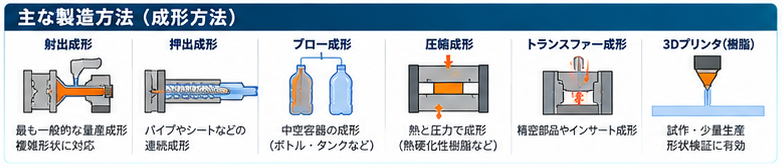
From Feedstocks to Polymerization, Pelletizing, and Molding
For many thermoplastics, monomers are obtained from petroleum- or natural-gas-derived feedstocks or other chemical raw materials, then converted into polymers by reactions such as addition polymerization or polycondensation. During compounding, additives, pigments, and fillers are blended into the material before pelletizing. Subsequent operations may include drying, molding, cooling, finishing, and inspection. PE and PP are generally made by addition polymerization, while the polymerization or polycondensation routes for materials such as PA, PET, and PBT depend on the particular polymer and grade.
Injection Molding: Mass-Producing Complex Parts from Pellets
A typical injection-molding sequence is 1. Dry the material (where required) → 2. Plasticize in the barrel → 3. Fill the mold → 4. Apply packing/holding pressure → 5. Cool and solidify → 6. Open the mold and eject the part → 7. Trim the gate and inspect. PA, PC, PBT, PET, PPS, PEEK, and similar materials can experience hydrolysis or defects in appearance and strength if predrying and temperature are not properly controlled. Follow the material manufacturer’s grade-specific drying instructions and the equipment requirements.
Extrusion, Blow Molding, Compression Molding, Thermoforming, Machining, and 3D Printing
| Process | Key Characteristics | Applications and Processing Considerations |
|---|---|---|
| Injection molding | Suitable for complex shapes and high-volume production | Sink marks, weld lines, warpage, gate location |
| Extrusion | Continuous production of constant cross sections | Rods, sheets, pipes; cooling and residual stress |
| Blow molding | Forms hollow products | Bottles, tanks, ducts; wall-thickness distribution |
| Compression molding | Fills and cures material in a mold under pressure | Thermosets, PTFE, etc.; shrinkage and voids |
| Thermoforming | Forms heated sheets over a mold | Trays, covers; localized wall thinning |
| Machining | Removes material from stock sheets or rods | Prototypes and low volumes; thermal distortion, burrs, clamping deformation |
| Additive manufacturing (3D printing) | Flexible for low-volume and complex shapes | Build-direction anisotropy, voids, thermal history |
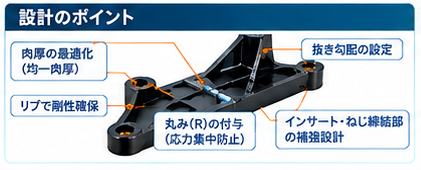
Injection-Molding Design Tips: Wall Thickness, Ribs, Bosses, and Draft Angles
- Keep wall thickness uniform: Abrupt thickness changes can cause sink marks, voids, warpage, and incomplete filling.
- Ribs: Use cross-sectional geometry to increase the stiffness of thin walls. Ribs are often thinner than the nominal wall, but determine dimensions with the material and mold supplier.
- Bosses: Avoid excessive local thickness at the base of screw bosses; use support ribs and fillets appropriately.
- Draft angles: Provide adequate draft for demolding based on the surface finish and texture depth.
- Gates and weld lines: Weld lines where melt fronts meet may reduce strength; keep them away from highly loaded regions.
- Dimensional tolerances: For semi-crystalline and glass-fiber-reinforced materials, account for directional differences in shrinkage and mold temperature.
How to Select a Plastic: Practical Application Examples for Designers
Step 1: Shortlist Materials by Load, Temperature, Chemicals, Environment, and Production Volume
First, define: 1. Static, impact, and fatigue loads; 2. Continuous operating temperature and short-term peaks; 3. Allowable deflection; 4. Moisture absorption, chemicals, and UV exposure; 5. Flame retardancy, insulation, and certification; 6. Wear and PV limits; and 7. Production lot size and cost. Before choosing an expensive high-performance plastic, compare commodity plastics, standard engineering plastics, and glass-fiber-reinforced grades that may meet the requirements.
Step 2: Material Selection Examples for Factory Automation Equipment and Mechanical Components
| Application / Requirement | Candidate Materials | Reasons for Selection and Key Checks |
|---|---|---|
| Light-duty protective cover | ABS, PC, PP | Match impact, chemical, and outdoor exposure requirements; PC/PMMA if transparency is needed |
| Transparent safety guard | PC | Impact-resistant grades are available; verify chemical ESC, scratches, applicable laws, and safety standards |
| Precision gear | POM, PA, PEEK | Compare wear, noise, creep, tooth-surface heating, and water absorption |
| Sliding guide or bushing | POM, PA, PTFE-filled grades, PEEK | Evaluate PV limits, mating shaft, load, temperature, and lubrication |
| Connectors and electrical parts | PBT, PA66, PPS, LCP | Insulation, heat resistance, flame retardancy, dimensional control, CTI, and product certification |
| High-temperature component near a motor | PPS, PEEK, PEI | Consider continuous service temperature, loading, electrical performance, and processing cost |
| Chemical tank or piping | PE, PP, PVC, PVDF, PTFE | Chemical concentration, temperature, stress, and joint sealing |
| Repeatedly fastened threaded section | POM, PA, metal inserts | Bearing pressure, creep, tightening torque, and thermal cycling |
| Low-cost, mass-produced housing | PP, ABS | Production efficiency and appearance; compare tooling cost, painting, and flame-retardant grades |
| High-precision fixture | POM, PPS, PEEK, metals | Assess temperature, moisture absorption, thermal expansion, stiffness, and material cost |
Design Calculation Tip 1: Deflection Is Not the Same as Strength
For beams of identical geometry under the same load, deflection in a simplified linear-elastic model is approximately proportional to the inverse of Young’s modulus E. Compared with steel at approximately 200 GPa, POM at approximately 3 GPa will deflect much more. When changing materials, redesign the second moment of area I, wall thickness, ribs, length, and support conditions as needed. Under long-term loading, account for creep rather than calculating with the initial E alone.
Design Calculation Tip 2: Dimensional Changes Caused by Temperature and Moisture
For a length L, coefficient of linear thermal expansion α, and temperature difference ΔT, the approximate change in length is ΔL = αLΔT. For example, with α = 100 × 10⁻⁶/K, L = 100 mm, and ΔT = 40°C, thermal expansion is approximately 0.40 mm. Because PA also changes dimensions as it absorbs water, check tolerances in both the dry state and the moisture-conditioned state after service exposure.
Design Calculation Tip 3: Creep and Threaded Fasteners
When a metal screw is tightened with high clamping force into a plastic boss, stress relaxation may reduce the clamping force over time and at elevated temperatures. Consider metal sleeves, suitable inserts, larger bearing surfaces, torque control, and vibration testing. For snap fits, evaluate not only the maximum strain but also stress relaxation during long-term engagement and repeated assembly/disassembly cycles.
Machining Precautions: Finishing Plastic Rods and Sheets
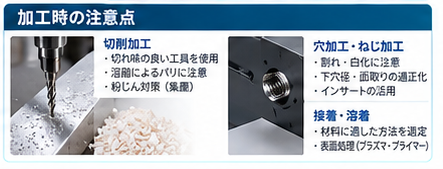
Compared with steel, plastics generally have lower elastic moduli and thermal conductivity, making them more susceptible to clamping deformation and heat buildup during machining. Consider sharp cutting tools, controlled cutting geometry, feeds and depths of cut, staged material removal, appropriate cooling, stress relief, and dimensional stabilization after machining. Conditions vary among POM, PEEK, PTFE, and other grades. When machining glass- or carbon-fiber-reinforced plastics, also manage abrasive dust, tool wear, dust extraction, and personal protective equipment. Control hazards from machining dust and thermal-decomposition products in accordance with the safety data sheet (SDS) and equipment safety procedures.
Frequently Asked Questions (FAQ)
What Is the Difference Between Commodity and Engineering Plastics?
Engineering plastics generally refers to polymers selected for demanding mechanical strength, heat resistance, or dimensional precision. However, the category is not a strictly harmonized international performance classification. What matters is whether a material satisfies the component’s actual requirements.
What Is the Difference Between Crystalline and Amorphous Plastics?
In crystalline plastics (more precisely, most are semi-crystalline), some polymer chains form ordered regions. Amorphous plastics lack long-range crystalline order. This distinction affects shrinkage, chemical resistance, transparency, dimensional stability, and thermal behavior.
Which Is Better for Gears, POM or PA?
POM is a strong candidate for gears requiring dimensional stability and low friction, while PA may be preferred for its toughness or wear characteristics. Choose based on water absorption, noise, loading, temperature, lubrication, and required service life.
Which Is Better for Transparent Covers, PC or PMMA?
Consider PC when high impact toughness is the priority, and PMMA when optical clarity, weather resistance, or scratch resistance is more important. For either material, assess chemical exposure, impact loading, and standards compliance using the actual component geometry.
What Is the Difference Between PPS and PEEK?
Both are candidates for applications requiring heat and chemical resistance. PEEK can be particularly advantageous in certain high-temperature and sliding applications, but its material cost is typically high. Depending on the grade, PPS can also provide high heat resistance and stiffness. Compare specific grades under equivalent loads and temperatures.
Does a UL 94 V-0 Rating Guarantee Equipment Safety?
No. UL 94 V-0 is a classification determined using specified specimens, thicknesses, and test methods. You must separately assess ignition sources, adjacent components, heat dissipation, electrical clearances and creepage distances, and the relevant safety standards for the finished product.
Conclusion: Select Plastics by Category, Structure, Long-Term Performance, and Processing Method
When designing plastic components, start by understanding both the hierarchy of commodity, engineering, and high-performance plastics and the separate distinction between semi-crystalline and amorphous polymers. Beyond comparing material strength tables, evaluate HDT, Tg, moisture absorption, creep, chemical resistance, flame retardancy, sliding performance, cost, and molding shrinkage under consistent conditions, and specify the exact resin grade. Designing the geometry, ribs, bosses, and manufacturing process together helps you make full use of the material’s advantages.
References and Related Articles
- Japanese Industrial Standards Committee (JISC): Search JIS K 7161, K 7171, K 7191, and related standards
- UL Solutions: Flammability testing and certification programs, including UL 94
- Ensinger: Material data for engineering and high-performance plastics
- Mechanical Design 1: Aluminum Alloys
- Mechanical Design 2: Copper and Copper Alloys
- Mechanical Design 3: Iron and Steel Alloys
- Mechanical Design 4: Titanium and Titanium Alloys
- Mechanical Design 5: Magnesium Alloys
- Mechanical Design 6: Carbon Fiber and CFRP
Property values and relative ratings are representative guidelines, not guarantees for any specific product grade. For engineering decisions, give priority to the latest manufacturer data sheets, test conditions, original certification and standards documents, and testing of actual parts under representative temperature, humidity, loading, and durability conditions.