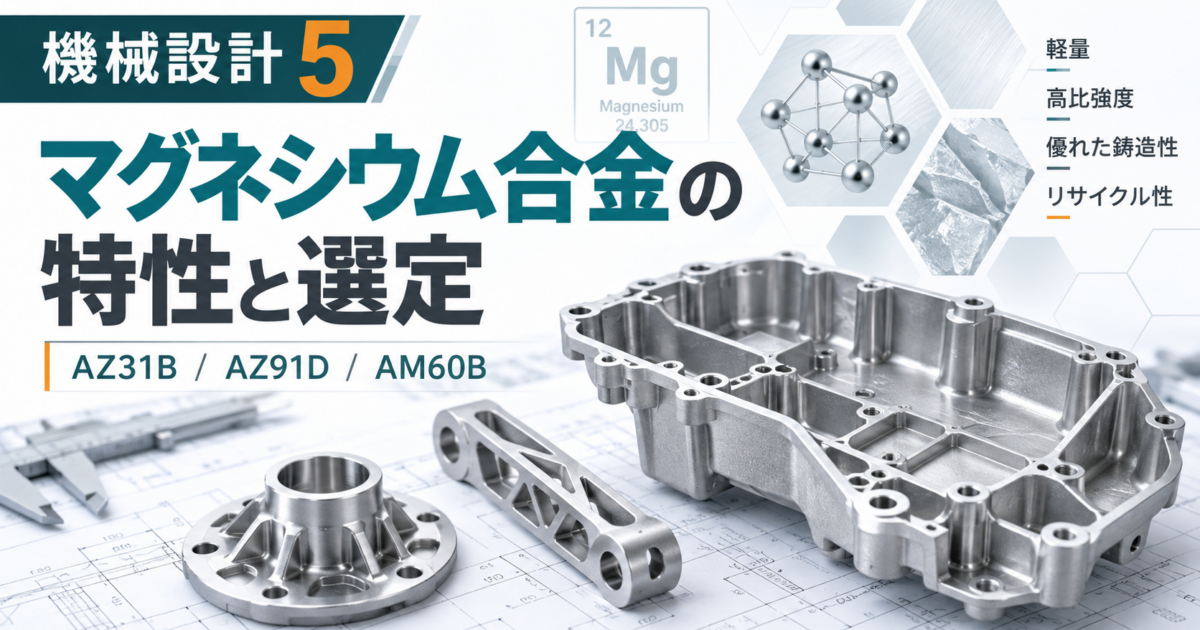
Magnesium alloys are among the lightest materials used in practical structural applications. However, it would be dangerous to conclude that “because they are light, they are superior to aluminum.” In this article, we will compare the properties of magnesium alloys—including the differences between AZ31B, AZ91D, and AM60B, JIS standards, casting and forging processes, and material selection—with those of iron, aluminum, and titanium, and explain everything from wall thickness and ribs to screw fastening, corrosion prevention, and machining safety.
Introduction | Differences Between Magnesium Alloys and Other Metals
Magnesium (Mg) has a density of approximately 1.74 g/cm³. The density of typical Mg alloys ranges from about 1.74 to 1.84 g/cm³, making them lighter than aluminum alloys (approximately 2.7 g/cm³) and about one-fourth the weight of mild steel (approximately 7.85 g/cm³). They are used in lightweight laptop computers, camera and robot housings, and automotive parts. Since pure magnesium alone cannot easily achieve the performance required for mechanical parts, it is common to use alloys with added elements such as aluminum, zinc, and manganese.
| Material | Advantages | Precautions |
|---|---|---|
| Magnesium Alloys | Extremely lightweight; thin-walled, complex shapes via die casting; good vibration damping | Low rigidity; corrosion protection required; fastening and sliding, and fire hazards from metal shavings |
| Aluminum Alloys | Lightweight, variety of machining and surface treatment options, availability | Heavier than Mg but generally higher rigidity |
| Steel | Balance of rigidity, strength, and cost | Weight and corrosion |
| Titanium Alloys | High specific strength and corrosion resistance | Material and processing costs |
| Copper alloys | Electrical and thermal conductivity | Weight and cost |
Chemical and physical properties | Weight, electrical and thermal properties, corrosion
Density and Weight Reduction | Approximately two-thirds the weight of aluminum for the same volume
As representative values, AZ91D is approximately 1.81 g/cm³, AZ31B is approximately 1.77 g/cm³, and AM60B is approximately 1.80 g/cm³. For comparison, aluminum alloy weighs 2.70 g/cm³, pure titanium 4.51 g/cm³, and mild steel 7.85 g/cm³. For parts of the same volume, AZ91D weighs approximately 67% as much as aluminum. However, design changes—such as adjustments to ribs and wall thickness—are necessary to achieve equivalent deflection.
Thermal Conductivity and Electrical Conductivity | Vary by Alloy
The thermal conductivity of magnesium alloys varies significantly depending on the steel grade and composition. Typical values for AZ91D range from approximately 50 to 80 W/(m·K), while those for the AZ31 series range from approximately 70 to 100 W/(m·K). In contrast, pure aluminum has a thermal conductivity of approximately 230 W/(m·K), and pure copper has a thermal conductivity of approximately 390 W/(m·K). The electrical conductivity of magnesium alloys is also lower than that of copper and aluminum, so they are generally not suitable for high-current conductors. When designing heat-dissipating enclosures, calculations must account for contact thermal resistance, coating thickness, surface area, and heat dissipation paths.
Thermal Expansion and Magnetic Properties | Verified Through Precision Assembly
The coefficient of linear expansion for magnesium alloys is generally 25–27 × 10⁻⁶/K, which tends to be higher than that of steel (approximately 12 × 10⁻⁶/K) and titanium (approximately 9 × 10⁻⁶/K). For example, if α = 26 × 10⁻⁶/K, the length is 200 mm, and the temperature difference is 60°C, the thermal expansion is ΔL = αLΔT = approximately 0.31 mm. When combining Mg alloys with dissimilar-material bolts or plastic covers, the difference in thermal expansion must be taken into account. Mg alloys are generally non-ferromagnetic.
Corrosion and Electrochemical Corrosion | Surface Treatment and Drainage Are Essential
Magnesium is an electrochemically active metal, so caution is required regarding saltwater, condensation, and contact with dissimilar metals. In areas where there is direct contact with aluminum or stainless steel bolts, galvanic corrosion of the magnesium side may occur if an electrolyte is present. Combine appropriate chemical conversion coatings, anodizing, painting, insulating washers, sealing, and drainage paths during the design phase. Also, check for scratches after surface treatment and any metal surfaces exposed during the assembly process.
Mechanical Properties | Strength, Toughness, Ductility, Workability, Price
Strength and Specific Strength | Guaranteed Values Are Not Determined by Material Name Alone
AZ91D is a representative Mg-Al-Zn-based alloy for die casting, while AM60B is an Mg-Al-Mn-based alloy used in applications that take advantage of its ductility and impact resistance. AZ31B is used in drawn products such as sheets and extrusions. Tensile strength varies significantly depending on the manufacturing process, thickness, casting defects, material orientation, and heat treatment; therefore, even for the same alloy, castings and rolled products cannot be simply compared based on numerical values alone. While typical ranges are around 200–300 MPa, the design allowable stress is determined based on standard guaranteed values, actual measured values, and a safety factor.
Rigidity | Young’s Modulus is lower than that of aluminum
The modulus of elasticity (Young’s modulus) of Mg alloys is generally 44–45 GPa, while that of aluminum alloys is approximately 69–72 GPa and that of steel is approximately 200–210 GPa. Under the same dimensions and loads, magnesium alloys may deflect more than aluminum alloys. Bending stiffness is evaluated using E × I (E: modulus of elasticity; I: second moment of area), and in some cases, changing to a ribbed or box-shaped cross-section may be more effective than simply increasing the plate thickness.
Toughness, Elongation, and Impact Properties | AZ91D and AM60B
Generally, AZ91D is compared for applications requiring castability and strength, while AM60B is compared for applications requiring relatively high ductility and impact absorption. However, performance varies depending on casting defects, plate thickness, and temperature. When evaluating the risk of failure in equipment used near people, verify the ductility, impact values, and fatigue life based on the specific component conditions.
Creep and Heat Resistance | Components Subject to Continuous Loading at High Temperatures
For many general-purpose Mg-Al die-casting materials, creep (plastic deformation that progresses over time) becomes an issue at high temperatures. Generally, when anticipating sustained loads at temperatures of 100–150°C or higher, the material grade, duration of use, and potential reduction in clamping force must be examined in detail, and an evaluation should be conducted that includes the possibility of switching to heat-resistant Mg alloys or alternative materials. It is not possible to uniformly set a specific maximum operating temperature.
Machinability and Fire Risk | Easy to Machine but Requires Safety Management
Magnesium alloys generally have relatively low cutting resistance, making it easy to increase machining speeds; however, fine chips and dust pose a risk of ignition and combustion. It is crucial to ensure tools are sharp, use appropriate cutting conditions, implement dust collection and recovery systems to prevent chip buildup, and establish a fire suppression plan for each piece of equipment. Decisions regarding the use of cutting fluids, the choice between water-based and non-aqueous systems, and the handling of dust should be based on the manufacturer’s safety instructions and risk assessments tailored to the specific material and equipment.
Fire Precautions: Magnesium fires require fire extinguishing agents suitable for metal fires (such as Class D). Using water, carbon dioxide, or standard powder fire extinguishers without proper consideration can be dangerous. In the event of a fire, follow the procedures of trained personnel and the fire department, and avoid attempting to extinguish the fire yourself.
Price and Recyclability | Cost of Finished Products vs. Material Unit Price
The unit price of magnesium alloys is generally higher than that of general-purpose steel and may even exceed that of aluminum; however, costs vary depending on material and procurement conditions, as well as the productivity of high-volume die-casting. Compare the total cost, which includes purchased materials, molds, post-processing, coating, corrosion protection, tools, inspection, yield, and recovery and recycling. Measures for alloy separation, prevention of foreign material contamination, and oxidation control during melting are critical to recycling quality.
How to Read JIS Standards | Comparing AZ31B, AZ91D, and AM60B
How to Read Material Designations | AZ stands for Al and Zn; AM stands for Al and Mn
AZ generally indicates the added elements aluminum (A) and zinc (Z), while AM indicates aluminum (A) and manganese (M). For example, AZ91 is a designation that generally represents approximately 9% Al and 1% Zn, while AZ31 is a series that generally represents approximately 3% Al and 1% Zn. The letters B and D at the end are used to identify material modifications and do not necessarily indicate strength grades or heat treatments. Material designations and JIS product standard numbers are separate entities.
Main JIS Product Standards for Magnesium Alloys
| Standard Number | Scope and Applications | Points to Confirm |
|---|---|---|
| JIS H 4201 | Magnesium Alloy Sheets and Strips | Material, Thickness, mechanical properties, heat treatment |
| JIS H 4202 | Seamless magnesium alloy tubes | Shape, dimensions, and material |
| JIS H 4203 | Magnesium alloy bars and wires | Processing Methods, Dimensions, and Material |
| JIS H 4204 | Magnesium Alloy Extruded Profiles | Extruded Shapes, Delivery Conditions, and Strength |
| JIS H 5203 | Magnesium Alloy Castings | Quality and Material Properties of Castings |
| JIS H 5303 | Magnesium Alloy Die Castings | Chemical Composition, Mechanical Properties, etc., of Die Castings |
*Note: JIS H 4201–4204 also have versions revised in 2025. Please refer to the latest original text from JISC (Japanese Industrial Standards Committee) for the official names of the standards, current editions, material designations, dimensional classifications, and specified values. Please be careful not to confuse information regarding revisions under review with standards that have already taken effect, such as JIS H 5303.
Differences in Performance and Applications of Representative Alloys
| Alloy | Main Manufacturing Methods | Characteristics | Examples of Applications |
|---|---|---|---|
| AZ31B | Rolled, extruded, and machined materials | Relatively good formability and light weight. Consider warm forming | Thin-sheet enclosures and lightweight components |
| AZ91D | Die casting | Good castability and strength; thin-walled monolithic forming | Cases and covers for electronic devices |
| AM60B | Die casting | Candidates prioritizing ductility and impact resistance over AZ91D | Structural parts subject to impact loads |
| ZK series | Extruded and forged materials, etc. | Zn-Zr series. Candidates with relatively high strength | Components requiring high specific strength |
Specifications in Drawings | Include not only the alloy but also the manufacturing method
For critical components, do not rely solely on “AZ91D”; instead, specifyproduct standards, manufacturing methods (die-casting, extrusion, forging, etc.), supply condition, dimensional tolerances, surface treatment, inspection, and material certification. In particular, since the performance of castings may vary depending on the sampling location and test specimen conditions, the required performance must be verified on the finished product.
Differences in Manufacturing Methods | Casting, Forging, Rolling, Machining
Casting and Die Casting | Suitable for Thin-Walled, Complex Enclosures
Among casting methods that involve pouring molten magnesium alloy into a mold, die casting—which fills the mold under high pressure—is suitable for mass-producing thin-walled, complex shapes. AZ91D and AM60B are typical examples. We evaluate gas entrapment, shrinkage cavities, surface defects, abrupt changes in wall thickness, flow patterns and cold shuts, as well as residual stress. We set appropriate machining allowances for seating surfaces and threaded holes that require machining.
Forging | Focus on Microstructure and Fatigue for High-Load Components
Forging involves applying pressure to a solid to shape it through plastic deformation. Many magnesium alloys are difficult to form plastically at room temperature, so warm and hot forging are used. While it is possible to improve strength and toughness by controlling flow lines, grain structure, and heat treatment, it cannot always be concluded that the resulting parts will have higher strength than die-cast parts. Design values are based on the actual materials and manufacturing methods.
Rolling and Extrusion | Suitable for Sheet Metal Enclosures and Long Members
Stretched materials such as AZ31B are used as sheets, bars, and extruded profiles. Due to its crystal structure, magnesium has limitations in formability at room temperature; therefore, bending radii and temperature conditions must be confirmed with the material supplier. For extruded products, attention must also be paid to differences in mechanical properties depending on the material’s grain orientation.
Machining, Drilling, and Threading | Machining Conditions and Fire Prevention Measures
When finishing raw materials or die-cast parts to precision via machining, manage not only clamping, burrs, and surface scratches on thin-walled shapes prone to deformation, but also the risks associated with chip collection and ignition. Develop a plan to prevent chip accumulation around equipment, and ensure that cutting fluids, dust collection systems, and storage methods comply with safety standards appropriate for the equipment and materials.
| Comparison | Casting and Die Casting | Forging | Rolling and Extrusion + Machining |
|---|---|---|---|
| Design Flexibility | Strong for Complex, Thin-Walled Parts | Mold and Constraints on plastic deformation | Strong for sheet metal, long materials, and prototyping |
| Mass-production suitability | Significant advantages in mass production | Depends on mold costs and lot size | Suitable for small to medium volumes and prototyping |
| Quality considerations | Casting porosity, flow patterns, wall thickness variations | Cracks, microstructure, orientation | Forming limits, anisotropy |
| Main Applications | Enclosures and cases | High-load, lightweight parts | Panels and brackets |
How to Select? | Application Examples by Component and Design Tips
Step 1: Determine Weight Reduction Targets and Requirements
① Weight reduction target ② Operating loads, impacts, and fatigue ③ Allowable deflection and vibration ④ Corrosive environments ⑤ Temperature and creep ⑥ Electrical, thermal, and surface treatments ⑦ Organize production volume and cost. Do not compare the benefits of weight reduction based solely on volume; instead, factor in the finished product’s rigidity, safety, and assembly costs.
Step 2: Wall Thickness, Ribs, and Bosses | Thinner Is Not Always Better
Since magnesium has low rigidity, simply replacing aluminum with thin flat plates will increase deflection. Designs that use ribs, bent flanges, and box-shaped cross-sections to increase the second moment of area are effective. In die casting, wall thickness should be kept as uniform as possible; avoid abrupt changes in wall thickness, thick bosses, and sharp internal angles, and include fillets and the necessary draft angles. The values for rib thickness, minimum wall thickness, and draft angles should be discussed with the mold manufacturer based on the manufacturing method, equipment, material, and dimensions.
Step 3: Screws, Press-Fitting, and Fastening | Beware of Seating Surface Sagging
For screws subject to repeated tightening or high axial forces, consider appropriate thread engagement length, inserts, washers, and boss reinforcement. For iron-based inserts, design measures to prevent intermetallic corrosion must be incorporated simultaneously. Verify axial force reduction due to temperature changes or creep, localized surface pressure, and cracking during press-fitting, and determine torque values through actual equipment testing.
Step 4: Corrosion and Surface Treatment | Countermeasures Based on Design Geometry
Rather than relying solely on painting or chemical conversion coatings, it is important to prevent the formation of gaps where condensation or salt water can accumulate. We evaluate insulation around bolts, protection of exposed metal surfaces, drainage, combinations of dissimilar materials and surface treatments, and repairability. Avoid simply extrapolating actual service life based solely on salt spray test results.
Step 5: Material Selection by Application
| Application | Candidate Materials | Reasons for Selection and Verification Points |
|---|---|---|
| Housings for laptops, cameras, and measuring instruments | AZ91D | Lightweight, thin-walled, integrated design. Rigidity, casting defects, coating, and electrochemical corrosion |
| Lightweight parts requiring impact resistance | AM60B | Compare ductility and energy absorption. Testing based on part geometry |
| Lightweight sheet metal covers | AZ31B | Sheet metal forming, warm working, and crack prevention |
| Long, lightweight brackets | Mg extrusions, aluminum extrusions | Rib cross-section and bending stiffness, and cost under identical conditions |
| High-precision shafts and sliding shafts | Steel, with surface treatment as needed | Prioritize alternative materials considering Mg’s wear resistance and stiffness |
| Cases requiring axial force retention at high temperatures | Heat-resistant Mg alloys, aluminum, steel, etc. | Verify creep and thermal expansion |
| Outdoor and coastal equipment enclosures | Treated Mg material / Aluminum / SUS | Compare dissimilar metal contact and corrosion maintenance costs |
A Brief Example of Design Calculations | Replacing Aluminum Parts with Magnesium Alloys
If the density changes from 2.70 to 1.81 g/cm³, the mass for the same volume decreases by approximately 33%. However, if the Young’s modulus changes from 70 to 45 GPa, the elastic deformation for the same cross-section may increase by approximately 1.56 times (a rough estimate assuming identical load and support conditions). Do not simply substitute the material just because you “want to reduce weight”; be sure to recalculate the cross-sectional shape (including ribs), bolted connections, and natural frequencies as well.
Frequently Asked Questions (FAQ)
Is magnesium alloy lighter than aluminum?
Yes. For the same volume, typical Mg alloys have approximately two-thirds the mass of Al alloys. However, please compare finished products that meet the same strength and stiffness requirements.
What is the difference between AZ31B and AZ91D?
AZ31B is primarily used for wrought materials such as sheets and extrusions, while AZ91D is a typical die-casting material. They differ in alloy composition, manufacturing methods, formability, strength, and defect control conditions.
Which is stronger, AZ91D or AM60B?
A blanket judgment cannot be made based solely on typical tensile strength values. AZ91D is a candidate prioritized for castability and strength, while AM60B is prioritized for ductility and impact properties. The choice should be made based on testing that includes part thickness, impact, and fatigue.
Do magnesium alloys burn easily?
The fire risk differs between large, finished bulk parts and the fine chips and dust generated during machining. Particular caution is required regarding the ignition of fine chips and dust. Machining plans should be developed with consideration for equipment, fire suppression systems, and work management.
Why are magnesium alloys prone to corrosion?
Magnesium (Mg) is electrochemically active and is prone to corrosion when exposed to saltwater or when in electrical contact with dissimilar metals. Surface treatment, insulation, and drainage must be designed together.
Summary | When selecting a magnesium alloy, consider “lightweight + shape + surface + safety”
The value of magnesium alloys lies in combining light weight with thin-walled, complex shapes. Taking into account the differences between AZ31B (stretched material), AZ91D (die-cast), and AM60B (a die-cast candidate designed for ductility), design specifications should explicitly include not only weight but also rigidity, fatigue resistance, temperature resistance, corrosion resistance, fastening, and processing safety.
Reference Materials and Related Articles
- Japan Industrial Standards Committee (JISC): Review the text of current JIS standards for magnesium alloys
- International Magnesium Association : Basic Knowledge and Industrial Applications of Magnesium Alloys
- Mechanical Design 2 | Copper and Copper Alloys
- Mechanical Design 3 | Iron and Iron Alloys
- Mechanical Design 4 | Titanium and Titanium Alloys
The physical property values listed are typical reference values at or near room temperature and do not constitute guaranteed values for specific materials or products. Be sure to verify these values against the latest original JIS standards, material manufacturers’ specifications and mill certificates, equipment safety procedures, and the intended operating environment.