Categories
Control design

Control design1 Image control camera selection ~ control

画像制御 カメラ選定〜制御

From now on, products and facilities by image recognition and image control will increase more and more.
Accuracy and design method will also change accordingly. Here I would like to explain how to use in an easy-to-understand manner.

Inspection by imaging equipment, measurement example:
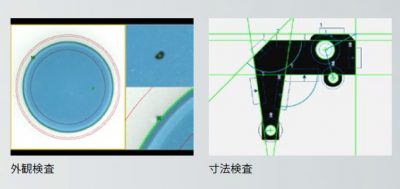
Keyence_CV-Xシリーズ参考
©Keyence/CV-Xseries

I was thinking of writing in the order of development, but I especially wanted to write it earlier, as there was a request for this topic.

Flow of image control and design

In order to incorporate and use the imaging device, it is necessary to easily consider the following as a design.

· What to do (measurement, recognition)
· Where do you want to see?
· Work distance
· Required precision
· How to maintain

· What to do (measurement, recognition)

Compare with model image (pre-registered image)
→ OK / NG or presence / absence judgment
→ Measure model image position
Specify measurement range from image and measure
→ Detect edge and measure position
→ Detect circle and measure position

· Where do you want to see?

Only the shape of the edge of the work
→ Transmission lighting · Backlight lighting
→ gray or black and white camera
(Grayscale, binarization process)
(Projection of shape: It will be like a shadow picture)

I want to suppress disturbance light and diffused reflection against a work
→ dome lighting · ring lighting
(Lighting surrounding the camera)

I want to increase the amount of light to work, I want to add lighting
→ Bar lighting
→ Spot lighting
(When you want to increase partial illumination, shutter speed, etc.)

I want to see fine scratches, shallow grooves
→ blue lighting color, camera color filter

I want to ignore a specific color
→ Color filter of camera
→ color camera

I want to judge by color
→ color camera
(Judged from hue, saturation, brightness)

Color filter (I want to ignore a specific color)
Grayscale (contrast only)

– Work distance

→ Work distance
(Distance between work and lens, field of view range)
→ depth of field
(Variation in distance to workpiece)

Required accuracy

→ Direct Accuracy
(Lens magnification, area to be received (imaging area), number of pixels)
→ accuracy and range that you need to think
(Distortion of lens (distortion), allowable focus blur amount (permissible circle of confusion))

How to maintain

→ White balance
(Gray card (reflectance 18%))
→ Work reference position
→ Calibration of camera coordinate system and work coordinate system

Let’s put these in one corner of the head and take it into consideration in the selection.

Prior to selection (pixel, idea of ​​camera)

pixel

A pixel or pixel is the smallest unit that can display image information.
It means that you can represent an image with 2 million pixels (2 megapixels) ≈ 2 million points (image information). Simply put, it is resolution.
The size of the light receiving element of the camera itself is relevant. The range of the field of view is determined by the area to be received (imaging area) and the magnification that can be captured by the lens.
Since the field of view can be displayed by the number of pixels, the precision that can be represented by one pixel can be obtained.
Therefore, accuracy and viewing range change with combination of “number of pixels”, “area to receive (imaging area)” and “magnification of the lens”.

subpixel processing

It is a method to virtually calculate between a pixel and a pixel. It is judged as a numerical value intermediate between the value acquired by the pixel and the value acquired by another pixel and displayed.
Although it is not actually captured values, the ambiguity of the image (extremely small change is unlikely to occur in a very small range)
It is a method that complements the value as. Suppress errors when measuring edges from images.
However, I think that it is better not to set the tolerance of the resolution to be the minimum.
(Resolution of camera = number of pixels, number of pixels * 2 not to be taken)
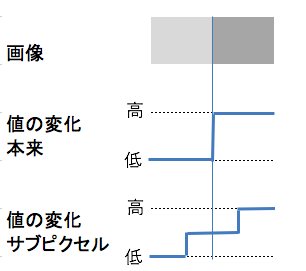
サブピクセル処理の考え方

Bayer array

In the case of a color camera, elements arranged through filters of red, green and blue (RGB) are arranged side by side.
Although it recognizes color, actual pixel size does not become the tolerance of camera resolution.
(It will be doubled.)
Therefore, when importing with grayscale, it may be better to capture with a black and white camera.
Some manufacturers complement their resolution by subpixel processing.
Depending on the camera, if you want to know more, please contact each manufacturer.
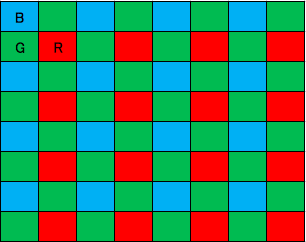
ベイヤー配列の考え方

Accuracy and field of view change with combination of “number of pixels” “area to receive (imaging area)” “magnification of lens”

How to select camera / lens

Field of View and Accuracy

In considering accuracy, you need to pay attention to the following points.
Direct Accuracy: “Lens magnification” “Area to receive (imaging area)” “Number of pixels”
Accuracy that needs to be considered, range: “Distortion of lens (distortion)” “Amount of blurred focus (permissible circle of confusion)”

“magnification of the lens” “area to receive (imaging area)” = field of view
The range of the field of view is determined by the combination of the camera and the lens. Where the camera and lens sell together, I think that the distance (working distance) from the lens to the workpiece and the graph of the field of vision are provided as follows.

The following is a view of the table as an example.
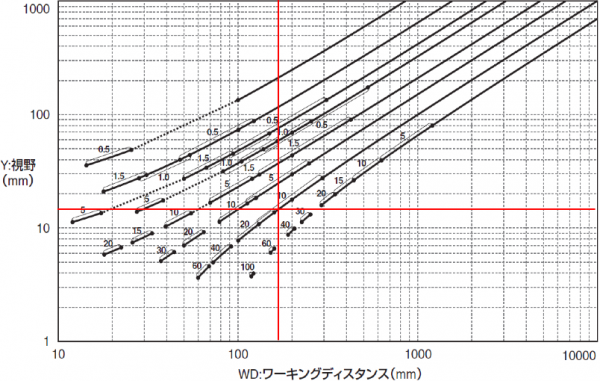
ワーキングディスタンス確認

Select the camera and lens at the point of intersection from the distance from the lens to the work (working distance) and the field of view.
In this graph, the working distance is 110 mm and the field of view (long axis) is 11 mm.

“Number of pixels” “Viewing range” = Direct precision
Consider the case of 2 million pixels (in the case of 1600 x 1200, exactly 1.92 million pixels) and the field of view 11 mm x 8.25 mm.
11 [mm] / 1600 [pixel] = 0.00688 [mm / pixel] = 6.88 [μm / pixel]
. However, this can not be used as it is as precision.

lens distortion (distortion)

Distortion always exists in the lens Especially distortion is likely to occur at the edge of the lens. Therefore, when you use it, the range becomes narrower, or you need to think based on examination. Some applications convert to a coordinate system without distortion.
As the end of the lens is distorted, it can not be used accurately like other parts of the lens.

Below is the image of distortion aberration.
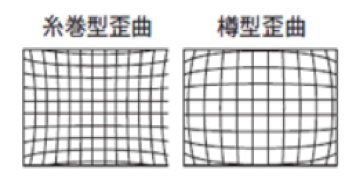
歪曲収差のイメージ

Here, the range without distortion is within the range of the red frame in the figure below.
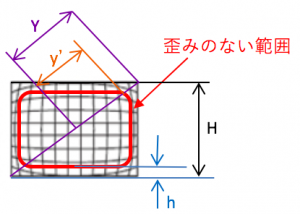
ディストーション

There are optical distortion ratio or TV distortion ratio in lens specification. The relational expression in this case is as follows.
Optical distortion
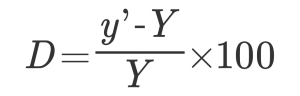
光学ディストーション式

TV distortion
TVディストーション式

As an example, we will explain it as optical distortion 0.1% in the case of the field of view (11 mm x 8.25 mm).
The calculation is omitted, but Y = 6.875 mm, y ‘= 6.868 mm.
Therefore, it is necessary to limit the actual field of view (usage range) to 10.99 mm x 8.24 mm, or to make correction calculation that takes distortion into account.

– Allowable out-of-focus blur amount (permissible circle of confusion)
The amount of blurred focus that is allowed when it is regarded that the subject is in focus
If it is not specified, I think that it is one pixel worth.
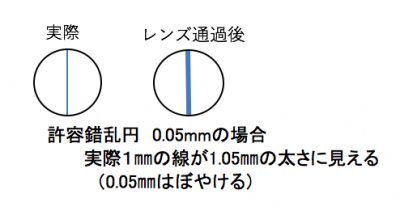
許容錯乱円の考え方
Here, as an example from the previous example, considering 5.5 [μm] x 5.5 [μm] per pixel, the accuracy becomes worse accordingly.

· To what extent does accuracy need to be considered after all?
“Direct Accuracy” + “Accuracy, range that needs to be considered” is the accuracy and range when images are acquired with the camera.

Considering the 2 million pixel camera so far, and the field of view range 11 mm × 8.25 mm, “direct accuracy” is 6.88 [μm / pixel].
“Accuracy necessary to think” is 5.5 [μm] of permissible circle of confusion
Total accuracy = 6.88 [μm] +5.5 [μm] = 12.38 [μm]
You can detect more than 24.76 [μm] from the idea of ​​sampling (more than twice) from this camera and lens.
However, it is assumed that the subject is in focus.
The usable range is 10.99 mm x 8.24 mm.

· Mounter shape of lens and camera
At the end of the selection of the camera and lens, there are many types of mounters with lenses and cameras attached.
There are various kinds such as C mount, CS mount, M12 mount, etc. It will differ in diameter, screw pitch and so on.
I think that there is no particular problem when purchasing a camera and a lens that are compatible with the same manufacturer.

Selection of the camera is done by finding the precision desired to see from the lens and the camera

Selection of lighting

Lighting selection becomes very important.
It depends on the shutter speed, the depth of field, and how to recognize the image.
If you actually try using the image and trying it out, a case may arise that is different from your mind.

Difference in light application by material

Work image on metal (engraved on metal)
Since light reflection is strong, regular reflection (direct reflected light) is used
→ Apply light from the front

Work image under film (work under reflective object)
Halation (reflection of lighting) is strong, so diffuse reflection (not directly reflected light)
→ Apply light at an angle

· Work image under the thin paper etc.
Since the reflectivity of the paper itself is bad, it is difficult to see the underlying paper
→ Apply light from the bottom of the paper (Transparent illumination)

Functional lighting differences

· Only the shape of the edge of the work
→ Transmission lighting · Backlight lighting

· I want to suppress the disturbance light and the diffused reflection against the work
→ dome lighting · ring lighting
(Lighting surrounding the camera)

· I want to increase the amount of light to the work, I want to add lights
→ Bar lighting
→ Spot lighting
(When you want to increase partial illumination, shutter speed, etc.)

· I want to see fine scratches, shallow grooves
→ blue lighting color, camera color filter

· I want to ignore specific colors
→ Color filter of camera

Lighting also affects camera image recognition depending on position, strength, color

Pint setting / way of thinking

If focusing is best, it is best that the distance between the lens and the workpiece varies depending on the workpiece.
It is also possible to expand the range of focus.
It is possible to adjust the amount of light.

F value

 People who have used cameras at the border are the part of the aperture. I think that you can understand Brightness is adjusted by this aperture.
An indicator showing the brightness of the lens. The smaller the F value is, the brighter it is.
The brightness through the lens is 1 / (F value * F value)

depth of field

Even if the workpiece surface moves back and forth with respect to the lens, it will be in a range where the focus can be clearly received without blurring.
Let’s examine how much the work varies with the lens first.

I will explain the calculation as an accurate range.
First of all, optical magnification is necessary.
Please stop it from the lens or the following formula.
Optical magnification M = one side of the receiving surface (one side of the imaging surface) / one side of the field of view range
Example: (H of imaging surface) 8.8 mm / (field of view H) 11 mm = 0.8

Next, execution F is necessary, and the calculation formula is obtained from F value.
Execution F is a value representing brightness in distance.

実行F値式
Execution F = (1 + optical magnification) * F value
FNO: F value, M: optical magnification
Example: (1 + 0.8) * (F value) 2 = 3.6

We will calculate the depth of field.
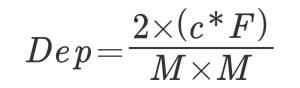
被写界深度式

Depth of field = 2 * (permissible circle of confusion * execution F) / (optical magnification * optical magnification)
C: permissible circle of confusion, F: execution F, M: optical magnification
Example: 2 * (0.01 * 3.6) / (0.8 * 0.8) = 0.11 [mm] width

The larger the F value, the darker the depth of field becomes wider. I will briefly explain the features.
Characteristic:
The larger the F value is, the larger the depth of field becomes. (The more the focus value is blurred, the more it is focused)
When the focal length is short, the depth of field decreases
The depth of field decreases if the work is nearby

Selection of the camera is done by finding the precision desired to see from the lens and the camera

The image detection method (mechanism of edge detection method) etc. uses the method of each control device, so we will skip this time.
From here, I will tell you how to devise how to relate an image to an actual work (how to control from an image).
Therefore, please refer to this book if you would like to know more about the mechanism of image processing method.
図解入門よくわかる最新画像処理アルゴリズムの基本と仕組み (How‐nual Visual Guide Book)

Image control method

On the control of the image, it is better to consider the content described below as a minimum.

· Difference in coordinate system
· Setting method of detection range
· Devices for model search
· Devices for edge detection

Difference in coordinate system

I am taking pictures with the camera, but what I want is the original coordinate system of the workpiece.
It is not necessary to judge OK / NG etc, but it is necessary when using position or measurement.

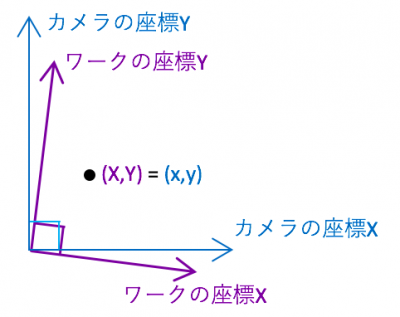
The image is as follows.
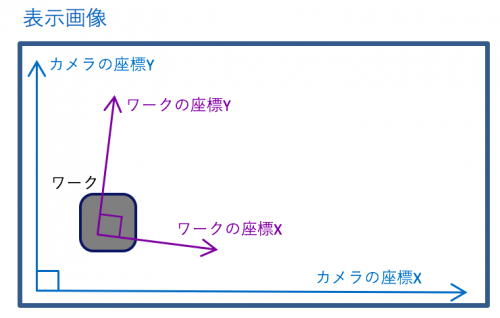
座標系の違い

In the case of a moving work, move at least two points on the screen and if there are mechanical standards, calibrate it by also taking two or more points on the screen so that you can know the position on the screen based on it. If there is no calibration of the coordinate system, tilt from the 2 point position, multiply the intercept of the work coordinate by sending an intercept can convert from the camera coordinate system to the work coordinate system. Please do this calculation and figure out the position.

This time I will show the conversion from the angle difference of the axis easily. As a method there is not limited to this, please consider it because there are various ways.
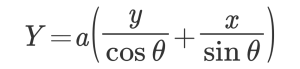
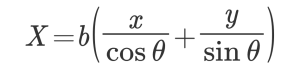
Let’s say that the axis (x, y) of the coordinate system of the camera and the axis (X, Y) of the coordinate system of the workpiece are tilted (angled) as shown below. At that time, compare the value when only one axis of the coordinate system of the work is changed with the coordinate system of the camera.
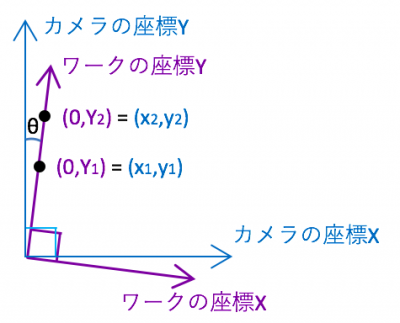
座標変換1

At this time angle θ can be expressed as follows.
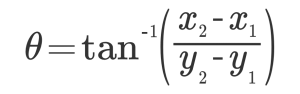
座標変換1

The converted ratio of the coordinate system of the workpiece from the coordinate system of the camera is as follows.
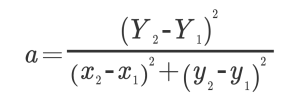
変換比率

Once we find the conversion constant like this. (The X side will do the same.)
From there, expand the transformation formula to arbitrary coordinates as below and consider it as work coordinates.
任意座標に展開

y変換式

x変換式
A: Conversion ratio of work coordinate Y axis
B: Conversion ratio of work coordinate X axis

How to set detection range

The range will be minimized if the actual work is repeated at the same position each time.
Therefore, let’s design to come to the same position as much as possible. However, I will not go that far.
Even if you try to come to the same position, let’s consider the following.

· Machine stacking tolerance, machining tolerance, assembly tolerance (generated by reassembling, negligible by calibration)
· Processing tolerance of work (variation of work)
· Other design considerations

Let’s set the detection range beyond the maximum design tolerance which adds all these.

ingenuity at model search

It is a method of finding the actual work position / work presence / absence from the reference model image (reference work figure).
It depends on the manufacturer, but I am looking for with the appearance of edge and color recognition.
Therefore, you may not be able to detect without paying attention to the following.

· Do not make models too small
· Do not give model recognition sensitivity (correlation value level: consistency) too high
· Shape and color similar to model do not exist in detection range

The model search compares and identifies the position and orientation of the work in any state.
However, it takes time to detect if the detection range is too wide or if the direction corresponds to 360 °.
It is better to regulate the detection range as much as possible and regulate the detection orientation (direction of comparison of model images).

ingenuity at edge detection

Here, we will explain in particular the points to note when using images as measurements.
For the majority of model comparisons and measurements, we will extract the change part of color (gradation derivative) as an edge.
In the model comparison, since it is judged to what extent it is close to the model image, it is not necessary to stick to detection much, but in case of measuring from the edge (measured at the change portion of the shading), caution is necessary.

The center of gradation change (the original edge) and the place the image recognizes as an edge are somewhat different.
In addition, edge sensitivity needs to be changed depending on the material. (Because metals have high reflectance and papers have low reflectance)

Below is the image image.
We set the sensitivity to recognize as an edge (here 50 is slightly different in position)
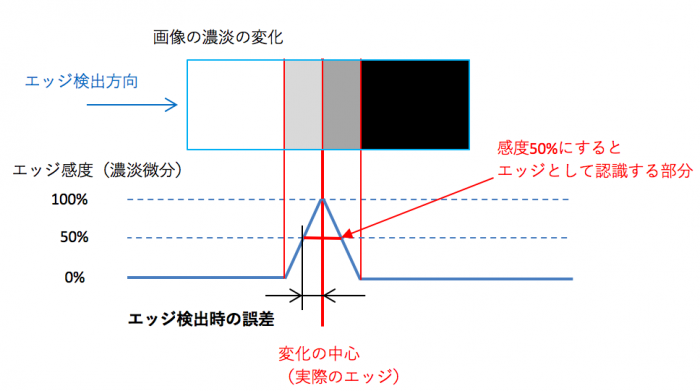
エッジ検出時の誤差

In this way, the center and difference of the actual change come out. If we take the “center of the range captured as an edge” (the center of the place where the edge sensitivity is 50% or more here), will it match “the center of change”? I think that some degree of error comes out because the degree of change (sensitivity) of the image does not change uniformly depending on the color. Therefore, calibrate the position of the image and the real thing, or devise the measurement method.

As a measure of the measuring method, not extracting the position from one edge but extracting the other edge, and using the center of that edge and edge as the measurement point.

Although the figure above was “White → Black”, I will try to detect the edge from the reverse direction in another place (another edge) where it changes to “Black → White” as it is.
By doing so, it prevents a difference from occurring due to focus blurring etc.

I will explain with a simple figure.
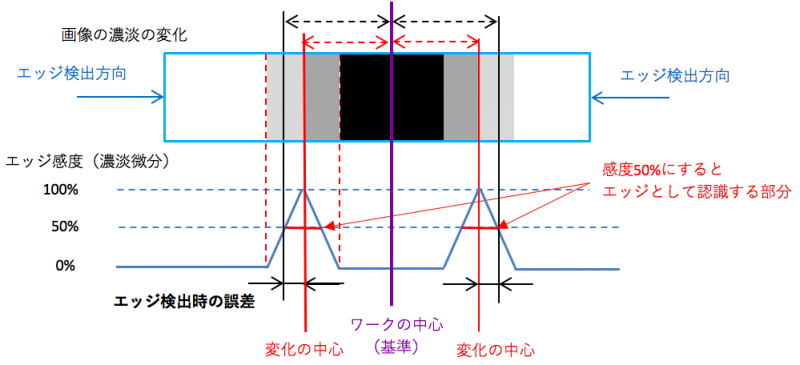
エッジ検出の工夫の仕方

The edge is detected with the same edge sensitivity from the opposite direction. The center of the position of the edge in the forward direction and the center of the position of the edge in the opposite direction is the center of the actual work. By doing so, the criteria detected from the work center and the edge are the same.

These “image control methods” are just a part of the control. It can be applied to many things and can be utilized. Please try it.

It can be applied to considerable precision and various things depending on the ingenuity.

trend of recent image processing device

The image processing device was mostly that maintenance and adjustment were very difficult.
Recently, simple image processing devices (sensors) similar to tuning-less, fiber sensor, photoelectric sensor are coming out.
I think that it will gradually increase from now on.
It seems that it will become mainstream not only as FA (factory automation) but also as a technology addition product.

Image processing technology gradually becomes widely used in various fields

Was it helpful? There are various other methods, and each maker is changing to a method that can be done more easily.
However, there are things such as precision and speed unless you consider it, so let’s design firmly there.

The image detection method (the mechanism of edge detection method) etc. uses the method of each control device, so we omitted this time.
If you want to know more about the mechanism of image processing method, this is easy to understand.

Categories
Management term

マネジメント2 ロジカルな発想力を高める視点・観点

ロジカルな発想力を高める視点・観点

すごい発想力を持っている人を見ると「すごい人だな」と思ってしまいます。
ですが、これから話す内容を自然とできるように実践していけば今の発想力や発見力を最大限に高めることができます。
実際にすごい発想力の持ち主は、自然にこれから話す「視点」・「観点」が出来ています。
一言で説明すると、
 ・視点とは見る角度を変えて物事を捉える
 ・観点とは考える角度を変えて物事を捉える
です。
この2つは非常によく似ていて重なる点もあります。
これらの事を細かく説明していきたいと思います。

視点 (視点、視野、視座)とは

ここで話す視点とは「見る角度を変えて物事を捉える」ことです。
それは簡単に話すと以下の3種類に分類されます。

「視点」・「視野」・「視座」

自然と誰もがこの3種類を行なっていますが、偏り方がまちまちになったりしています。
「見る角度を変えて物事を捉える」時には一度立ち止まって振り返ってみましょう。

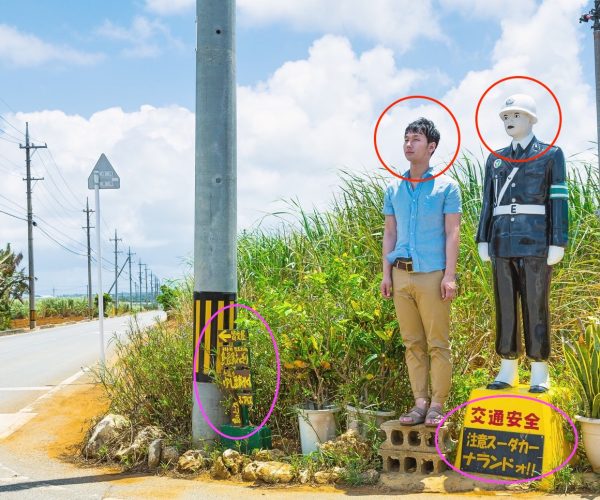
以下の画像を例にして説明したいと思います。
視点・視野・視座

・視点

 見ている場所を変えた物事の捉え方

視点2
現在フォーカスの合っている場所を変える事です。
赤枠の「人の顔」に今までフォーカスを当てていました。
次に紫枠の「文字」にフォーカスを合わせて見るといった具合に見ている場所を変える捉え方になります。
実際に「文字」にフォーカスを合わせたことで、文字の内容を受け取ることができます。

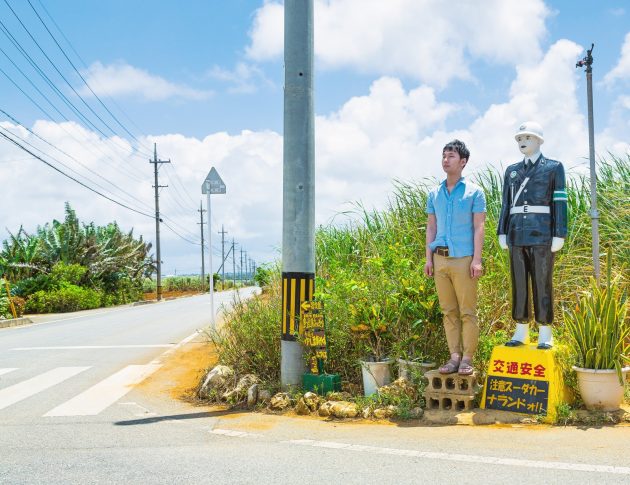
・視野

 見る範囲を変えた物事の捉え方

視野1
現在の見ている範囲から範囲を変える事です。
どういうことかというと、上の画像では範囲が大きくなっています。
範囲が大きくなったことで、今まで見えなかった風景も見えるようになりました。
逆に範囲を小さくしてクローズアップしてより詳細を確認するといったこともできます。
画像を撮る時間帯が違った場合というように時間軸を範囲と捉えて変えていってもいいです。
このように見れる範囲を変えた捉え方になります。

・視座

 見る立ち位置を変えた物事の捉え方

視座
この画像は画像に載っていた人が見ていた先の風景になります。
今までの画像に一切映らなかった内容が受け取れます。
このように立場や場所・立ち位置を変えた捉え方になります。

これらのように、見るという行動を少し変えていくだけでも多くの情報が受け取ることができます。

見る角度を少し変化させただけでも情報がより多く受け取れる

こちらの本も発想力として役に立ちます。
参考にさせていただきました。
とらわれない発想法 あなたの中に眠っているアイデアが目を覚ます

観点 (立場、時間、価値、経験、環境、不釣合い)とは

ここで話す観点とは「考える角度を変えて物事を捉える」ことです。
それは簡単に話すと以下の6種類に分類されます。

「立場」・「時間」・「価値」・「経験」・「環境」・「不釣合い」

これらを使って「考える角度を変えて物事を捉える」事をすると今まで見えなかった多くの部分も見つけられるようになります。

今度は以下のスマートフォンを例にして説明したいと思います。
以下説明の中では個人的な意見が含まれますが、必ずしもそうではありません。一例として捉えてください。
観点 (立場、時間、価値、経験、環境、不釣合い)

・立場

 性別、年代、職種等の違いからの観点

・年配の方:使い方がわかりにくい、プッシュ式の方が使いやすい
・女性:ローズゴールドの色の方が好き
・全盲の方:触る感覚がないと使えない
立場が変われば考え方もそれぞれ変わります。
その方達の立場にたった考えをした物事の捉え方です。

・時間

 現在、過去、未来、歴史等の時間軸の違いからの観点

・未来:インプラントや身につけるタイプのガジェットに変化する?
・現在:価格が徐々に高くなっていく、性能が良くなっていく
・過去:容量200MBでも昔は大きいと感じていた、カメラとビデオの差が明確にあった
時代の変化、時間に対する考えをした物事の捉え方です。

・価値

 価値観の違い、価値の変化に対する観点

・価格が高い、使いたいアプリが少ない
・世界一使いやすい、機能と比べると価格は安い
・電話の機能をほとんど使用していない
・複数台で使い道を分けている
価値または価値観に対する考えをした物事の捉え方です。

・経験

 経験上の観点

・ハードボタンはホームに戻るボタン
・水中に落とすと壊れる
・サイズが大きいタイプだと、お尻のポケットに入れておくと反ってしまう
このように経験上こうなるだろうと予測ができる物事の捉え方です。

・環境

 場所、国、文化の違いからの観点

・日本:スマートフォンの約半数はiphone
・海外:ユーザー数は比較的少ない
・海外の特定の場所:性能が最大限発揮できない(電波法上、LTE環境がない)
場所などの違いに対する考えをした物事の捉え方です。

・不釣合い

 ありえない方法、不釣合いな組み合わせからの観点

・スマートフォンを放り投げるゲーム→「S.M.T.H.(Send Me To Heaven)」
・100%歩きスマホ→AR(拡張現実)ナビゲーション
通常合わない内容をあえて掛け合わせてみて、それに対する考えをした物事の捉え方です。

考える角度を少し変化させただけでも考えが拡がる

使用している場所・人

たくさんの方々が色々な場面で使用しています。
職場としてはビジネスだけでなく、研究・開発、スタートアップを考えている企業などなど。
職業としては開発・設計者、弁護士、芸人などなど。

機転・発想を利かせる職場やそれを職業としている人たちからは非常に多く使用されています。

「イノベーション」や「日本企業・日本人の間違った認識」の中のマーケティングにも説明している内容にもつながっていきます。

物事を捉える方法はどんな分野でも使用できる

こちらの本も発想力の参考として大変役に立ちます。

Categories
Flow of development

Avoid the danger! Risk assessment

Avoid danger! Risk assessment

Risk assessment is a way to grasp whether the dangers of products and equipment made are not hidden as logical thinking.
Therefore, the risk here is not a risk of product strategy or product quality, simply speaking as a risk as “safety”.

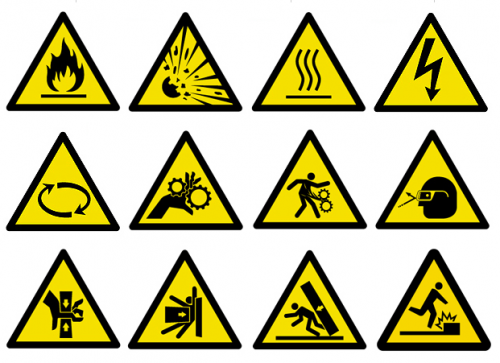
リスクアセスメント注意ラベル

1. Why is there a need to think about safety?


1. Manufacturer responsibility has been questioned for safety against products.
→ It can be said that designing with risk taken into account in product design is made even when it comes to a situation where responsibility is required

2. It is time to question CSR (corporate social responsibility).
→ International standards It is stipulated that manufacturing competition will be done with safety ensured as ISO

3. Large damage amount
→ It can be a civil lawsuit without having to be a criminal case. In that case, it will expand from tens of millions to billions of yen yen at the compensation responsibility

4. Can not sell overseas
 It is asked whether the risk assessment was carried out even overseas certification such as CE and CCC.

It is becoming an era where supplier liability is strictly questioned

2. Why are you making noise in Japan?


Japan is still country under risk aversion ! It is!

As for what it means, there are two ways of thinking about safety design.

· Danger detectable
When it becomes dangerous, send a signal and control and display
→ In the event of a sensor malfunction or the like, it does not detect danger and it operates.

· Safety confirmation type
Only when safety is secured, signal transmission control.
In case of sensor failure or the like, it does not operate because it does not detect safety.

Japan is rather dangerous sense type of the former.
In Europe and the United States, the latter safety confirmation type is mainstream.
Because it will not move unless it is safe,

Japan is a country undergoing security measures

3. What should the designer do?


First of all, we have to make products with intrinsically safe design (not dangerous, not approaching danger, not making danger).

Nevertheless, when the danger can not be avoided by any means, the designer must make efforts to reduce the danger according to the level of the risk.
It is a risk assessment that leaves them as a form.
The level of risk in this case is as follows.

Risk level = magnitude of injury + contact frequency + probability of injury

As I will explain in detail later, it is to judge correctly whether this risk level can be accepted as a company.
It is the designer’s job to use the judgment to do the following.

· Minimize risk
· Make the user recognize the risk
· Present usage without risks

Essentially it does not have risks without making risks

4. Risk assessment flow

Risk assessment is done by multiple people so as not to miss as much as possible.
I will explain the flow easily.

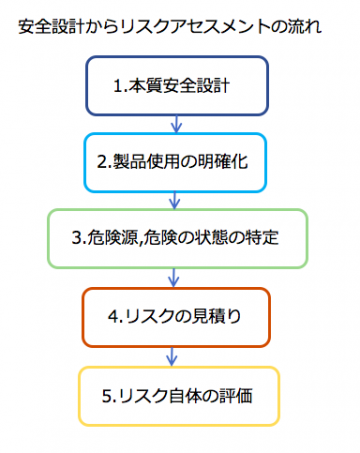
Below is a diagram of the flow of risk assessment from safety design.
安全設計からリスクアセスメントの流れ。最大限に安全を見つめ直す

We will consider as early as possible in the design stage.
Because, if it is retrofitted, it will only protect the safety guards.
→ Cost rises, maintainability, operability is affected.

1. Intrinsically safe design

· It is not dangerous
· Do not approach danger
· Do not make danger
Is it supposed to be

“1. Intrinsic Safety Design” will not be explained as it will vary depending on the product, but let’s design it so as not to be dangerous.

2. Clarification on Product Usage

· Who, when and how to handle

“2. Clarification on Product Usage” becomes important in conducting risk assessment.
· Who is the product user?
· Are there any changes in hazards depending on the operating environment?
· How do I use it?
· Is there a possibility of encountering danger other than usage?
· Who maintains the product?
· Do you encounter maintenance danger?
· Hazards do not appear as synergies when using tools and other instruments?
· Are there any risks encountered by other third parties?
As we use it, we will identify the hazards along the flow of work.

3. Identify hazards and hazardous conditions

· Type of danger: impact, entanglement, noise, vibration, electric shock etc.
· Danger status: size of disorder, frequency of contact, avoidance from danger

“3. Identification of hazards and hazardous conditions” will correctly describe the situation of hazards sources from the contents that were done in 2..
Here, the same hazards of the same part that spans use can be summarized.
However, even if it is the same part, if the type and state of danger differ, it should not be summarized.

4. Risk Estimate

  · Estimate the risk level

For “4. Risk Estimation”, we will quantify each risk level from the type and state of the danger done in 3.
By numericalization, we will visualize the priority of improvement against danger.
However, since it may be influenced by the values ​​of each designer in setting this risk level,
I think that it is better to decide certain rules in advance.

5. Evaluation of risk itself

· Determine whether it is acceptable or not for risk level
· If there is a range where the risk is unacceptable, repeat it from the beginning

“5. Evaluation of Risk itself” will decide how to respond from the risk level quantified in 4 in the future.
Depending on the value of the level, we will classify “unacceptable levels”, “remaining risk” and “acceptable levels”.
· If it is “unacceptable level”, review the design and lower the level or eliminate hazards.
· If it is “residual risk”, we will rethink the design and lower the level or notify the user of the risk and leave it as a user’s responsibility.
· If it is “acceptable level”, we will promote product design by notifying the user of the risk depending on the situation.

It is best if there is no risk to the product, but it seems that it can not be done anything to make it zero.

The following books are helpful for details of the flow of risk assessment and how to respond at the manufacturing site.
製造現場等におけるイラストで学ぶリスクアセスメント 第1集

5. Identify hazards and hazardous conditions

As I mentioned briefly earlier, after extracting hazards, we will consider risk levels one by one for hazards.
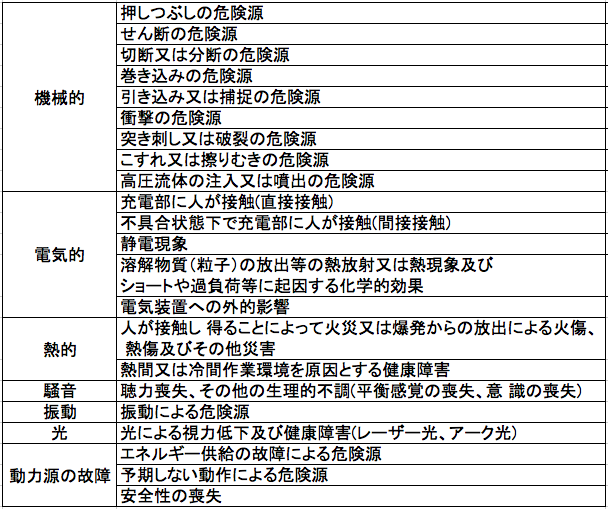
The following are the main items to look for hazards.
· Mechanical
Crushing, shearing, cutting or cutting, entanglement, retraction, impact, rubbing or scuffing, injection or ejection of high pressure fluid
· electrical
Direct contact, indirect contact, electrostatic phenomenon, thermal radiation or thermal phenomenon · short circuit, external influence on electric device
· Thermal
Burns caused by fire or explosion, burns and other disasters, causing health problems
· noise
Hearing loss, other physiological malfunction
· vibration
Hazard source by vibration
· light
Diminished vision and health problems due to light
· Failure of power source
Failure of energy supply, unexpected operation, loss of safety

危険源特定
These contents are not all.
Depending on the content you need to add. Also, depending on the company, I think that the contents to be prioritized and details to be viewed in detail are different.

Identifying hazards sources can lead to activities of risk reduction

6. Risk level thinking

As I explained a little bit earlier, the risk level can be expressed as follows.

Risk level = magnitude of injury + contact frequency + probability of injury

However, this is one of the risk assessment methods.
As a method
· Addition method (add risk element)
The above method, the most used in Japan
· Integration method (accumulate risk factors)
Sometimes the effect of risk reduction seems to be large
· Matrix method (expression with risk as a table)
Can not be reflected in fragmented risk
· Lithograph method (Risk expressed as chart)
Risk comparison is easy. But I can not do much classification to evaluate
there is ………, ………, etc.
I will explain with addition method.
Other methods will be omitted.
Let’s explain each item of the addition method.

o Size of injury

The size of the injury will be based on “magnitude of force”, “space to escape” “range to be covered” and will create standards.
Size of force: impact, thrust, speed
Space to escape: space to relieve force
Area covered: Number of people, range of body at risk
It becomes important.
For example, “I pulled my arms in a place that was crushed to 2 mm of clearance at a speed of 5 mm / s with a force of 20000 N”
If you think, your arms will break.
But, “I got my fingers in the place where the force of 20,000 N, crushed to the gap of 300 mm at a speed of 5 mm / s”
It seems that it will not get caught when becoming. (I think impact will be added)
The concept of “escape space” and “range to be covered” is also included in the JIS standard.
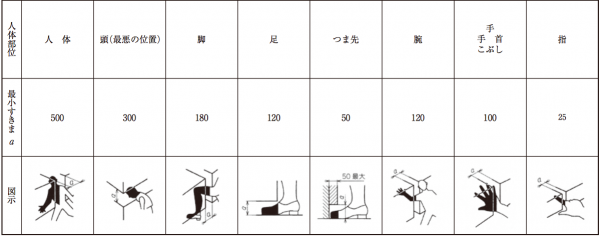
As an example, the minimum clearance for avoiding crushing (JIS B 9711)
Body: 500 mm or more
Leg: 180 mm or more
Toe: 50 mm or more
Arm: 120 mm or more
Hands: 100 mm or more
Finger: 25 mm or more
押しつぶし回避の最小隙間。この場合はうでで、120mm以上必要です。
I think that it is good to refer to.

Based on these assumptions, we will classify the following.
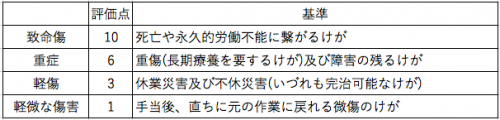
· mortal wound : injuries leading to death or permanent labor inability
· Severe : serious injury (injury requiring long-term care) and injuries remaining
· minor injuries : accidents involving lost work and injuries (injuries that can be recovered at all)
· minor injuries : injury injuries that can return to the original work immediately after the allowance
This is an example and I think that strict numerical values and standards are different for companies, but it will look like this.

Some companies assign “injury class” on the assumption that injuries remain after the accident.
傷害程度・度合い。程度により致命的なものから軽微なものまで範囲があります。

○ Contact frequency

The frequency of contact is the frequency of approaching a hazard.
I will divide it as follows as a guide.
· Frequently : 3 times or more / 1 day
· occasionally : 1 to 2 times / day
· Rarely : at least 1 / week
Again as before, I think that strict numerical values and standards are different for companies, but it will look like this.
危険源に近づく頻度。週に数回程度から時間に数回など近づく頻度になります。

o Probability of injury

The probability of injury will be based on “detectability of danger” and “avoidance from danger”.
The probability of occurrence of risk depends on whether it is an easy-to-understand hazard.
Danger is perceived differently in “Blade in front of you” and “Blade in place hidden behind the shadows”. Of course it also leads to avoidability.
As avoidance from danger, consider whether you can avoid or encounter hazards.
· Safety distance to prevent reach of upper limbs / lower limbs (JIS B 9718)
Distance not reaching hazards
Arm: opening 120 mm or less, distance to hazardous source 850 mm or more
Hands: opening 30 mm or less, distance to dangerous source 200 mm or more
Fingertip: opening 6 mm or less, distance to dangerous source 10 mm or more
Leg: opening 95 mm or less, distance to hazardous source more than 1100 mm
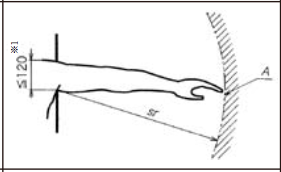
Below is an illustration of an arm case
  腕の安全距離 この場合は腕の安全距離になります。850mm以上離れていれば安全と規格では見なしています。
· Response time of safety guards (JIS B 9715)
S = (K * T) + C
S: Distance from detection point to hazard source, K: Part approach speed (upper limb 2000 mm / s), T: Time to eliminate hazards, C:
If this is a detection device, if the safety protection device is activated or the machine is stopped and the hazards are gone, consider using this formula.

Based on these, we will divide it as follows.
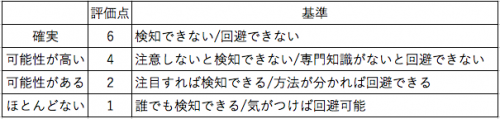
· certainty : can not detect / can not be avoided
· highly likely : can not be detected unless careful / can not be avoided without expert knowledge
· There is a possibility : It can be avoided if you can recognize by noticing / knowing a method
· Almost none : Anyone can detect it / Avoid it if you notice it
I think that it is necessary to decide how to avoid and detect how to detect hazards.
Again as before, I think that strict numerical values ​​and standards are different for companies, but it will look like this.
傷害発生の確率

○ Risk level

We add the score so far and figure out the risk level.
Respond according to risk level.
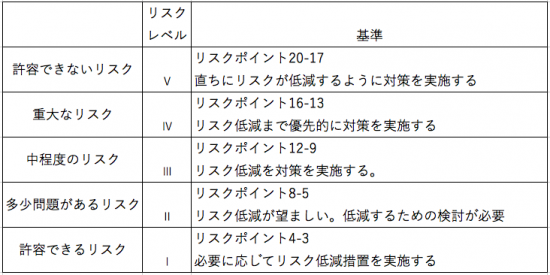
· Ⅴ: unacceptable risk
 Risk points 20 – 17, Implement measures to immediately reduce the risk
· IV: serious risk
Risk points 16 – 13, prioritize measures to reduce risk
· Ⅲ: moderate risk
Risk points 12 – 9, implement measures to reduce risk.
· Ⅱ: Somewhat problematic risk
Risk point 8-5, risk reduction is desirable. Study to reduce it is necessary
· Ⅰ: acceptable risk
Risk point 4-3, implement risk reduction measures as necessary
Again as before, I think that strict numerical values ​​and standards are different for companies, but it will look like this.
By implementing these, designs that reduce risk as much as possible will be designed to approach intrinsically safe.
リスクレベル

Risk assessment can reduce risk as much as possible

Details of the flow of risk assessment and how to deal with the manufacturing site are easy to understand below.

Categories
Manufacturing terms

Let’s reduce the number of tests (experimental design method)

Let’s reduce the number of tests (experimental design method)

We try to figure out combinations of several conditions for testing for quality and purpose extraction. If it is a normal idea, if you do the number of rounds per minute (by testing) it is certain. , but in cases where there are many types of combination conditions or there are many condition contents, the number of brute force increases exponentially. (It increases the number of tests.) It becomes way to suppress it as much as possible.

Rather than doing the number of experiments by round robin, express by probability · Reduce the number of times by performing with probability

Difference from brute force

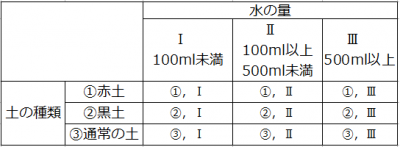
Suppose, for example, you want to investigate the best condition under the condition that the seed of the plant germinates. Tentatively, as the type of condition, “type of soil” “quantity of water”. As the content of the condition, the brute force in the case of “type of soil” is “red soil”, “black soil”, “normal soil”, “the amount of water” is “less than 100 ml” “100 ml or more and less than 500 ml” or “500 ml or more” The number of times and the table (combination pattern) are as follows.
実験計画法総当たり1

The round-trip count (test count) is 3 × 3 = 9 times .

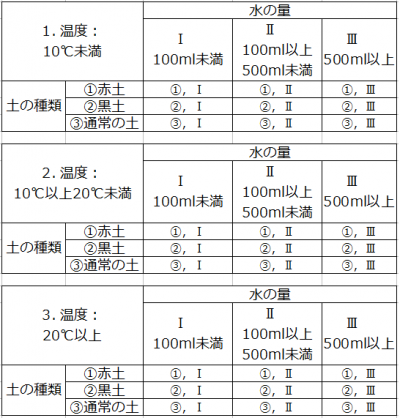
I will increase the type of condition here by one. The type of condition is “temperature”, the contents of the condition is set to “less than 10 ° C”, “10 ° C to 20 ° C”, “20 ° C or more”. In this case, the total number of contacts and the table are as follows.

実験計画法総当たり2

The round-trip count (test count) is 3 × 3 × 3 = 27 times . It increases steadily with a multiplier. . .

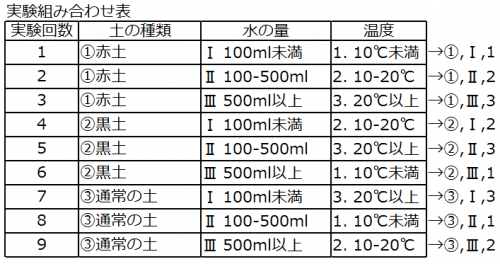
However, If it is the idea of the experimental design method, the number of times of experiments is not required for the total number of rounds. What are you talking about? You might think. It is represented in the table below.

実験計画法パターン

I think that I thought that “There is a pattern that is not done !!” ! In the experimental design method, the proportion of the contents (large elements) of the related condition is given using the analysis method of variance analysis. To put it briefly, a technique for establishing relevance by establishing it . Therefore, we have to compute the result. . . If you make it in Excel etc. beforehand, it is no problem.

Benefits:
The number of tests decreases. The relevant ratio of the contents of the condition can be specified.
Demerit:
The best combination is hard to understand, calculation is necessary
(You can see which items are strongly related by the content of each condition.)


Two things can be analyzed by using the experiment design method.

1. Reducing the number of tests: It will also be the subject of the title.
2. Analysis of data: You can tell by the probability how much the condition contents are related.


Concept of experiment design method

In the experimental design method, the type of condition mentioned earlier is called “factor” and the content of condition is called “level”.
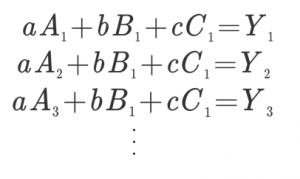
I think that we can write the factors A, B, C and the levels 1, 2, 3 (A1, A2, A3) as calculation formulas as follows when thinking in brute force.
実験計画法考え方

It is not simple, but I will briefly explain.

· way of thinking

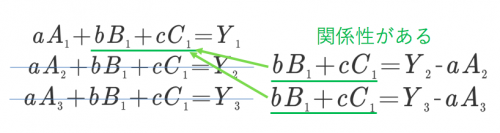
Among the above formulas, I think you will find that there are related parts (common parts) when rewritten as follows.
Even if you do not conduct a direct test using this relationship, the test results will appear in the common part so that it is a way to be tested without testing the whole number. Originally I will think about dispersion (variation).
実験計画法考え方2

Therefore, combination is very important . The combination uses an orthogonal table derived from a table called Latin square. It will be a combination called. By using the orthogonal table, the effect of each factor can be evaluated without counting in round robin (even without combining all patterns). This combination is important.

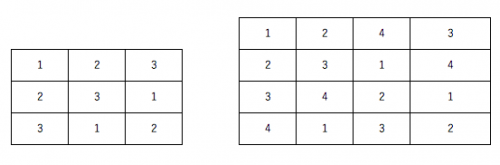
· What is Latin square?


If you explain the Latin square in a simple way, it arranges so that one element is inserted in each row. Use it to spread the combination.
ラテン方角

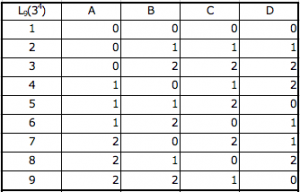
An orthogonal table is obtained by weighting the variance using this Latin square.
The following is an orthogonal table to be used in this case.
直交表

The idea is difficult ~! Well, I am the same.
The theory is difficult, but If you apply the correct pattern as it is, there is no problem.
For those who want to know more, the following books will be helpful.

Experimental Design

Next we will show the orthogonal table to use.

The important thing is just to assign an orthogonal table to use, depending on what level / factor / you want to do .

Reduce the number of tests by utilizing the fact that the test results appear in the common part.

Orthogonal Table Type

First of all, it is the notation method before showing the kind.
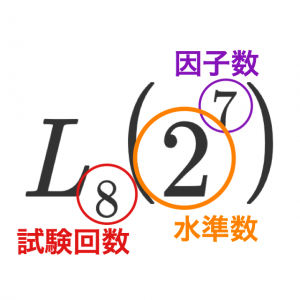
Write it as orthogonal table as follows.
直交表の表示
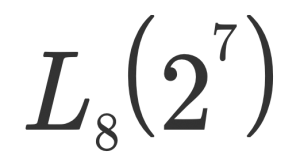
What’s this? However, this means that two levels of factors are orthogonal tables that can be handled up to 7 tests in 8 tests.
 
直交表の表示2

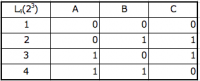
Orthogonal table: 2 levels 3 factors
2水準4因子

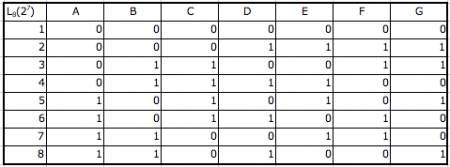
Orthogonal table: 2 levels 7 factors
2水準7因子

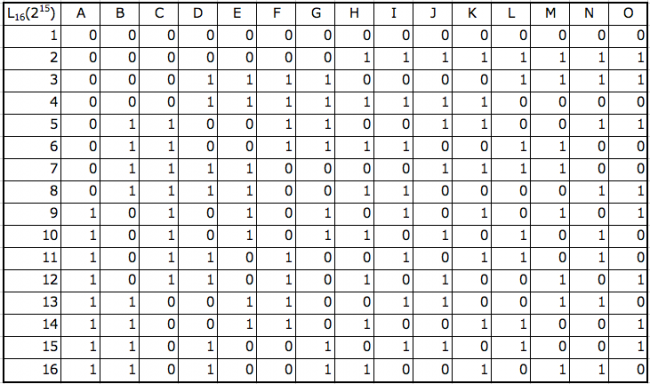
Orthogonal table: 2 levels 15 factors
2水準15因子

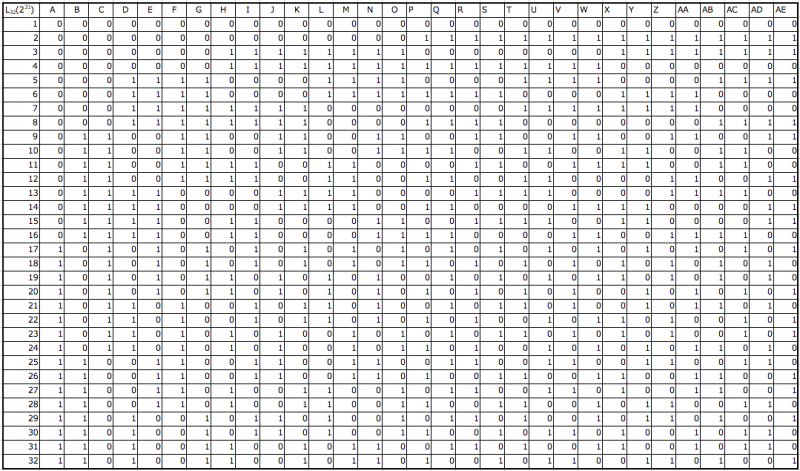
Orthogonal table: 2 levels 31 factors
2水準31因子

Orthogonal table: 3 levels 4 factors
3水準4因子

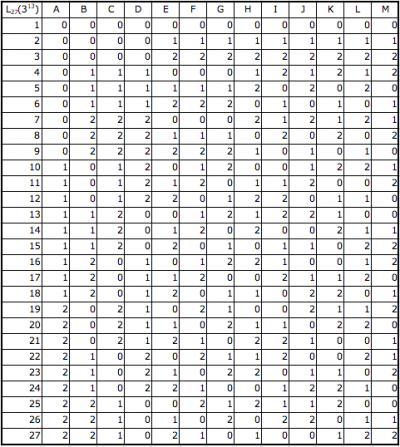
Orthogonal table: 3 levels 13 factors
3水準13因子

If the number of factors to be used is small, please use the factor without assigning any factors that have the remainder of the orthogonal table.
I presented a representative one. There are many others and it is also possible to derive.
There are combinations of levels (combination of 2 levels and 3 levels, etc.) and multiple levels of orthogonal tables, but we will skip here.
For details, please see the reference material at the end of the sentence.

After all, let’s try to minimize as much as the number of factors / level number increases as the number of experiments increases.

There are various kinds
Minimize the factor / level to conduct the test

How to evaluate in Excel

I think that I understood the kind of the orthogonal table. I will explain concretely how to use it.

Evaluation of Pass Rejection

In this state, we know the value of the acceptance and we will put out the completeness of the combination.

First select the orthogonal table you want to use. Here we use an orthogonal table of 8 tests (2 levels 7 factors).
As mentioned earlier, even if the number of factors is small (in this case two factors, six factors can be used).
In that case, please ignore the column (column).

· Thinking (pass failed)

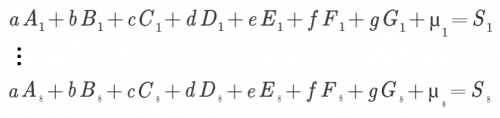
As a way of thinking, we solve the following simultaneous equations.
Compare the characteristic value (predicted value, average value) μ with the result S and see the change in the coefficients a to g.
If the characteristic value and the result are the same, the coefficient becomes 0. Changes appear in the coefficients involved when they are different.
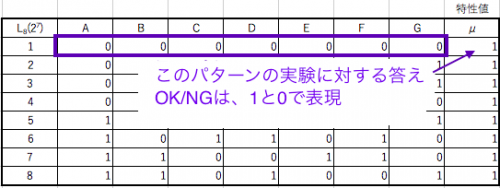
特性値

· How to use Excel (pass fail)

First, we will output the necessary orthogonal table. Add the column of the experimental characteristic value (predicted value, average value) μ to the last column of the orthogonal table.
For 2 pole like OK / NG for characteristic value, indicate it with 1 and 0.
特性値の追加

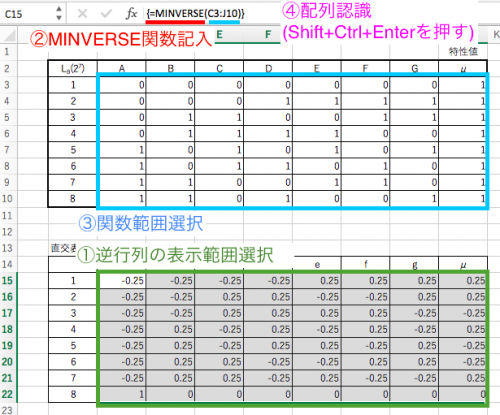
First, create an inverse matrix to solve the simultaneous equations.
In Excel, we use “MINVERSE function”.
① Select the same range as the orthogonal table + characteristic value range for the place you want to create the inverse matrix (the place you want to display).
② Fill in MINVERSE in the input field.
③ Select the range of MINVERSE (what you want to inverse matrix: orthogonal table + characteristic value).
④ I will let Excel recognize it as an array. In Excel, “Shift + Ctrl + Enter” will be recognized as an array that is related not to a simple numerical value.
This completes the inverse matrix table.
Excelでの逆行列

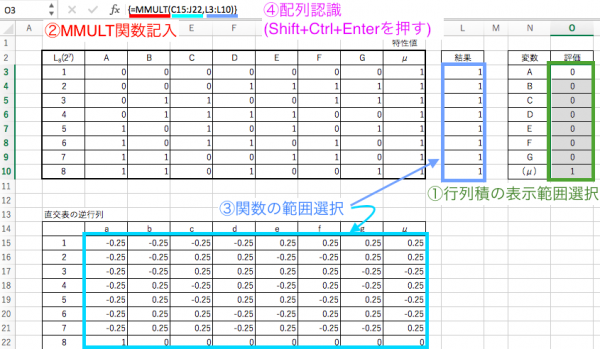
This time, it performs matrix multiplication and displays the change of coefficients a ~ g.
In Excel, we use “MMULT function”.
① Select the range of the number of factors plus 1 (characteristic value) in the same way as above, where you want to make the matrix product (the place you want to display).
② Fill in MMULT in the input field.
③ Select the range of MMULT (what you want to matrix, orthogonal table + inverse matrix of characteristic value, result).
④ I will let Excel recognize it as an array. In Excel, “Shift + Ctrl + Enter” will be recognized as an array that is related not to a simple numerical value.
This completes the matrix product table (values of coefficients a – g).
Excelでの行列積

You can see which factors are related from these.
· It can be said that factors with a change in the evaluation (coefficient) have influence (change) on the characteristic value.

Of course, if the characteristic value and the result are exactly the same, the evaluation (coefficient) will be 0.
In the case of evaluation such as pass fail, it means that it is a failure if the evaluation is other than 0.
As a factor of rejection, if the characteristic value (acceptance value) is 1, a negative factor of evaluation is a factor.
In this case, it can be said that factors of E and G cause this result to be different from the characteristic value.

Evaluation judgment and relevance of factors can be judged by Excel
If you prepare a calculation formula in Excel in advance, you can easily find related factors

Evaluation of maximum or minimum combination estimation

Here, we will explain how to find out which combination the numerical value is the maximum or minimum.
First select the orthogonal table you want to use. Here we will use orthogonal tables (2 levels 3 factors) of 4 tests.

· Concept (combination estimation)

We will use the orthogonal table to obtain the evaluation value.
Assign the result to the level of each factor.
Divide the factor by the number of allocated results of that factor and level and compare it.

If there are multiple test results, errors in measurement are suppressed and accuracy improves.
At that time, if the test result is D, the relationship between the true measured value S and the error N is as follows.
D = S + N

If it is 1 time, this is fine, but if you do it more than once, you will see the error on average as you try to express it on average.
Assuming that the test result is 3 times (D1, D2, D3) the average value D of the test, it can be expressed as follows.
/ 3 = S + (N 1 + N 2 + N 3) / 3 (S 1 + N 2 + D 3) / 3 =

If the error is close to the true measured value, it is difficult for the error (variation) to understand the difference between the true measured values ​​by just normal means alone.
So it is the idea of ​​dispersion.
We will give the expected value of variance of sample mean.
σ ^ 2 = (D1 ^ 2 + D2 ^ 2 + D3 ^ 2) / 3 = (Measurement 1st ^ 2 + Measurement 2nd ^ 2 + Measurement 3rd ^ 2) / 3

This variance value itself does not make sense, but if the error is even slightly less than the true measurement value, the true measured value is largely reflected.
“When the result of the test is multiple (n times)”, because the variance itself is raised to the second power, digits of the value are sometimes enlarged and it may be difficult to see, so we use LOG to reduce the scale.
The error (variation) is explained in “Variance and process capability” .

· When the test result is single (once)

I will explain the case where there is only one result for the number of tests.
Actually, since there is noise (variation), the number of tests will be reduced by the experimental design method but the test result will be more accurate if you do multiple tests.
Later, I will explain the case where multiple results are issued, but here we will explain the result one time.

In this example, we will find combinations (combinations of factors and levels) that maximize the test results.
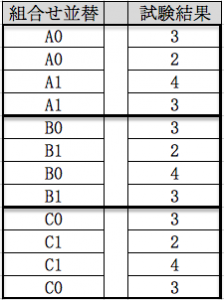
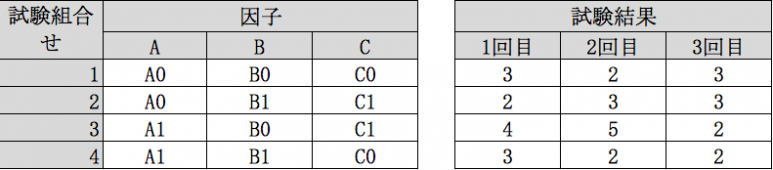
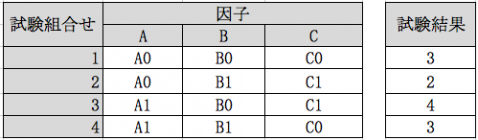
We will use an orthogonal table of 2 levels 3 factors as below and take the results once (4 in total) for 4 test times (4 patterns).
パターンに対して単一の結果

With this list of test counts in order, rearrange the test order and test results of each factor as follows.
As you can see from the table, we just assigned the test results to the factor test order.
パターンに対して単一の結果 並び替えを行い因子水準に割り当てる

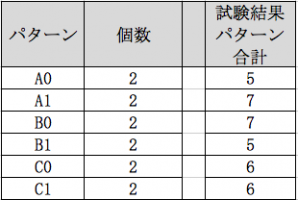
After that, we will issue total test results at the level of each factor.
Also we will count the number of factors that each level of factor has come up in the test.
Because of the test combination of the orthogonal table, the number of items appearing in the test of the level of each factor differs depending on the table.
パターンに対して単一の結果 直交表に出てきた水準因子をまとめる

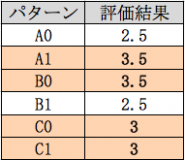
We take an average and estimate the level value of each factor.
Since we want to find the maximum combination here, the highest combination of levels of each factor of the largest numerical value becomes.
(If you want to obtain the minimum, the combination with the smallest level of each factor is the combination with the smallest level.)
パターンに対して単一の結果4 平均より割り出し

The maximum combination here is “A1, B0, C0” or “A1, B0, C1”.
Even if you use a different orthogonal table it is possible to do the same.

· When the test result is multiple (n times)

I will explain the case where multiple results are output for the number of tests (when multiple measurements are taken).
As I mentioned earlier, since there are errors in practice, the number of tests will be reduced by the experimental design method, but the test results will be more accurate if you do multiple tests a few times.

We use three factor 2 level orthogonal table as below and take 3 results (total of 12) for 4 test times (4 patterns).
It is the same as halfway “When the test result is single (once)”.
パターンに対して複数の結果1

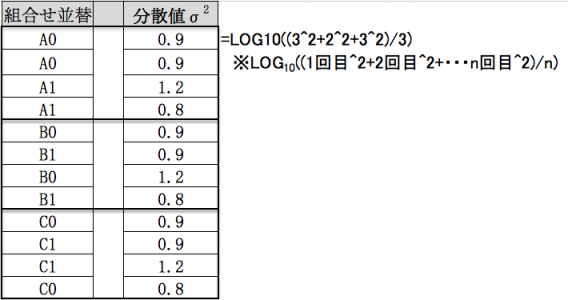
With this list of tests in order, distribute the test order of each factor and three test results and rearrange them as follows.
As I mentioned earlier, we will give the expectation of sample variance from test results.
Dispersion (σ 2) = (first test result ^ 2 + … + n th test result ^ 2) / n

Here we are logarithm using LOG.
When using Excel, try using the function “LOG 10”.
In sorting you can see by looking at the table, but the dispersed test results are only repeating for each factor.
パターンに対して複数の結果2 並び替えを行い因子水準に割り当てる

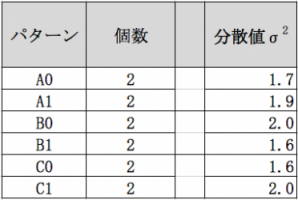
After that, we will make a total variance at the level of each factor.
Also we will count the number of factors that each level of factor has come up in the test.
パターンに対して複数の結果3 直交表に出てきた水準因子をまとめる

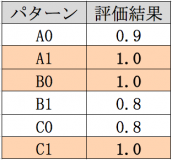
We take an average and estimate the level value of each factor.
Since we want to find the maximum combination here, the highest combination of levels of each factor of the largest numerical value becomes.
(If you want to obtain the minimum, the combination with the smallest level of each factor is the combination with the smallest level.)
パターンに対して複数の結果4 分散より割り出し

The maximum combination here is “A1, B0, C1”.
Likewise, even if you use a different orthogonal table, you can do it in the same way.

The largest combination can be easily estimated with Excel

Points to note in testing

Although it is not limited to this, attention is required for measurement in the test.
It is to make sure that data is not going wrong due to bias of conditions. For example, in the case of experiments such as those measured by humans, elements other than logical, such as preconceptions and memorization of previous data values, may be included. By doing it in random order, you can reduce those factors.

1. Measure several times

Measure several times to suppress variations in measured values. However, it can be omitted if the result does not vary.

2. Constant content other than factors

In order to limit to only the factors that become the condition, the external factor must be constant at all times.

3. Do in a random order

It is necessary to do it in random order to eliminate accustomment and prejudice to the examination.

Although the number of tests can be reduced, efforts to minimize external factors other than factors / levels are required


Experiment planning method in the field of economics (conjoint analysis)

The factor is called an item, and the level is called a category. Basically, with the same idea, I figure out what kind of element (the category in the item) is the strongest.

Since the way of thinking is the same as the explanation explained, we omit it.
Although it is not an exam as it was explained so far, it will be a method of making judgment using the data you have.
Up until now, the goal was to reduce the number of experiments.
For conjoint analysis, it is used to see how much the factor (the element here) is related as explained in Excel.

It is used in various fields other than economics. The name is variously different. . .
In addition to reducing the number of experiments, we often use it to see relationships like conjoint analysis.

· Analysis of factors and causes (confirmation of relevance of elements)
· Test for product defect check

It is used for element judgment and result judgment stochastically in various fields.

The experiment design method is performed when the relation of the element is not known. For that reason, we do experiments with content that understands relevance, which makes it much more troublesome. (I think that it is good in terms of confirmation) I think that there is a part that the expert in that field “knows somehow” that the relevance is related and it is said that it is said to be an experience · kang etc I will. Let’s use it for various things.

For those who want to learn more, this book is helpful.

Partial addition 2017/03/30

Categories
Software description

全国水利台帳 概要・操作説明

全国水利台帳について

全国水利台帳は、火災現場に迅速に対応でき地域防災の強化に役に立つようにつくりました。消防団、消防職員、地域防災や自主防災、防災に興味がある方に使用していただきたいと思います。

以下がアプリの取得場所になります。

Google Play で手に入れよう 全国水利台帳Lite
Google Play で手に入れよう 全国水利台帳

Google Play:全国水利台帳Lite(無料版)、全国水利台帳(有料版)

AppStore ダウンロード 全国水利台帳Lite
AppStore ダウンロード 全国水利台帳

App store:全国水利台帳Lite(無料版)、全国水利台帳(有料版)

・開発経緯として
実際に火災現場に立ち会ったことのない人はわかりにくいかもしれませんが、火災現場では一刻一秒を争います。火事に合われている家、近隣住民等はすぐに消してほしいですし、どうしていいかわからない状況になっています。すぐに来てほしい消防士の方々も常にたくさん消防署に常駐しているわけではありません。連絡しても場所が離れていれば到着まで時間がかかります。また、消防車もそれだけで放水する時間が限られています。消火するための水を確保するためにもたくさんの人数が必要になります。どこで水を確保するかも知っている必要があります。(ホースを伸ばして離れた場所からポンプでくみ上げる必要があるため)
そこで、地域防災がとても重要になります。(火災に限ったことではありませんが)

ですが近年、地域防災力がとても落ちてきています
理由としては以下があげられます。
常に市町村等の経費削減案で出てくる内容が災害対策費
(災害対策というのは起きなければ無用な出費のため)
地域防災に協力する人が少ない
(近年少子高齢化、地域交流の低下)

全国水利台帳は全国の水利を表示できるようにしました。また、火災現場に近い水利をだれでも瞬時に分かるようにし、水利データがない場合でも水利データを追加できるようにしました。
地域防災力を少しでも改善できればうれしい限りです。

全国水利台帳 情報

ここでは全国水利台帳の情報として全国水利台帳が使用しているオープンデータ等の登録箇所情報およびメディアニュース情報を掲載します。全て掲載できておりませんが、ご了承ください。

ベースデータ登録箇所

ベースデータとして登録されている箇所は消火栓、防火水槽、防災施設等のデータを見ることができます。
そのデータを基にして変更等が可能です。これ以外でも個人で入力していただいている地域がたくさんあります。表示されていない場所はアプリ上で新規で入力することができます。
・北海道 室蘭市
・岩手県 滝沢市
・秋田県 横手市
・福島県 会津若松市
・茨城県 笠間市
・埼玉県 さいたま市
・埼玉県 本庄市児玉
・東京都 豊島区
・神奈川県 厚木市
・神奈川県 川崎市
・神奈川県 鎌倉市
・神奈川県 相模原市
・神奈川県 綾瀬市
・千葉県 袖ヶ浦市
・静岡県 三島市
・静岡県 裾野市
・静岡県 御前崎市
・静岡県 袋井市
・静岡県 清水町
・静岡県 菊川市
・静岡県 磐田市
・愛知県 豊川市
・長野県 駒ヶ根市
・新潟県 糸魚川市
・新潟県 十日町市
・新潟県 三条市
・新潟県 見附市
・福井県 鯖江市
・福井県 敦賀市、三方町、若狭町
・岐阜県 羽島市
・三重県 伊勢市
・三重県 度会町、玉城町
・奈良県 大和郡山市
・大阪府 大阪市
・大阪府 枚方市
・愛媛県 伊予市
・福岡県 北九州市
・熊本県 菊池市

上記、情報公開および対応させていただきました各消防団、消防組合、市町村担当者様ありがとうございます。
また、ベースデータとして使用している著作データのクレジットはアプリに掲載しております。
ベースデータとして登録したい地域・地区の一覧情報(消火栓、防火水槽、防災設備・施設)がありましたら、こちらより連絡をお願いします。
現在ベースデータの他にも各自主防災組織、消防団で入力していただいております。ありがとうございます。
現在全国で総数25万件以上のデータが反映されています。
このアプリを有効利用していただけたら幸いです。

メディアニュース

大阪市オープンデータポータルサイト
袋井市ホームページ 便利なアプリ一覧
裾野市のオープンデータへの取り組み マッシュアップアプリ
室蘭市オープンデータ利用例のご紹介
Data for citizen 会津アプリマーケット
磐田市ホームページ オープンデータを活用しているアプリ
伊勢市オープンデータの利活用事例の紹介
鎌倉市オープンデータ活用事例
政府CIOポータル「オープンデータ100」
上記にて掲載・紹介させていただいています。対応していただいた方々ありがとうございます。
他にも多々展開していただいてる方々もおりますが全てを紹介できなくて申し訳ありません。

全国水利台帳 概要

全国各地の防災用の水利(災害対応用水場)を検索できます。(防火水槽、消火栓、自然水利)また、防災設備も表示します。
水利が登録されていない箇所では、サイトメンバー登録により水利の登録・修正・削除を可能にしました。

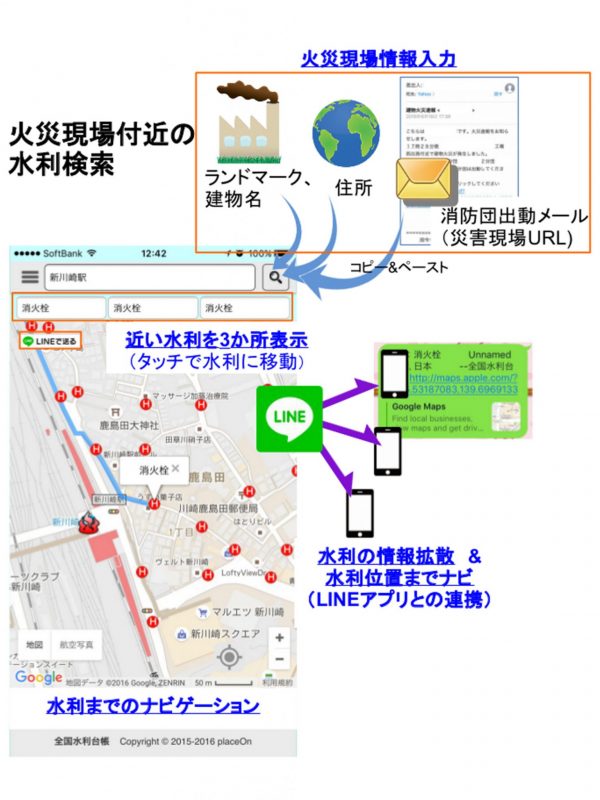
概要図

水利検索概要

水利検索画面の概要図

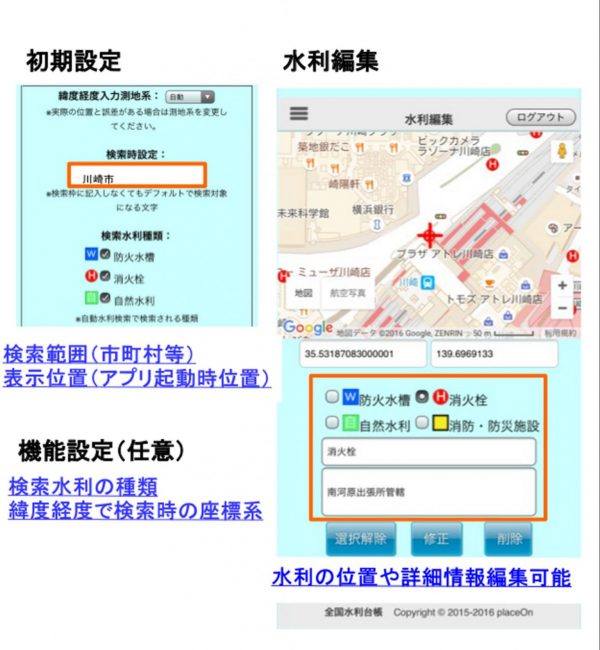
水利初期設定概要

水利設定画面及び編集画面の概要図

消防団、消防職員、自主防災の方々に実際に災害が起こった際にすぐに場所の把握等の対応できるように使っていただけたら幸いです。みんなが作り、みんなが使う水利台帳です。
各機能は以下になります。

水利表示

・地図表示位置の水利の自動表示
・水利の名前、詳細情報表示
・防災施設、防災設備情報の表示
・GPSによる現在位置表示
・GPSによる現在位置の追跡(現在位置ボタンON/OFF)
・地図上のラベルの表示切替(デフォルト非表示)

水利検索

・災害地点から距離の近い順に最大3箇所の水利を検索(半径2km以内)
・地図表示の災害地点への自動移動
・ランドマーク、住所から災害地点の表示対応
・緯度経度の記載されているURLから災害地点の表示対応
・スラッシュ「/」で区切った度分秒の緯度経度(60進法)、緯度経度(10進法)から災害地点の表示対応
・世界測地法、日本測地法の切り替え可能
・防火水槽、消火栓、自然水利の検索分け可能
・デフォルト地図表示位置変更可能
・デフォルト検索文字による
・検索水利の位置情報拡散(LINEアプリと連携)
・検索水利への簡易ナビゲーション
・地図上を長押しで災害地点の設定可能
・災害地点付近の推定風向きと推定風力を表示

水利登録

・サイトメンバーによる水利登録、修正、削除機能
・サイトメンバーによる防災施設、防災設備の登録、修正、削除機能
・水利の名前、詳細情報記載可能
・登録、修正者の名前表示
・登録、修正水利の種類分け(色わけ)

マップコメント登録、表示(有料版のみ)

・マップ上へ表示時間指定のコメント登録、修正、削除機能
・マップコメント自動表示

そのほかの有料版の機能

・全ての画面に広告表示なし
・水利登録、編集、削除時間の短縮(インターバル:登録・修正15秒、削除5分)
・水利表示数の拡大(表示最大75個)
・動作レスポンスの向上

利用において
ナビゲーションおよび現在位置の追跡機能はGPS対応モバイルのみ有効になります。ナビゲーションは必ずしも正しいとは限りません。自己責任として把握していただき、参考として使用してください。
本アプリは理由を問わず、本サービスまたは利用者による本サービスへのアクセスを予告無く、また利用者に対しいかなる責任を負うことなく、随時変更または終了する権利を留保します。利用者が本アプリおよび本アプリのデータ、本サービスを使用してなんらかの不都合が生じた場合でもplaceOnは責任を負いません。
また、不定期に25時〜26時の間でバックアップ・メンテナンスを行います。その時間帯に水利編集をしても反映されない可能性がありますので注意してください。


全国水利台帳 操作説明

1.画面ボタン名称と役割

1-1.水利検索画面(メイン画面)

この画面では以下の内容を行なえます。
水利検索画面は災害現場から近い水利を検索
地図上の水利の表示(表示されない場合は、その水利の登録がされていません)

※以下の画面は全国水利台帳(有料版)になります。

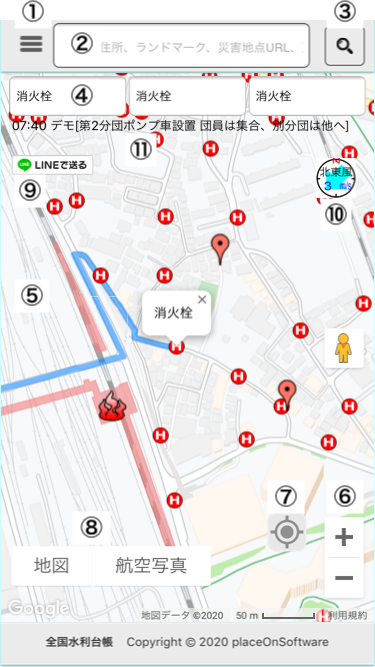
水利検索画面
メニュー

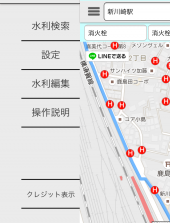
①メニューボタン
ボタン押下でメニューがスライド表示します。

水利検索、設定、水利編集、操作説明、クレジット表示に飛ぶことができます。
メニュー画面外を押すことにより、メニューが閉じます。

②検索記入欄
災害現場の情報を入力します。この災害現場から近い場所の水利を検索します。コピー&ペーストでも入力できます。入力形式は以下になります。
・緯度経度(小数:10進数)
・緯度経度(度分秒:60進数)
・緯度経度が含まれるURL(60進数)
・住所
・ランドマーク(建物名称)

地図上の災害現場のマーク

緯度経度(小数:10進数)
小数点で表された緯度経度です。入力は「緯度(小数点含む)」「,」「経度(小数点含む)」の形式で入力します。
入力例として東京タワーの場合(緯度:35.658581 経度:39.745433)
入力値:「35.658581,139.745433

緯度経度(度分秒:60進数)
度分秒(°′″)で表された緯度経度です。入力は「緯度の度」「/」「分」「/」「秒」「,」「緯度の度」「/」「分」「/」「秒」の形式で入力します。
入力例として東京タワーの場合(緯度: 35度39分30.89秒 経度: 139度44分43.558秒)
入力値「35/39/30.89,139/44/43.558

緯度経度が含まれるURL(60進数)
URL内に緯度経度が度分秒で含まれている
入力形式「***&nl=”/で繋がった緯度60進数”&el=”/で繋がった経度60進数”&scl=”縮尺”」
入力例として東京タワーの場合
入力例:
http://*******/&nl=35/39/30.89&el=139/44/43.558&scl=25000
http://*******/?scl=25000&nl=35/39/30.89&el=139/44/43.558
※mapion系のURL
http://*******/&lat=%2b035.39.30.89&lon=%2b139.44.43.56
※navitime系のURL
http://******&lon=+139.44.43.56&lat=+035.39.30.89
***は任意です。
※その他対応してほしいURL等がありましたら、こちらからお問い合わせください。

住所
住所は「都道府県」「市町村」「地区」「番地」で入力可能です。
入力例として東京タワーの場合
入力例:「東京都港区芝公園4丁目2−8

デフォルト検索文字記入時
例:デフォルト検索文字「東京都」、
入力値「港区芝公園4丁目2−8」→「東京都 港区芝公園4丁目2−8 」

ランドマーク(建物名称)
google mapが対応しているランドマーク(建物名称)で入力可能です。
ただし、ランドマーク検索開始時の画面中心から半径20kmのランドマークの名称で一番近いものを検索します。
入力例として東京タワーの場合
入力例:「東京タワー

③検索開始ボタン
「②検索記入欄」に災害現場情報を入力後、ボタン押下で災害現場の表示および近い水利表示をします。

④検索結果表示欄
1-2-1「⑤検索水利種類」に対応します。
※選択された種類の水利のみ検索結果として表示されます。
「③検索開始ボタン」を押下後、災害現場より最も近い水利の名称を表示します。(最大3か所)
表示された後、表示欄を押下することでその水利の場所に移動します。
GPSの搭載のモバイルでは現在位置からの押下した水利までの道順(ナビゲーション)が表示されます。
再度、現在位置から水利までの道順を表示したい場合はもう一度表示欄を押下してください。

⑤google map内操作
・画面移動
・拡大縮小(ピンチ操作)
・ストリートビュー
(画面右上の人のアイコンをドラッグして見たい場所においてください)
・地図上を長押しで災害地点の設定および水利検索
(地図上をロングタッチ「3秒」すると災害地点が設定され、水利が検索されます。スワイプ動作が入るとロングタッチがキャンセルされます。再度設定したい災害地点を長押しし直してください。)
*メニュー「水利検索」を押すと表示がリセットされます。

⑥地図の拡大縮小
+:地図拡大
−:地図縮小
動作は⑤の拡大縮小(ピンチ操作)と同じです。

⑦現在位置追従ボタン
ボタンを押すことにより現在位置を追従するように画面が自動で移動します。
以下の状態は現在位置追従機能はOFFの状態です。ボタンを押下で機能をONにできます。

以下の状態は現在位置追従機能がONです。ONの状態でもう一度ボタンを押下でOFFになります。
現在位置追従機能がONの状態でも検索結果表示欄(④)を押した時は機能がOFFになります。

現在地の表示は以下のようなアイコンになります。
青い丸いアイコンにリング状に波紋が広がる動きのあるアイコンです。

現在位置追従機能2
現在位置追従ボタン
現在地表示

⑧地図表示切り替えボタン
地図:ロードマップ(デフォルト)
航空写真:空からの写真+ロードマップ
通常、地図の状態で表示されます。地図の地形にチェックを入れると標高に応じて表示が変化します。
航空写真のラベルのチェックを外すと空からの写真のみの表示になります。
アプリを使う機器により、航空写真にすると動作が遅くなります。
デフォルトで地図上のラベルが非表示になります。(水利アイコンは表示)
地図切替ボタンの「地図」または「航空写真」を押すと地図上のラベルが表示されます。

⑨LINE転送ボタン
LINEに選択水利情報及び地図情報を送ります。

検索結果表示欄(④)の水利表示を押さないと、このボタンは表示されません。
ボタン押下で選択した水利情報及び地図情報がLINEアプリに送られます。LINEアプリが入っていない機器では動作しません。
ボタン押下でLINEアプリが自動起動します。

情報を送る相手もしくはトークを選択してください。
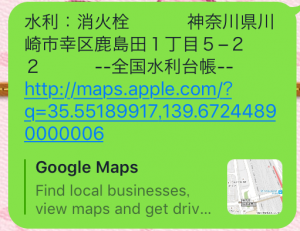
LINEで送る情報は
・水利名称
・水利住所
・GoogleMap地図情報
になります。GoogleMap地図情報URLを押すことでGoogleMapの地図及びナビゲーションを使用することができます。

ラインに送る
アイコン
LINE表示

⑩推定風向きと推定風力表示
災害地点付近の推定風向きと推定風力を表示します。

表示アイコンの矢印が風向き方向表示。
表示アイコンの上半分の文字が風向きの読み。
表示アイコンの下半分の文字は風力。
例:この表示の場合、「風向き:北西の風」「風力:5m/s」
*地形や建物等により風向き風力は変わります。参考程度に使用してくだい。

推定風向きと推定風力表示

⑪マップコメント自動表示(有料版のみ)
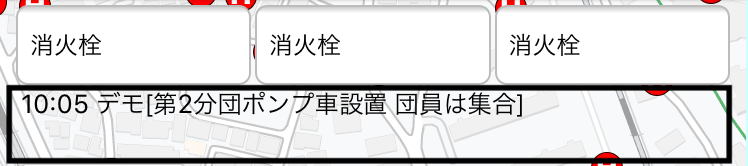
現在表示の中心より2kmの範囲のコメントを近い順に最大10件自動スティッカー表示。
コメント掲示時間、コメント記載者名、[コメント]が表示されます。
2秒毎に表示が切り替わります。
また、マップ内のピンで表示され、色は4種類表示されます。タッチすることで詳細が表示されます。

10件までコメント自動表示 検索結果下のスペース

マップ内のコメント表示のピン

1-2.設定画面

この画面では以下の内容を行なえます
水利検索画面の表示設定
水利検索画面の検索設定

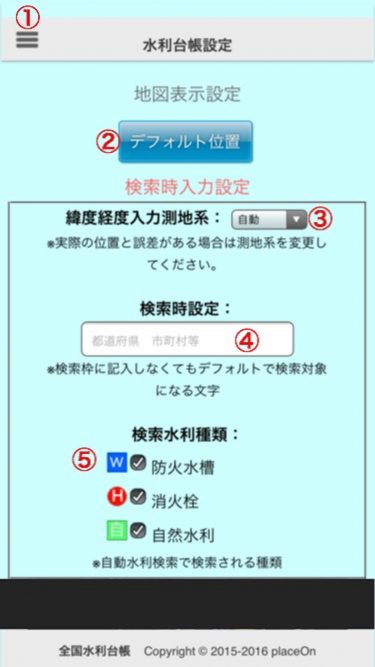
1-2-1.設定画面

全国水利台帳2

①メニューボタン

②デフォルト位置設定ボタン
水利検索画面の通常の表示位置を設定します。
アプリを開いた際の水利検索画面の表示位置になります。詳細は次項の「デフォルト位置設定画面」を確認してください。

③マップ上コメント掲示ボタン(有料版のみ)
「1-1.水利検索画面」の「11マップコメント自動表示」および画面内に登録されているコメントを表示します。

④緯度経度入力測地系選択ボタン
「1-1.水利検索画面」の「②検索記入欄」に入力した緯度経度の測地系の変更をします。
google map等の海外の緯度経度表示は「世界測地」。
カーナビ等の国内の緯度経度表示は「日本測地」。
※測地系が違うと数十~数百m単位で表示位置が違ってきます。表示位置が違うと判断した場合、測地系を変更してみてください。

⑤デフォルト検索文字欄
「1-1.水利検索画面」の「②検索記入欄」に入力した文字に自動で加える文字になります。
都道府県、市町村等の検索範囲を指定すると使いやすいです。

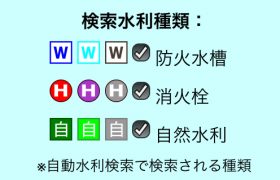
⑥検索水利種類選択ボタン
検索時、選択された水利の種類のみ表示します。

水利の種類は各3類で3つの色(3種類)のアイコンが表示されます。
※選択された種類の水利のみ検索結果として表示されます。

1-2-2.デフォルト位置設定画面
①メニューボタン

②緯度経度表示
現在表示している地図の中心座標の緯度、経度を表示します。
表示されている緯度、経度は世界測地系です。

③縮尺レベル表示
現在の縮尺の度合いを数値で表します。

④設定完了ボタン
設定完了ボタン押下時の現在表示されている中心座標および縮尺レベルを設定します。
この位置が、アプリを開いた際の水利検索画面の表示位置の中心座標および縮尺レベルになります。

⑤google map内操作
水利検索画面の「⑤google map内操作」と同じです。

1-3.水利編集画面

この画面では以下の内容を行なえます
メンバー登録
水利データの新規追加
水利データの修正および削除
※水利データとは水利検索画面に表示、水利検索字に使用するデータです。

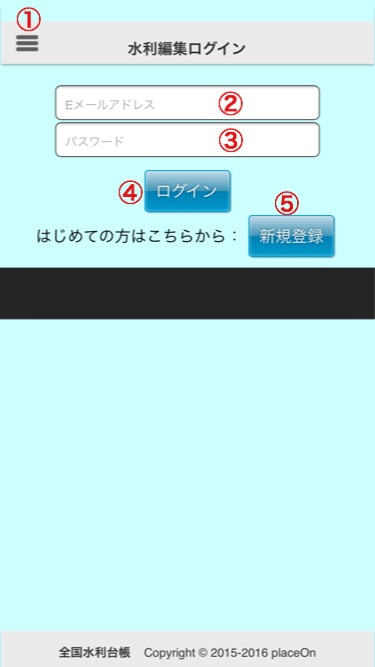
1-3-1.ログイン画面

全国水利台帳3

①メニューボタン

②Emailアドレス記入欄
メンバー登録完了後、登録したEmailアドレスを記入します。

③パスワード記入欄
メンバー登録完了後、登録したパスワードを記入します。

④ログインボタン
Emailアドレス、パスワードを記入後にログインボタンを押下することにより水利編集画面に移行します。
一度ログインすると自動ログインします。
自動ログイン状態は「ログアウトを押す」または、「水利編集画面を抜けて24時間以上」することで解除されます。
ログアウト後は、もう一度ログインをお願いします。

⑤新規登録画面移行ボタン
初めて水利編集を使用する際、メンバー登録をしたい際にボタンを押下します。
新規登録画面に移行します。

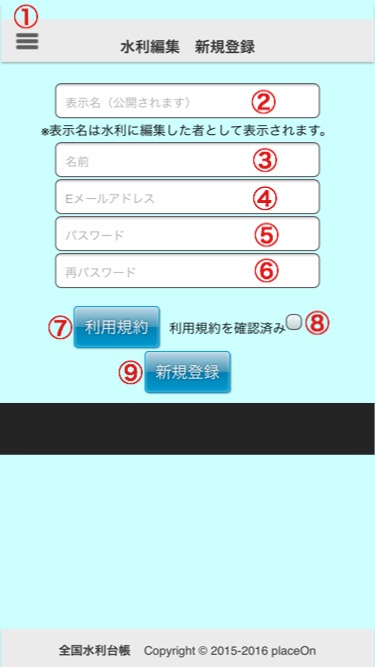
1-3-2.新規登録画面

全国水利台帳4

①メニューボタン

②表示名記入欄
水利データ登録・修正時に表示される表示名になります。
※こちらに記入した名は一般に表示されます。

③名前記入欄
こちらは本名を記入してください。
パスワードを忘れた際等に使用します。
※こちらに記入した名は表示されることはありません。

④Emailアドレス記入欄
メールが受け取れるEmailアドレスを記入してください。
新規登録ボタン押した後、仮登録のメールが届きます。
仮登録のメールが届いた後はメールから本登録をしてください。
※URLつきメールの着信拒否している場合、メールが届かない可能性があります。
「@mb.cloud.nifty.com」からのメールの着信を受け付けれるようにしてください。

⑤パスワード記入欄
ログイン時のパスワードを登録します。
※ほかのサイトとは別の独自のパスワードを設定してください。

⑥再パスワード記入欄
「④パスワード記入欄」と同じパスワードをもう一度記入してください。

⑦利用規約ボタン
ボタン押下で利用規約が表示されます。
利用前に必ず利用規約を確認してください。
規約表示後、規約コピーボタンが表示します。
規約コピーボタン押下で利用規約をコピーします。
利用規約を残したい場合は、メモ帳等にペーストしてください。

⑧利用規約チェック欄
利用前に必ず利用規約を確認後チェックをいれてください。

⑨新規登録ボタン
①②③④⑤記入および⑦チェック後、ボタン押下で仮登録をします。
仮登録メールがEmailアドレスに送られます。
※すでに登録してあるEmailアドレスは重複して利用できません。

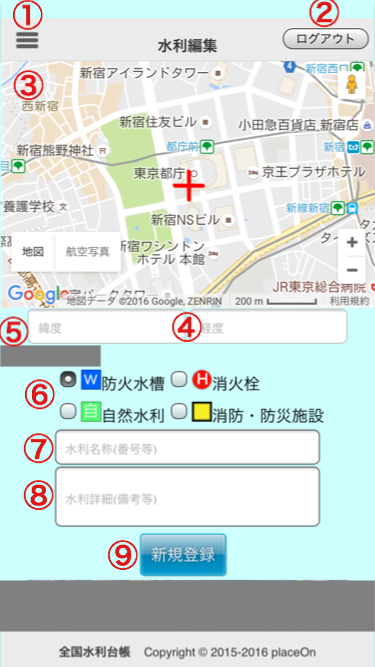
1-3-3.水利編集画面

全国水利台帳 水利編集


①メニューボタン

②ログアウトボタン
ボタン押下でログアウトします。
ログアウトをすると自動ログインは解除されます。

③google map内操作
赤の十字は画面中心の位置になります。
登録、修正の位置がこの十字の位置の場所になります。
その他の操作は1-1.「⑤google map内操作」を確認してください。

④緯度経度表示
赤の十字(画面中心)の緯度経度を表示します。
新規登録ボタン押下時には新規登録水利の緯度経度、修正ボタン押下時には修正後水利の緯度経度の位置になります。
表示されている緯度、経度は世界測地系です。

⑤編集者名表示(表示名)
登録をした表示名が表示されます。

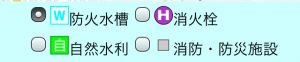
⑥水利種類選択
新規登録・修正の際に登録したい種類を選択します。
水利選択時(修正時)登録されている種類に一度切り替わります。
選択できる種類は以下になります。
・防火水槽
・消火栓
・自然水利(海水、泥・ゴミ等によりポンプ車に負担が掛かる水利)
・防災施設・設備
このうち水利検索で検索されるのは「防火水槽」「消火栓」「自然水利」になります。

文字の部分をタッチすることでアイコンの色が変わります。
アイコンの色は各3種類です。
登録・修正時にその色で地図上に登録されます。

水利の種類と選択

⑦水利名称(水利名、防災施設・設備名)
「1-1.水利検索画面」の「④検索結果表示欄」に表示される水利の名前になります。
水利番号等を記入してください。記入が無い場合登録できません。最大文字数20文字になります。

⑧水利詳細(水利の詳細、防災施設・設備の詳細)
水利のアイコンを押した際に表示される水利の詳細になります。
特殊な水利の説明や形状、注意点等を記入してください。最大文字数50文字になります。

以下、水利未選択時(新規登録時)に表示されます。

⑨新規登録ボタン
ボタン押下で赤の十字(画面中心)に⑥⑦⑧で入力した水利データを登録します。
登録完了後に「登録OK」の表示があわられます。表示が出るまで連続で新規登録ボタンを連続で押さないでください。
※通信状態により、表示まで少し時間がかかる場合があります。
次に登録できるまでのインターバルは5分になります(有料版は15秒)

新規で登録した水利データを修正したい場合は画面を更新した後(画面移行または水利アイコン再表示)となります。
それまで、水利名に「(仮)」が追加表示されます。水利名に「(仮)」は選択しても修正はできません。
※画面移行、水利アイコン再表示後には水利名の「(仮)」は無くなります。
連続で登録する場合には1分以上、間をあけてください。

以下、水利選択時(修正時)に表示されます。

修正ボタン

⑩選択解除ボタン
ボタンが表示されている間は選択された水利データの修正になります。
ボタンを押下することにより水利データの選択を解除します。

⑪修正ボタン
ボタンが表示されている間は選択された水利データの修正になります。
修正完了後に「修正OK」の表示があわられます。表示が出るまで連続で修正ボタンを連続で押さないでください。
※通信状態により、表示まで少し時間がかかる場合があります。
次に修正できるまでのインターバルは5分になります(有料版は15秒)

ボタン押下で選択した水利データを赤の十字(画面中心)の位置に⑥⑦⑧の内容で再登録します。
※修正というのは前のデータを消して、新しいデータを上書きする操作になります。

⑫削除ボタン
ボタンが表示されている間は選択された水利データの修正になります。
ボタン押下で選択した水利データを削除(消します)。
※修正というのは前のデータを消して、新しいデータを上書きする操作になります。

次に削除できるまでのインターバルは60分になります(有料版は5分)

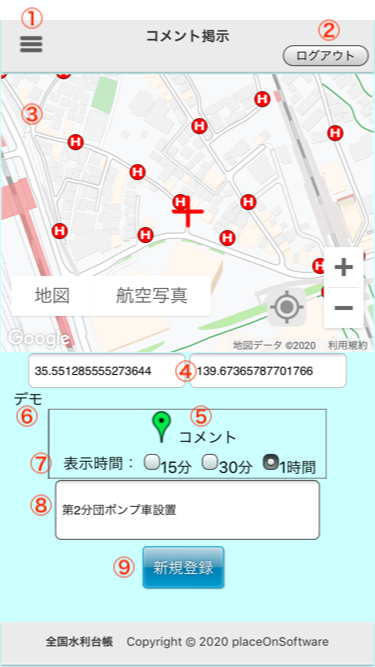
1-3-4.コメント掲示画面(有料版のみ)


①メニューボタン

②ログアウトボタン
ボタン押下でログアウトします。
ログアウトをすると自動ログインは解除されます。

③google map内操作
赤の十字は画面中心の位置になります。
登録、修正の位置がこの十字の位置の場所になります。
その他の操作は1-1.「⑤google map内操作」を確認してください。

④緯度経度表示
赤の十字(画面中心)の緯度経度を表示します。
新規登録ボタン押下時には新規登録水利の緯度経度、修正ボタン押下時には修正後水利の緯度経度の位置になります。
表示されている緯度、経度は世界測地系です。

⑤編集者名表示(表示名)
登録をした表示名が表示されます。

ピン色選択
新規登録・修正の際に登録したいピン色を選択します。
文字の部分をタッチすることでアイコンの色が変わります。
アイコンの色は4種類です。
登録・修正時にその色で地図上に登録されます。

表示時間選択
新規登録・修正後にマップ上に表示される時間を選択します。
登録または修正した時から選択した時間が経過するとコメントは自動で削除されます。

登録コメント欄
新規登録・修正でマップ上のピンアイコンを押した際に表示されるコメントになります。
「1-1.水利検索画面」の「⑪マップコメント自動表示」に自動スティッカー表示で記載されるコメントになります。
また、特殊な水利の説明や形状、注意点等を記入してください。最大文字数50文字になります。

以下、ピンアイコン(コメント)未選択時(新規登録時)に表示されます。

⑨新規登録ボタン
ボタン押下で赤の十字(画面中心)に⑥⑦⑧で入力したコメントデータを登録します。
登録完了後に「登録OK」の表示があわられます。表示が出るまで連続で新規登録ボタンを連続で押さないでください。
※通信状態により、表示まで少し時間がかかる場合があります。
次に登録できるまでのインターバルは15秒になります。

新規で登録した水利データを修正したい場合は画面を更新した後(画面移行またはピンアイコン再表示)となります。

※画面移行、水利アイコン再表示後には水利名の「(仮)」は無くなります。

以下、水利選択時(修正時)に表示されます。

修正ボタン

⑩選択解除ボタン
ボタンが表示されている間は選択されたコメントデータの修正になります。
ボタンを押下することにより水利データの選択を解除します。

修正ボタン
ボタンが表示されている間は選択されたコメントデータの修正になります。
修正完了後に「修正OK」の表示があわられます。表示が出るまで連続で修正ボタンを連続で押さないでください。
※通信状態により、表示まで少し時間がかかる場合があります。
次に修正できるまでのインターバルは15秒になります。

ボタン押下で選択した水利データを赤の十字(画面中心)の位置に⑥⑦⑧の内容で再登録します。
※修正というのは前のデータを消して、新しいデータを上書きする操作になります。

⑫削除ボタン
ボタンが表示されている間は選択されたコメントデータの修正になります。
ボタン押下で選択したコメントデータを削除(消します)。
※修正というのは前のデータを消して、新しいデータを上書きする操作になります。

次に削除できるまでのインターバルは5分になります。

2.水利検索時操作

ここでは水利検索する際の操作を説明します。

2-1.初期設定(初回、変更したい時)

①メニューから設定画面を開きます。

②デフォルト検索文字欄に通常検索したい都道府県、市町村等を入力します。
※入力は任意です。入力はこの限りでなく、検索時に入力文字を省略したい文字を記入します。
詳細は1-2-1「④デフォルト検索文字欄」を確認してください。

③水利種類選択で検索したい水利の種類を選択します。選択できる種類は以下になります。
・防火水槽
・消火栓
・自然水利(海水、泥・ゴミ等によりポンプ車に負担が掛かる水利)
・防災施設・設備
このうち水利検索で検索されるのは「防火水槽」「消火栓」「自然水利」になります。
※詳細は1-2-1「⑤検索水利種類選択ボタン」を確認してください。

④デフォルト位置設定ボタンからデフォルト位置設定画面を開きます。

⑤マップを操作して、通常表示させたい位置・縮尺を設定します。
※詳細は1-1.「⑤google map内操作」を確認してください。

⑥メニューから水利検索画面を開きます。

※基本は初回のみの変更ですが、変更したい場合はその都度変更してください。

2-2.検索操作

①災害現場情報を検索記入欄に入力します。
ここでの災害現場情報とは以下を指します。
・災害現場の緯度経度
・災害現場および災害現場近辺のランドマーク(建物名)
・災害現場の住所
住所とランドマークを入力する場合は、デフォルト検索文字欄に入力した文字列(都道府県、市町村等)は入力を省略できます。

※入力が緯度経度の場合、1-2-1「③緯度経度入力測地系選択」により位置が変わります。
測地系選択により、表示位置が数十~数百m単位で表示位置が違ってきます。表示位置が違うと判断した場合、測地系を変更してみてください。

※入力文字が名称・住所の場合、1-2-1「④デフォルト検索文字欄」により検索文字が省略できます。
デフォルト検索文字記入欄に入力された文字は、この検索記入欄に入力しなくても検索文字として加えてくれます。

②入力後、検索ボタンを押します。

③災害現場に地図が移動し、近くの水利名が表示されます。
※ここで表示される水利名は水利種類選択で選択した水利種類になります。

④水利名を押します。その水利名の場所に地図が移動します。

3.水利編集時操作

ここでは水利データを編集する際の操作を説明します。

3-1.メンバー登録(初回のみ)

①メニューから水利編集を開きます。

②新規登録ボタンを押します。

③必要情報を記入します。
※詳細は「新規登録画面」を確認してください。

④利用規約を読んだ後、利用規約のチェックを入れて新規登録を押します。

⑤仮登録メールが記入したEmailアドレスに届きます。
メールの中のURLを押し、本登録を行なってください。
※届かない場合、URL付きメールを受け取れるようにするか、「@mb.cloud.nifty.com」のアドレスを受け取るようにしてください。

3-2.メンバーログイン

①メニューから水利編集を開きます。
※自動ログイン中はログイン画面を飛ばして、水利編集画面を開きます。

②登録したEmailアドレス、パスワードを入力します。

③入力後、ログインボタンを押します。
※一度ログインすると自動ログインします。
自動ログイン状態は「ログアウトを押す」または、「水利編集画面を抜けて24時間以上」することで解除されます。
ログアウト後は、もう一度ログインをお願いします。

3-3.水利編集操作

3-3-1.水利を新規登録したい場合
①水利を追加したい場所へ赤の十字(地図中心)を移動します。

②登録したい水利の種類を選択します。選択できる種類は以下になります。
・防火水槽
・消火栓
・自然水利(海水、泥・ゴミ等によりポンプ車に負担が掛かる水利)
・防災施設・設備
このうち水利検索で検索されるのは「防火水槽」「消火栓」「自然水利」になります。

③水利名称(水利名、防災施設・設備名)を入力します。

④任意で水利詳細(水利の詳細、防災施設・設備の詳細)を入力します。

⑤新規登録ボタンを押します。
※選択解除、修正、削除のボタンが表示されている場合は、選択解除のボタンを押して新規登録ボタンを表示させてください。
連続で登録できません。登録後1分経過後にもう一度行ってください。

※不定期に25時〜26時の間でバックアップ・メンテナンスを行います。その時間帯に水利編集をしても反映されない可能性がありますので注意してください。

3-3-2.水利を編集(修正)したい場合
①編集(修正、削除)したい水利のアイコンを押して選択する。
※選択するとその水利の情報が表示され、選択解除、修正、削除のボタンが表示されます。

②移動先に赤の十字(地図中心)を移動させます。

③修正したい水利の種類を選択します。

④修正したい水利名称(水利名、防災施設・設備名)に変更します。

⑤任意で修正したい水利詳細(水利の詳細、防災施設・設備の詳細)に変更します。

⑥修正ボタンを押します。
※新規登録のボタンが表示されている場合は、水利のアイコンが選択できていません。
再度、修正したい水利のアイコンを押して選択してください。
また、短時間連続で水利を修正はできません。登録後1分経過後にもう一度行ってください。

3-3-3.水利を編集(削除)したい場合
①編集(修正、削除)したい水利のアイコンを押して選択する。
※選択するとその水利の情報が表示され、選択解除、修正、削除のボタンが表示されます。

②削除ボタンを押して削除してください。
連続で削除できません。登録後20分経過後にもう一度行ってください。
・操作終了後、ログアウトもしくはメニューより画面を出てください。

※不定期に25時〜26時の間でバックアップ・メンテナンスを行います。その時間帯に水利編集をしても反映されない可能性がありますので注意してください。

4.トラブルシューティング

ここでは問題があった際の主な修正手順を説明します。

4-1.水利表示時

4-1-1.水利の表示がされない。
水利の登録がないため表示されません。水利編集画面より水利を追加してください。
地図移動時に水利の登録があれば定期的(数秒)に水利情報にアクセスするため、表示まで少しお待ちください。
水利表示は一度に最大100件までしか表示されません。表示させたい位置まで地図の中心を移動してください。

4-1-2.水利の表示がおかしくなる。
大量表示時タイミングにより稀に表示がおかしくなることがあります。
モバイルのメモリの状況によっても起こることがあります。
現在調査中ですが、起こった場合はメニューバーより「水利検索」を一度押していただくか、再度アプリを立ち上げ直してください。
状況判明・修正次第アップデートしたいと思います。お手数おかけしますが、よろしくお願いします。

4-2.水利検索時

4-2-1.表示位置が違う
「1-2-1.設定画面」の「③緯度経度入力測地系選択ボタン」で測地系の選択を変更してください。

4-2-2.水利の種類によっては検索されない
「1-2-1.設定画面」の「⑤検索水利種類選択ボタン」で検索水利の種類を確認してください。

4-3.水利編集時

4-3-1.仮登録のメールが届かない。
URLつきメールの着信拒否している場合、メールが届かない可能性があります。受け取れるようにメール設定を変更してください。
もしくは「@mb.cloud.nifty.com」からのメールの着信を受け付けれるようにしてください。

4-3-2.水利を連続で新規登録・修正・削除ができない。
連続で新規登録・修正・削除ができません。一定時間経過時間後にもう一度行ってください。

4-3-3.水利を変更したのに反映されない。
通信状態の良いところで操作してください。
また、不定期に25時〜26時の間でバックアップ・メンテナンスを行います。その時間帯に水利編集をしても反映されない可能性がありますので注意してください。

4-3-4.仮登録メールのURLから登録できない。
機種によりURLの「https://」が抜ける場合がありました。
改善をしましたが、機種により同様の問題の可能性があります。

もし「https://」のURLリンクが抜けていた場合(アンダーライン&色が変わっていない場合)リンク先のアドレスの先に「https://」をつけてください。

4-3-4.パソコンで水利登録ができない
現在、モバイル端末のアプリケーションのみでしか対応しておりません。お手数ですが、アプリケーションを使用して入力してください。
また、データがたくさんあり一括で入力したい場合は「お問い合わせ」より連絡をお願いします。

4-3-5.パスワード忘れて編集画面に入れない
パスワード忘れた場合は、以下より登録削除依頼をして下さい。
(登録したEメールアドレスを記載して送ってください)
約72時間後に自動で削除されますので、再度登録をおねがいします。
通常の登録削除はログイン後の画面より行ってください。
登録削除依頼メールはこちらへ

4-4.お問い合わせ

・アプリについての相談
・水利の一括登録の要望
・水利検索URLの追加対応
など、その他のご意見や要望など何かありましたらこちらからお問い合わせください

2016/10/30:全国水利台帳Ver1.10 内容更新
2016/11/20:全国水利台帳Ver1.11 内容更新
2017/02/27:全国水利台帳Ver1.16 内容更新
2017/03/06:コメント修正
2017/04/12:コメント修正
2017/07/29:コメント修正
2017/10/28:コメント修正
2018/02/12:コメント修正
2018/04/18:全国水利台帳Ver1.2.2 内容更新
2018/12/25:コメント修正
2018/12/28:全国水利台帳Ver1.3.0内容更新
2019/03/03:全国水利台帳Ver1.4.0内容更新
2020/05/11:全国水利台帳有料版内容記載
2023/05/17:コメント修正

Categories
Policy

全国水利台帳 プライバシーポリシー

1. プライバシーポリシーについて

対象

全国水利台帳」アプリケーション・プライバシーポリシー(以下「本ポリシー」といいます)は、placeOn(以下「当社」といいます)が提供する携帯端末(ただし、Apple Inc.が提供するOS「iOS」又はGoogle Inc.が提供するOS「Android」を利用できる携帯端末に限ります、以下「携帯端末」といいます)向けツールアプリケーション「全国水利台帳」(以下「本アプリ」といいます)における個人情報の取扱を定めたものです。

2. 個人情報の取得、利用目的

取得する情報の一覧

当社は、本アプリの提供にあたり、お客様から以下の情報を取得する場合があります。
メールアドレス
Facebook ID
Twitter ID
Google ID
生年月日
ユーザー名
パスワード
IPアドレス
GPS位置情報
本アプリの利用状況
本アプリの中で行われたコミュニケーション内容
お問い合わせの際にご提供いただいた情報

Facebook等の外部サービス(以下「外部サービス」といいます)との連携による本アプリへのアクセスを行った場合、上記情報に加えて、お客様から以下の情報を取得する場合があります。
外部サービスのお客様ID
氏名、性別
外部サービスで使用しているニックネーム、プロフィール画像
外部サービスに登録しているメールアドレス

利用目的

当社は、取得した情報を以下の目的で利用いたします。
本アプリのサービス提供
本アプリ利用状況の引き継ぎ
本アプリ利用者間のコミュニケーション
当社とお客様間のコミュニケーション
安心・安全なコミュニケーション環境の実現
本アプリの利用状況及び各種施策の実施結果の測定、調査、分析
マーケティング調査、アンケートの実施
本アプリの改善、不具合対応
当社が運営する各種サービス、プロモーション、キャンペーン、イベント等のご案内
広告表示及びその表示内容の最適化
利用規約違反行為の是正
お問い合わせ対応(本人確認を含みます)

3. 水利データの取り扱い

水利データの権利

本アプリで登録しました水利データは当社に帰属します。
そのため、水利データは当社が随時変更または終了する権利を有します。

水利データとは以下を指します。
防火水槽、消火栓、自然水利、消防・防災施設(以下「水利」といいます)の種別
水利の場所
水利の名称
水利の詳細情報

4. 通知・公表又は同意取得の方法、利用者関与の方法

通知・公表

本ポリシーは、メンバー登録時の画面からのリンク及び説明ページのほか、アプリストア(App Store、Google Playなど)の本アプリダウンロードページに設置されたプライバシーポリシーリンクに掲示・公表しております。当社は本ポリシーを変更することがあり、重要な変更を行う際は本アプリ内又は各掲示箇所において告知いたします。変更後の本ポリシーは、本アプリ内又は各掲示箇所に掲示された時点から適用されるものとします。

同意取得の方法

本アプリは利用規約及び本ポリシーをご確認いただき、同意の上でご利用ください。お客様が本アプリを利用すること(変更後の本ポリシーについては、変更後に本アプリの利用継続)を以て、本ポリシーに同意したものとみなされます。

情報の取得・送信の停止

本アプリを携帯端末より削除(アンインストール)することで、情報の取得及び送信を停止をすることができます。

5.政府機関、行政機関との関係性

オープンデータの利用

一部行政発行のオープンデータを利用しています。利用しているオープンデータ情報に関してはオープンデータのポリシーに準拠します。

本アプリとの関係性

本アプリは行政および行政サービス支援として一部の行政ホームページ等に掲載されていますが、本アプリが政府機関および行政機関を代表するものではありません。そのため、本サイト及び本アプリ外に関して責任については一切保証いたしかねます。

6. 開示等請求、お問い合わせ

開示、訂正、追加、削除、利用停止等の請求

当社は、お客様本人又はその代理人から当該お客様の個人情報の開示、訂正、削除、利用停止等の請求があった場合、法令に基づき可能な範囲で遅滞なく対応を行います。これらの請求に関しては、当社の「個人情報保護に関する基本方針」をご確認ください。

問い合わせ

本アプリにおける個人情報の取扱に関するお問い合わせ、ご相談、及び苦情は、その他の相談は当社のお問い合わせより行って下さい。

2016年10月1日 placeOn

Categories
Manufacturing terms

Variability and process capability

Variability and process capability

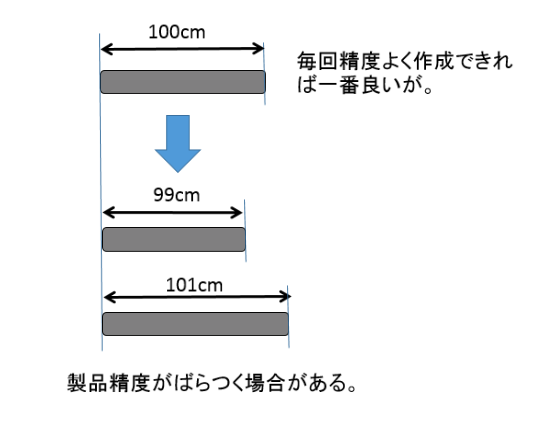
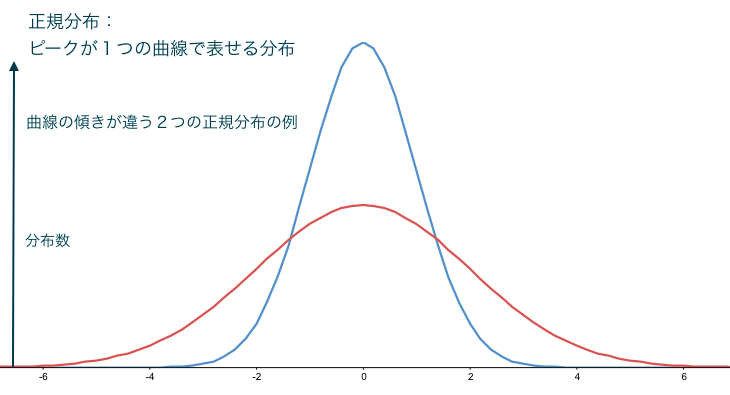
Manufacturing and process capabilities are inseparable edges. Although it may not have been heard, simply say, process capability is ability to express the probability of fitting within the product’s standards in making the product .
Based on the capability index, we will grasp the loss of products and determine the inspection frequency. This way of thinking is used and applied also in considering probability other than monozukuri. Before explaining that, I would like to talk about product standards for making products.

Please look at “Noise of intention in decision” and “bias of intention in decision” for variations and bias in business and decision.

What are product standards?

There are standards for product manufacturing. For example, assume that a 100 cm stick is a product. There is no problem if the products are all 100 cm, 99 cm or 101 cm etc will come out on making.
製品ばらつき
However, if the product can be released as a product, for example, 99 cm to 101 cm, the product can be put out to the world if it is 100 cm ± 1 cm. At this time “± 1 cm” is the standard. If it is 98 cm, it becomes a defective product and it becomes a manufacturing loss.
By stochastically obtaining variations (measured several products) for this standard, we can figure out the number of product losses and lead to quality assurance. We use a normal distribution to determine the number from the probability at this time.

The product standard is the acceptance range that allows products to be released to the world

Normal distribution and variation

What is a normal distribution?

The probability distribution that represents the distribution of data around the mean value is called a normal distribution.
Even other articles briefly explain, what is the normal distribution? I will briefly explain it for people.
Normal distribution is the distribution from average / center (variation). The distribution is used to explain probability theory and statistical theory that the degree of variation will converge to the form of a graph of normal distribution.
It is not a phenomenon of any kind but if there is no disturbance it will actually converge to the shape of that graph. For a relatively large number of process capabilities, we will decide that this variation will be distributed with probability along this normal distribution.
標準偏差の図

This figure is a graph of normal distribution, and the normal distribution can be represented by one curve with peaks. (The 0 on the X axis in the graph means the center.) In the figure, a normal distribution in which the slopes of the two curves are different is shown. Assuming that there is variation in shape along this normal distribution process capability to be described later will be issued.
I think I understood the distribution of how to vary. We will explain the standard deviation which is the standard value of variation method.

Shape of distribution in probability. The distribution of the nature world will converge to the shape of this graph if there is no disturbance.

What is the standard deviation?

When values ​​are distributed in the form of normal distribution, it is difficult to explain how much variation (how to tilt in the graph) exists. The criterion becomes the standard deviation. The standard deviation is scaled by σ, but this value also changes as the gradient of the graph changes, and the distribution between ± σ is 68.2% from the entire graph and distribution ratio Is fixed . Therefore, it is often used as reference value for variation .

標準偏差と正規分布の関係

Even if there are n variations (99 cm, 101 cm in the previous example), you can not grasp the position of the graph by simply adding, subtracting, or just breaking out the average. How do you ask for it?
Therefore, in order to judge to what extent it is away from the center value, subtract the value which deviates from the center value μ.
(μ – 99), (μ – 100), … n pieces

Even if it is added as it is, we only calculate the center value, we weight the way of spreading (spreading). Apply the same value (squared)

(μ – 99) ^ 2, (μ – 100) ^ 2, … n pieces

Add all the values ​​and divide by (n – 1). This is the average value of the weighting of spreading.

((- 99) ^ 2 + (μ – 100) 2 + … n pieces) / (n – 1)

We call this dispersion as σ ^ 2. But it does not match the graph unit so it will not be displayed on the graph. Square root to make it the unit of the x axis of the graph.

σ=√(σ^2)

This is called standard deviation. This is a value that will be a measure of the dispersion.
Next, we will use this value to see how many can fit within the standard or not.

The standard deviation is a position that is an index of the inclination of the graph

 
The way of thinking is statistical analysis. Please see this reference if you want to know more.
Process Capability Indices
 

Process capability index CP value, CPK value

Process capability index CP value

I think that I do not know how much it is sensuously with the value of variation (standard deviation). Considering this as the probability or the number falling within the standard, it is necessary to compare with a reference value. The value to be compared is “CP value” .

Usl: Standard upper limit value
Lsl: Standard lower limit value
σ: standard deviation

CP値の計算

Although the calculation is expressed like this, the meaning is “Cp = 1 and the center value μ ± 3σ is the same as the standard width”. The width of the same standard as ± 3σ has the probability of 27 defects out of 10000 (nonstandard) occur.

What is one-sided standard?

It is an index that considers only the upper limit side or the lower limit side from the center from the difference between the two side standards. Therefore, calculation is done with half of 3σ.

Usl: Standard upper limit value
Lsl: Standard lower limit value
μ: average value
σ: standard deviation

Upper limit one side standard
CP値(片側規格:上限)

Lower limit single side standard

CP値(片側規格:下限)

The idea of ​​the CP value is a value when the average is the same as the center of the standard, or when the center is not considered. Failure also occurs when the central value does not meet the standards. So we will talk about the center later “CPK value” will be the probability and number of taking into account the misalignment of the center. (The difference from the CP value is the difference in the center position)

“CP value” is a numerical value to be compared with a value serving as a guide

Process capability index CPK value

The way of thinking is the same, it is value taking into account the central deviation . Therefore, the one with the smaller value of one side standard becomes the CPK value.
CPK値

For each company or product, measure the quality of the product, determine the content of the quality inspection, and judge the loss of the product depending on whether the CP value or the CPK value is larger than the set value.

Consider also the deviation of the “CPK value”

As a way of thinking, it is summarized below.

· CP value and CPK value are large → the defect rate is small. It is difficult to become defective in manufacturing (out of specification).
· CP value and CPK value are small → the defect rate is large. It tends to be defective in manufacturing (out of specification).
· CP value, CPK value & gt; Setting value: There are large variations, there is no standard center and average value. The set value is too severe.
· CP value & gt; setting value, CPK value & lt; setting value: Variation is large, setting value is too severe.
· CP value & lt; Setting value, CPK value & gt; Setting value: Standard center and average value are not present. The set value is too severe.

You can judge to what extent the defective rate is by setting value. Next, I would like to explain the setting values ​​that will set the CP value and CPK value.

The CP value is a value to know to what extent it is within the specification range. The CPK value is a value which shows to what extent with respect to the standard range and the standardized center


Six Sigma and PPM

Before talking about setting values ​​that will set CP value and CPK value, we will briefly explain words related to Six Sigma (6σ) and PPM defects.
In the manufacturing industry, Six Sigma (6σ) or PPM is often used.

What is PPM?

parts · par · million (one part per million) is called and is often used at the defect rate. For example, in 3PPM defective rate, the failure rate is 3/1000000. In the manufacturing industry, we often use this to express defective rates etc well.

Parts · Par · Million (one part per million).
It is often used with a value less than a percentage

What is Six Sigma (6σ)?

In the manufacturing industry, we decided to slogan Six Sigma to lower the defective rate and create a good product. In its slogan “We accept up to 3.4 (3.4 PPM) defects out of 1 million.” Actually, 6σ is statistically “2 out of 1 billion”, which is a much lower probability than the slogan mentioned earlier. As the idea of ​​Six Sigma, 6 σ is taken into account, 1.5 σ is taken into consideration of blur such as deviation of the standard center from the average value to 4.5 σ “tolerance of defects of 3.4 (3.4 PPM) out of 1 million.

4.5 σ is a numerical value considering 1.5 σ for blur such as deviation of the standard center from the average value

CP value, set value of CPK value

The criterion of the CP value was ± 3 σ. (Center value μ ± 3σ is the same as the standard width and Cp = 1)
Compared with the concept of this PPM I tried to make it a table. However, it is the ideal defective rate of CP value (one side standard). In case of CP value (two-sided standard), the defect rate is doubled.

Specification width CP value
(One side standard)
Rejection rate
(Nonstandard rate)
Fraction defective[PPM]
1 1.4/1000 1350
1.33 3.2/100000 32
4.5σ 1.5 3.4/1000000 3.4
1.67 2.8/10000000 0.28
2 2/1000000000 0.002

As we said in the case of Six Sigma, 4.5 σ is the value of 3.4 PPM. For that reason, the setting values ​​in the manufacturing industry are relatively using a CP value of 1.33 (32 PPM) of 4 σ and a CP value of 1.67 (0.28 PPM) of 5 σ.

The criterion of the defect rate can be determined from the set values ​​of CP value and CPK value

& Nbsp;

How to use Excel

Some people think that “Calculation is difficult, so it can not be used”? However, if you use functions in Excel you can easily obtain it. I will explain how to do it.

As an example, suppose you make a product of “100 cm stick” and measure 10 pieces. Ten measurements were written on lines 2 to 11 of the C column. We will calculate the process capability CP value and CPK value at this time. D line is the calculation content of line C.
Excelで工程能力の求め方

First, calculate the average value. We use Excel’s [AVERAGE function] for the mean value μ. (C Line 12 Line) I think that everyone understands this usage, but the range will be 10 measured values.

Find the standard deviation. The standard deviation σ is Excel’s [STDEV function]. It is a function that calculates the contents explained earlier in “Normal distribution and variation”. (C column, line 13) As well as AVERAGE, the range is 10 measured values.

We will calculate the CP value of process capability. It is the value obtained by dividing the standard width “standard upper limit – standard lower limit” by 6 σ as explained earlier in “Process capability index CP value”. (Line C, line 14)

We will calculate the CPK value of process capability. As explained earlier in the “Process capability index CPK value”, the smaller one obtained by dividing “standard upper limit – average” by 3 σ and the smaller “average – standard lower limit” divided by 3 σ as the one side standard becomes CPK value I will. (Line C, line 15)

If we summarize the order easily, we will ask in the following order.

  1. Mean value “μ”
  2. Standard deviation “σ”
  3. Process capability “CP value”
  4. Process capability “CPK value”


Process capability in the management field

Likewise, it can be used depending on ingenuity in management.
For example,
·production quantity
· Standard work in process
· Workload of subordinates (overtime)
Such

However, it can be managed only by thinking that the variation will be a normal distribution.
In other words, if it seems to be a normal distribution, you can use it accurately.

Statistical method that can use process capability in various fields


Relationship with educational scholastic ability deviation value

You often hear the deviation value, do not you? Although the deviation value itself is difficult to understand, it can easily be inferred from “how much group” from the idea of ​​normal distribution.
The deviation value is the same as the previous way of thinking, and it is a value representing the position in the whole.
As we said earlier, we can guess if it is a normal distribution (one distribution peak).

Scholastic deviation values ​​are calculated as follows.

Deviation value = ((score – average point) / standard deviation) × 10 + 50

We calculate the standard deviation as 10 and the average value as 50.

Easily made a list of deviation values.
However, these may be only Japan.
 

Deviation value ranking
90 0.000032*Total number
80 0.001350*Total number
70 0.022750*Total number
60 0.158660*Total number
55 0.308538*Total number
50 0.500000*Total number
45 0.691462*Total number
40 0.841134*Total number
30 0.977250*Total number
20 0.99865*Total number
10 0.999968*Total number

The following books will be helpful.
Please refer to those who want to know more.

Layout correction 2017/03/22

Categories
Management term

Management1 Know the “satisfaction / dissatisfaction” of customers and people

Knowing “satisfaction / dissatisfaction” of customers and people

What is satisfaction?
Everyone has experienced something somewhat satisfied / dissatisfied.
I would like to see what kind of influence and actually how satisfied / dissatisfied are actually pulled out.
I would like to think about desire before satisfaction / dissatisfaction.

Desire ~ Maslow’s desire stage ~

To ask for something is true for animals as well as humans. Among them, considering from the desire stage of Maslow, There are five levels of human desire. Moreover, the five stages are said to change gradually from primitive to pyramidal desire. Well I will briefly explain what this human desire is.
マズローの5段階欲求

Maslow’s desire stage

     
  • Physiological desire : instinctive desire in life activities (diet, sleep, excretion, etc.)

     
  • Safety needs :Desire to obtain a predictable state that can be seen ahead, such as safety · economic stability · health maintenance and living standards (stability, security, maintenance, etc.)

     
  • Social desire : Necessary to be himself from society, it should have a social role, desire to satisfy it (affiliation, role, etc.)

     
  • Respect for respect : desire to be respected and respected as a valuable entity (status, prestige, authority, etc.)

     
  • self-fulfillment desire : desire to maximize your own power and become yourself (want to realize)


There are these stages, it is said that if the desire is satisfied in descending order of “physiological appetite”, it will shift to the next stage. Based on this, desire is fulfilled if desire is fulfilled and transition to desire of the next stage. The more you shift to the high-level desire, the more clearly you have in mind.

Desire goes to the desire of the next stage as it is satisfied

As an aside, some people have passed beyond the stage of “self-realization desire” and some people are said to have “enlightenment”. If you would like to know more about Maslow’s desire stage, please check it.


Relationship of satisfaction / dissatisfaction – Hersburg’s two factor theory –

Next is about the relationship between desire and satisfaction.
Hersburg’s two factor theory states that satisfaction and dissatisfaction are not anti-symptoms. Theory seems to be difficult, I do not like it much, but I will chew and explain.


満足と不満足

It is said that it is not “satisfied ⇄ satisfaction” but “unsatisfactory ⇄ unsatisfactory” rather than “satisfied ⇄ unsatisfactory” as briefly expressed as the figure above.
Why, if it says like that, it depends on the type of desire in 5 stages explained earlier.

“Satisfaction”: motivational factors are related (higher level desire)
“Unsatisfactory”: hygiene factors are related (primitive desire)

· Motivational factors

Relating to part of “social desire”, “desire for respect”, “desire for self realization”, satisfaction is gained when satisfied.
This will be satisfying and motivation will be up .
For example, for employees, “promotion”, “responsibility and authority for work” etc. are involved.
For customers, “adding value (for customers’ self-actualization)” and so on are involved.

· hygiene factor

Relating to “physiological appetite”, “desire for safety”, “social desire”, satisfaction can not be obtained even if it is satisfied. Dissatisfaction is suppressed.
For example, for employees, “wages”, “work environment”, “working conditions” and so on are involved.
“Customer satisfaction” and “social common sense” relate to customers.


Consider the case where the contents of the provision satisfy the “motivation factor” and do not satisfy the “hygiene factor”.

マズロー理論にハーズバーグの二要因理論

Consider the case of an employee in a company. Suppose that it is given to a person who feels satisfying that “obtaining responsibility and power for work” that satisfies the “motivational factor” gets satisfied. But, on the other hand, if the “sanitation factor” “wage / working condition” is a bad condition, that person will be dissatisfied.

Likewise, when considering with customers, even if adding value added for self-actualization of customers is not solved, if they do not meet the minimum customer requirement, dissatisfaction will not be solved.

“Satisfied, not unsatisfactory” state gives the most satisfying feeling and fulfillment feeling. To that end, you have to think “add value to customers” + “achieve customer request” . That will maximize your benefits. Quality is not necessarily required, even if trying to pursue other than “customer’s self realization” in the same way of thinking, it is useless. That is “excess quality”.


“Satisfied and not unsatisfied” state gives the most satisfaction and fulfillment feeling

Next, I will give an example on satisfaction that many companies are mistaken.


Customer survey (satisfaction survey)

In the survey of satisfaction with customers, is not it actually main to suppress dissatisfaction?
Let’s think about it.


· content to suppress dissatisfaction

To listen to content that suppresses dissatisfaction is to ask “achievement of request” and “social common sense” etc for customers .

The content of the item should be content that customers can judge as social common sense.
In terms of quality, cost, and delivery time, customers are better if the quality is high, cheaper if the costs are cheaper, and shorter is better if it is short in terms of the delivery date. Therefore, caution is required when putting these into customer’s survey.

For example, in case of cost
· Bad example: Is it okay if the charge is higher? Is it better to be cheaper?
· Good example: Do you think that the charge is high compared with other companies? Do you think it is cheap?

The majority tend to be similar if you simply incorporate it as a survey content of the customer’s perspective. Knowing how customers are perceived by comparison with social common sense is the content of the investigation in this item. Attention is required because the profit of the enterprise itself slows down when sticking to the wrong investigation.

Most customer survey · questionnaire contents are biased here?


· content to be satisfied

Listening to content that gives satisfaction is to “add value (for customers’ self-actualization)” to customers. Therefore, it is to listen to the contents of the customer’s original (self-actualizing) value.

We hypothesize the content you want to know and we will listen to the original value (self-actualization) with content that leads in concretely by guiding from a large category.

· Bad example: Our products [satisfied · somewhat satisfied · ordinary · somewhat dissatisfied · dissatisfied]
· Good example: What is the most important content? 【Product design · function · size】 (to deepen further with the next question)

The original value that the customer is seeing is different. Therefore, it is necessary to know “which customer”, “what product / service”, “what part” and “how satisfied are you”.

Customer survey (satisfaction survey) differs depending on “listen to contents to suppress dissatisfaction” and “to listen to content that gives satisfaction”

Self Actualization Maslow Self Actualization


Satisfaction / dissatisfaction of stakeholders

Knowing the satisfaction / dissatisfaction of stakeholders and acting against it will be related to the organization as a whole.
However, the content of satisfaction and dissatisfaction differs depending on stakeholders. Here is one example.


Example of satisfaction / dissatisfaction factors of stakeholders
Hygiene factors (factors that make unsatisfactory) Motivational factors (satisfactory factors)
Shareholder Stability and security of the future of the company, innocence of the company Power to the company, responsibility
Employee Wages, working conditions Power, responsibility in work
Customer Achievement of request Add value
Community Living environment Activate the Region
Customer Secure transaction (customer) growth / expansion

If you become an organization that gives a sense of satisfaction to many stakeholders, the motivation of the whole organization will be improved and a virtuous circle will be created. It tends to be considered a small difference, but it has a very big impact. Let’s get more detailed factors and revitalize! It is!

Categories
Flow of development

Think about what you need before developing!

Before developing, think about necessary things!


Development is an act of creating new things to the world . (The design here refers to the design in terms of development activities.) Therefore, resources (human resources, funds, tools, materials) are required to be very large.

We must judge what is really necessary taking into consideration the situation / state of the organization (other than the company) and the trend of society.
Also, even if you are doing development design activities, it will be in vain due to changes in circumstances.

It is also important to establish monitoring so as to judge appropriately whether to continue or stop.

Based on these, there are some things to consider when developing and designing.


Grasp the situation and state of the company

The thing to think about when developing and designing is to first decide its own situation accurately. In other words, it is the first thing to grasp the situation and state of the company.

· Understand the situation and state of the company


  1. Check resources (human resources, funds, tools / materials)
  2.  

  3. Confirm the root cause of the problem
  4.  

  5. Standing position of developed products

1 “Checking resources” is important in checking the health condition of the company. It is also necessary to raise the success rate of development itself . For example, doing large-scale new development without considering funds is very risky.

2 “Confirmation of the root cause of the problem” means that there is a need to resolve the problem facing by doing development design.
In the case of product development, we need to know whether it can be a product leading to innovation or whether the problem will be solved in product development. Perhaps it’s a matter of sales or supply. In the case of manufacturing process / equipment development, there is no point unless the bottleneck in manufacturing is eliminated in its development, or if it is impossible to improve the efficiency of the whole manufacturing (overall optimization).

3 “Standing position of developed product” is It is necessary to know how important the product is. There is also development that wonders whether development is really necessary. There is no such thing as there is no thing to develop or you have to develop continuously. As I mentioned earlier, the act of development is very resource intensive. Sometimes it is better to divide resources into other tasks if development is wastefully done.

By grasping the current situation of own company, it is possible to know whether preparation is ready for development.


& Nbsp;

Grasping the position of the company in society

Next is to check your opponents and situation. In other words, it is to know the objective position seen from competitors and society.

· Understand the standing position of companies in society


  1. Compare competitors with companies
  2.  

  3. Will many stakeholders happy with development?


1 “Comparison between competitors and companies” means Let’s develop to become dominant over competitors and increase future sales of development requests and development products . This is not the case in the case of manufacturing development in-house, but it is very important to check trends of other companies and trends in that field will be visible.

2 “How many stakeholders will be happy with development activities?” Is to confirm whether impossible for the development act itself and not annoying to stakeholders . “Customers first principle” was seen in many companies long ago. If you force employees to give priority to “customer first principle”, productivity will fall and profit will decline. Also, if you neglect other stakeholders, the social status of the company will decline. Care must be taken for that.

I will briefly explain the stakeholders. “Stakeholders” in Japanese, people concerned with companies such as shareholders, customers, customers, regions, employees, etc.

By confirming the position in society, we can know the advantage and social position from other companies.


& Nbsp;

Consideration of social trends related to development products

· Consideration of social trends related to development

     
  1. Where products are creating new markets?

  2.  
  3. Do you satisfy the quality of people who need customers / products?

  4.  
  5. How long is the trend related to the product?

  6.  
  7. Can you draw a product roadmap?

1 “Whether it is creating a new market” is a concept that is necessary in the case where there is no orderer of the product and the product itself is offered to the world for an unspecified majority. It is necessary to know whether development activities of the product itself are not wasted .

<2> “Do you satisfy the quality of people who need customers / products?” Judge whether customers are satisfied with the quality of the products using the product It is that. If it can not be judged, this is a waste of development.

I will describe in detail in the item of quality, but “quality = customer’s request + value added” will be. This is the same as what leads to satisfaction . I will explain in detail later, but not “satisfied ⇆ unsatisfactory”, it is different from “not satisfied ⇆ satisfied” or “unsatisfied ⇆ unsatisfied”. Even if you make these mistakes, even if you make the best offer to customers, if you do not have customers offering much, they will be inconsistent.

3 “How long is the trend” is to know the content related to the product Know how long it will be done in the world . When developing in pursuit of products of other companies that can be innovation, if the product is saturated or the product becomes obsolete at the completion of development, the cost effectiveness will be diminished.

I think that the duration of the trend can somehow be judged from the trend of innovator theory and similar products, but it is very difficult to judge. The trend period is getting shorter considerably than in the past.

In order to prevent big companies from falling into the dilemma of innovation, or when not allowing SMEs to follow up as one of the Ranchestar theories, we may ignore the direct cost effectiveness of development.

Please also take into consideration that “Can you draw a product road map” in 4, leading to future product development and own technology. It would be even better if it would be technologies that take social trends into account.

By reviewing the product before development, we minimize resource waste and maximize the return on investment.


& Nbsp;

What will you do for that?


I wrote a lot, but …. specifically?

“Knowing yourself and knowing others (· world)” , “Knowing what to do” . There are different ways of doing it, there are times when you think independently. But, if you do not understand, I would like you to try especially.

· “Know yourself, know the other party (world)”

SWOT analysis : Used when your company knows what is the strength and what is weak compared to competitors. Originally it is used to seek optimization of resources in response to business change, but after deciding the development product, you can use it to confirm the extent of resources required from other companies.

& Nbsp;

· “Know what to do”

Anzov’s Growth Matrix Analysis : Understand the position of the developed product in product and market analysis and use it to decide future growth strategies. It is used here to draw a product roadmap.

I will explain in detail at that time.

These are necessary not only for development design activities but also for management management.
If you try to know more regularly than usual, these man-hours will be relatively small.

I think I understood the difficulty of development.
Next, I will explain the development in detail by development flow and development process .

Categories
Manufacturing terms

Innovator theory and casm theory

Innovator theory and casm theory

In manufacturing, innovation (explosive popularization, or product thereof) is an important word and a goal.
In fact, in manufacturing, if we can innovate, is not it a successful person of manufacturing?

This time I will explain the theory which should be an indicator for innovation.
One is Innovator theory
The other is Cismuth theory .

The word theory seems to be difficult and I do not like it very much, but I would like to explain briefly.

Innovator theory

First of all, it is innovator theory. In the first place, what is innovator theory?

It is classified according to the correspondence at the time of product purchase along the normal distribution.
What is a normal distribution? I will briefly explain it for people.
Normal distribution is the distribution from average / center (variation).
The distribution is used to explain probability theory and statistical theory that the degree of variation will converge to the form of a graph of normal distribution.If there is no disturbance it will be surprising as it actually converges to that graph shape. Well, I do not think it is all ,,,, (The X axis center of the graph is average)

Well, in this case how you use it, say the time from purchasing the product to the time you purchase it . I think that everyone purchased a product and represents the distribution of time to purchase. I will leave it to the scholars’ people to see if it distributes like this, and I will see how to divide this theory.

· (anyone who purchases) innovator

(2.5% of the total)
People who buy anything as soon as a new product comes out

· (initial purchaser) Early Adapter

(13.5% of the total)
A person who considers products and purchases products with their own values. People who are comparatively social values ​​and can lead the purchase of products. It is also called a pinion leader.

· (follow-up purchaser) Early Majority

(34.0% of the total)
People who think relatively carefully about new things. But those who purchase it under the influence of Early Adapter.

• (Follow-up buyer) Late Majority

(34.0% of the total)
People who are not very interested in new things. People who buy with the sense that trying to use the same thing because the majority purchase.

· (Those who do not buy without tradition) raggard

(16% of the total)
Especially conservative people. It is a person who does not handle new things, purchase it after matured for a long time as a product for many years. It also includes people who have no intention of purchasing at all.

image_innov1

It can be divided like this. Why is it such a way of dividing here? Some people thought so, so I will briefly explain. A standard normal distribution is used for this theory. Then the way of variation is determined (the unit of standard deviation is σ), so it can be seen as an indicator as to how much it is dispersed and where it is. The standard deviation concept is as follows. (Perhaps I think that the percentage explained earlier is easy to understand.I have such a thing, please, please.

· Innovator: (- 2σ or less)
· Early Adapter: (-2 σ ~ -1 σ)
· Early Majority: (-1 σ ~ 0)
· Late majority: (0 to 1σ)
· Ragged: (1 σ or more)

Products will be known to the market in this order as new products come out. If the majority know the product and purchase it, it can be said that it is “popular”.
Especially if it can be accepted as “(initial purchaser) early adapter” (it can be known to the majority of initial purchasers), it is told that the majority is known and “to spread”.
If it is accepted to more than 16% in a group, it is easy to understand that Early Adapter prioritizes its own interests and values ​​to purchase products, Early Majority is convenience It is because the intention to purchase products is different.

Therefore, it can be said that you need to change the management approach to early adapter and Early Majority people. First of all, we offer brand newness for the early adapter, high value sought by society. In the case of Early Majority, it is necessary to convey the appeal of popularization and the sense of security and stability of products.

From here it is an arbitrary idea, but let us assume that the shape of prediction and actual normal distribution are the same. Suppose that the state of purchase of the product currently on sale is expected to be in the middle of the early adapter and Early majority (predicted -1 s position). However, if it is actually the position of the vertex of the normal distribution, the average value (the height of the center) of the number of purchasers originally thought is very different. Naturally, the total number of purchasers will be quite different as well.
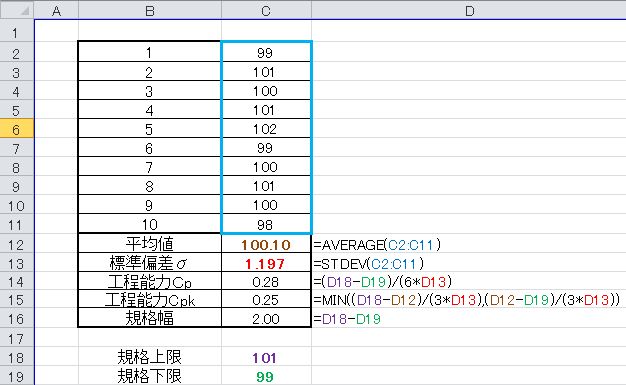
I think that it is a difficult technique to actually grasp the current state accurately. Does it lead to the theory of casm? I think.

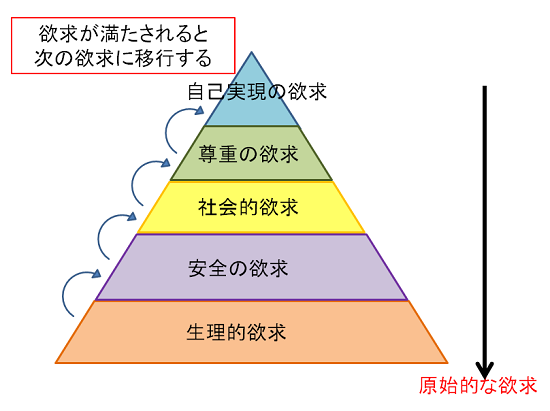
yosou

“Innovator” of paradigm shift concept is this article .
& Nbsp;

To spread the explosive products, there are points that can not pass easily (16% penetration rate wall).
In order to spread it, we need to change our approach.