Categories
Electrical and electrical / electronic design

Electric design 3 How to select power supply and circuit breaker unexpectedly not known

Do not know as it is known, how to select power supply and circuit breaker

Selection of power supply is the foundation of equipment and equipment.
Depending on this selection, the countries, areas of use, and methods of use are largely restricted.
Therefore, let’s think first.
The power supply here is a low voltage (AC 1000 V or less) talk.
Especially it is the selection method for equipment and equipment.

I would like to talk about power selection (AC) and selection of circuit breakers.

Power Supply Selection

First of all I would like to select the power supply.
We will select power supply for equipment and equipment as we select power supply.
There is a necessity of choosing the power source mainly depending on the place, type and usage to use
.
Flow in power selection

1. Voltage check mainly for areas to be used
2. Power supply stability
3. Selection of commercial voltage (single phase, three phase) to be used
4. Selection of equipment to be used

Depending on the equipment used, 3 and 4 may be reversed.
If you want to use it in various areas, if the power supply and the used power supply which are absolutely supplied as applications are different, you can also change it with a transformer etc, so please take it into consideration.

Verify the voltage of the area mainly used

This is not the case when the power supply is other than the commercial power supply, but check the voltage of the main use area of equipment and equipment to be designed from now.

The table below shows typical commercial power supply voltage.
However, voltages other than this table may be available.
Please use it for reference level.

Regional Commercial Supply Voltage (AC)


Region Household (single phase) Industrial (three phase) frequency
Japan 100 V 200 V 50/60 Hz
America 115 V 230 V 60 Hz
UK 230 V 400 V 50 Hz
Germany 230 V 400 V 50 Hz
China 220 V 380 V 50 Hz
India 220 V 380 V 50 Hz
Thai 230 V 400 V 50 Hz
Australia 240 V 415 V 50 Hz

Commercial voltage and frequency vary depending on the area.
Let’s check the supplied power supply of the area to be used and design it.
Also, if you are considering power generation from self-power generation or batteries, let’s check the power specifications there.

Voltage and frequency are different depending on the area. Confirm specification of power supply side

Power supply stability

Japan maintains a very good power supply stability.
However, there are many places where power supply stability is not good depending on the region.
As far as know, there is also a region that once the entire region in a few months may become a sudden power outage.

It also causes shortening of the life of the equipment.
Let’s got the information by the measurement and interviews to local people in the case of anxiety.

Voltage fluctuation rate
· Utilization rate of power supply

In some cases it is necessary to consider the following introductions and protect facilities and equipment.
Fluctuation of · voltage ⇨ AC stabilized power supply
· power supply interruption ⇨ uninterruptible power supply (UPS), etc.

There is a difference in stable power supply depending on the region

Selection of commercial voltage (single phase, three phase) to be used

Once you have grasped the power supply voltage of the country you mainly use, decide the commercial voltage to be used next.
This way of deciding how to use equipment and equipment and power consumption will also be decided.

It is characterized by industrial (3 phases) and household (single phase) respectively.
The following is a guide for each feature. Please put it in one corner.

Industrial (three-phase)

· Power efficiency is good (loss is small)
· The electricity price per unit is cheaper compared with home use (single phase)
· Large power can be used
· Use three-phase equipment
· Cable can be thinned
(Even with the same power consumption, the current can be reduced because the voltage is large)

Household (single phase)

· Do not have to dedicate electric contract
· Equipment can select household (single phase) power supply voltage
· Small and often moving like a tabletop machine
· Do not use in the factory, but use it in a general residence
· Do not use large electric power (usage current 15 A or less)
· Use DC power supply as equipment power supply, use only DC power supply
· No wiring work is necessary when connecting the power supply (when using the power plug)
· Consider safety

In addition, general current that can be used as home features is maximum 15 A
In Japan, 1500 W is the maximum output (1200 W for most products including safety factor) because it is 100 V.
In the United States, 1725 W (1400 W including safety factor) will be the maximum output.

As a supplement (home plug shape)
The shape of the power plug is as follows.
Please check the details of the corresponding area etc from the quoted place.

Aタイプ Bタイプ Cタイプ B3タイプ BFタイプ SEタイプ Oタイプ
海外の家庭用電源Aタイプ 海外の家庭用電源Bタイプ 海外の家庭用電源Cタイプ 海外の家庭用電源B3タイプ 海外の家庭用電源BFタイプ 海外の家庭用電源SEタイプ 海外の家庭用電源Oタイプ

TravelersCafeWorldGallery:Quote from overseas outlet / plug shape and list of voltage types

When using electricity charges or large electric power, for industrial use (three phases). When emphasis on usability select home use (single phase)

Selection of equipment to be used

It is necessary to select the power supply voltage of equipment used for equipment and equipment.
As a rough selection, we divided into industrial (three-phase), household (single phase) and power type, but I will check the equipment to see if it matches the voltage to be used.

Especially when special power supply is required or only specific power supply is necessary etc.

Required confirmation for device selection

· Check available power supply
· Check whether there is a change due to frequency
· Check if there is an alternative item to be applied to the power supply
· Confirmation of power consumption and total power consumption

If it is inevitable usable power supply does not match, it is necessary to redo “select commercial voltage (single phase, 3 phase) to use” again or change the power supply by transformer etc etc.

Confirm whether special and specific power supply is necessary for use equipment

This time I talked about AC (AC) mainly as a commercial power supply, but it is the same also in direct current.
The way of thinking after converting it to direct current in equipment is also the same.

Next I will talk about circuit breaker.
The following books will be helpful too, so please take a look if you are interested.
選び方・使い方 遮断器・開閉器

About circuit breakers

Next, I would like to talk about selection of circuit breaker.
A circuit breaker (commonly called a breaker) is an important device to draw from the power supply to equipment and equipment.

It is incorporated in the equipment itself, attached to the power board, and is used in various places and distribution plants in the home.
Selection of the wire to be connected must be larger than the capacity of the circuit breaker.

I would like to select the electric wire itself next time.

Purpose of breaker

There is a fuse in what works like a circuit breaker.
There are several purposes and the following functions are incorporated.

Breaker objective

· Circuit opening and closing
· Prevention of burnout of electric wire
· Prevent device failure
· Safety consideration to the human body

I described the circuit breaker for the purpose as the type of the corresponding circuit breaker.
Please consider it as a guide as it differs somewhat depending on selection and usage.

Corresponding Circuit Type
· Circuit opening / closing
Switch
Safety breaker (wiring breaker)
Electromagnetic contactor
Electromagnetic switchgear (electromagnetic contactor + thermal relay)
Earth leakage breaker (earth leakage breaker)
Circuit protector (AC, DC)

• Prevent burnout of wire
Fuse (temperature, current)
Safety breaker (wiring breaker)
Earth leakage breaker (earth leakage breaker)
Electromagnetic switchgear (electromagnetic contactor + thermal relay)
Circuit protector (AC, DC)

· Device malfunction prevention
Circuit protector (AC, DC)

· Safety consideration to human body
Earth leakage breaker (earth leakage breaker)

In addition to circuit breakers, there are many ones that have similar protective functions on the equipment itself.
For example, protection circuit such as hiccup of switching power supply is one of them.

Use circuit breaker according to purpose

Selection of circuit breaker

I will talk about the type of circuit breaker briefly explained earlier.
Among them, I mentioned the points to consider when selecting.

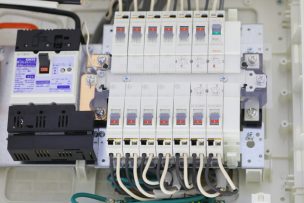
Examples of circuit breakers in distribution boards
分電盤内の例

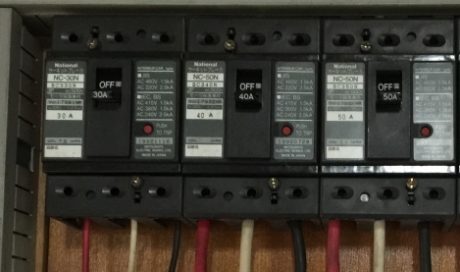
Safety breaker (wiring breaker)

It is a general circuit breaker like switchgear + fuse that can be used many times .
It is common to install instead of the switch.

There are the following concepts of selection.
Selection of Safety Breaker (Circuit Breaker)

· I want to open and close circuits as main circuit and branch circuit
· I want to prevent burnout of electric wire
· The withstand current capacity of the wire is lowered
· I want to recover earlier than fuse

operation time
Even if it exceeds the rated value (display value) it does not fall immediately (does not trip)
There are the following provisions.


Rated current Operating time
1.25 times the rated current twice the rated current
30 A or less 60 min or less 2 min or less
30 A – 50 A 60 min or less 4 min or less
50 A ~ 100 A 120 min or less 6 min or less

Even if the rated current is exceeded, it does not operate immediately.
Therefore, please select it taking into consideration the current to be used and the safety factor of the electric wire used.

Safety breaker is “switchgear + fuse that can be used many times”

About earth leakage breaker (Earth leakage circuit breaker)

The earth leakage breaker (earth leakage circuit breaker) is like “wiring breaker + ground fault monitor” .

Electric shock by earth fault (leakage) and function to prevent fire are attached.
To prevent electric shock from a ground fault (earth leakage), earth (ground) is common, but it is used in combination.

It is about the installation standard of earth leakage circuit breaker in case of Japan.
※ The contents of this section are approximate. Because there is possibility of revision,「電気設備の技術基準の解釈の解説

Selection of earth leakage breaker (earth leakage breaker)

· Use in a wet place
· Fire prohibited place such as pyrotechnic cabinet etc
· There is no mechanism for automatically shutting off when a ground fault is detected
· Place omitted for earth (ground)
As an exception
· Use the equipment at power stations, substations, etc.
· Use in a dry place
· Use it at 150 V or less in places other than moisture
· The equipment is covered with rubber, synthetic resin or other insulation
· Contact protective measures (measures not touched easily) have been done
· Earth (earth) resistance of C · D type grounding work is 3 Ω or less

The circuit is shut off by the current (sensitivity current) at the time of leakage.
As another method of classification, classify according to the operation time (time to shut off).

Type of sensitivity current
(Leakage current due to leakage current)
· High sensitivity type 30 mA or less
· Medium sensitivity type 1000 mA or less

Type of response speed (time until operation)


type (shape) operation time corresponding function
High speed type Within 0.1 s Electric shock prevention
time delay within 2 s burnout prevention
Infinite time form Within 0.3 s, depending on sensitivity current Burnout prevention

Sensitivity current of less than 15 mA, response speed less than 0.1 s is selected for earth leakage circuit breaker at earth omitted (300 V or less)

As a rough guide of the selection method in the function, it is as follows.


Sensitivity current Operating speed Earth (ground) Corresponding function
~ 15 mA Within 0.1 s No ground, C / D type ground Electric shock prevention
~ 15 mA Over 0.1 s C · D grounding Fire prevention
16 mA to 500 mA Within 0.1 s C · D grounding Electric shock prevention
16 mA ~ 500 mA 0.1 s over C · D grounding fire prevention
501 mA ~ Within 0.1 s C / D grounding Fire prevention
501 mA ~ 0.1 s over C · D grounding fire prevention

There are standards for setting earth leakage breakers in Japan. It is necessary when monitoring earth faults.

About electromagnetic contactor and electromagnetic switch

Basically both are mainly used when connected to a motor or an electric heater.
It can control opening / closing of the circuit itself, also called magnetic switch from the feature.

The relationship between the electromagnetic contactor and the electromagnetic switch is as follows.
Electromagnetic switch = electromagnetic contactor + thermal relay

·thermal relay
Monitor the wire temperature to shut off the circuit by overload or short circuit.

electromagnetic contactor selection

· I want to control the opening and closing of the circuit (remote)
· No load fluctuation

Selection of electromagnetic switch (electromagnetic contactor + thermal relay)

· I want to control the opening and closing of the circuit (remote)
· Use a motor or an electric heater (there is load fluctuation)
· I want to shut down the circuit by overload or short circuit
(Monitor electric wire temperature)

important point
· Setting of thermal relay
At the start of the motor, a large current (about 7 times the rating) flows for several seconds.
Depending on the setting, malfunction may occur at startup.
Let’s check the characteristic curve and adjust it at about 120% overload.

· Consideration of surge absorption
If you are using a large motor (large inductive load), the counter electromotive voltage will occur when opening the circuit.
This will markedly reduce the durability of the switch.
Therefore, it is necessary to suppress the counter electromotive force with a surge absorbing varistor or the like.

Especially when you want to control opening / closing of the circuit (remote)

Circuit protector

It is a circuit breaker made on the premise of protection of the control circuit of the electronic circuit and the load, load.
It becomes a circuit breaker whose operation until shutdown is fast.

Selection of circuit protector

· Control circuit, I want to protect the load
· I want to block low capacity
· I also want to shut off the DC (DC) circuit
· Just a good rated current can not be found
(The rated current lineup is fine)
· I want to protect the secondary side wiring

Circuit breaker made on the premise of load protection

Household circuit breaker

Of course we also use circuit breakers in the home.
· Examples of distribution boards for household use (earth leakage circuit breaker, wiring breaker)
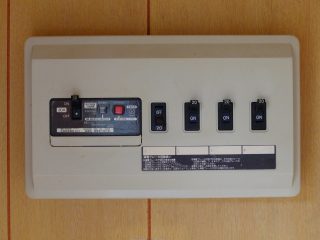
家庭用の遮断器の例

Normally, I think that the circuit breakers for households are configured as follows.

Ampere breaker (breaker with contract current value)
  ↓
Earth leakage circuit breaker (breaker with leakage test button)
  ↓
Circuit breaker (small breaker around)

I would like to explain how to deal with each breaker fault.
Anyone can recover if you cope without hurting.

Also, I have listed the possible factors, so please check as preventing recurrence.

If the ampere breaker has failed (tripped)

(Breaker with contract current value written)
Total electricity consumption in home exceeds contract value.

Let’s make the following correspondence.

1. Identify where you are using high power
2. Do not use devices that use large electric power at the same time
3. Stagger the timing of using devices that use large power

Power used exceeds contract value

If the earth leakage circuit breaker fails (trips)

(Breaker with leakage test button)
There is a possibility of electric leakage somewhere.
Try not to turn it on until you can check it.

If safety inside the house is confirmed, let’s correspond in the following order.

1. Turn off all wiring breakers
2. Turn on earth leakage circuit breaker
(At the time of a trip, the lever is temporarily stopped at the intermediate position, so OFF → ON once)
3. Turn on the circuit breaker one by one
4. When the earth leakage circuit breaker turns OFF again, check the corresponding position of the circuit breaker in the OFF state

There is a possibility that electric leakage is occurring somewhere

Circuit breaker failed (tripped)

It consumes a lot of electricity in part.
Usually, because the interrupter for wiring in the home is 15 A, if you use 3000 W under one circuit breaker it will fall within 2 minutes.

Let’s make the following correspondence.

1. Do you use instruments simultaneously with octopus foot wiring
2. Do not use large power at the same outlet, nearby outlet
3. If you really want to use a large amount of electricity, have an additional circuit created

Although it is not recommended, in the case of using for a short time, the following can be done due to the characteristics.
· Use slightly beyond 1500 W
· Use about 3000 W for about 1 minute
I use a lot of electricity at the same outlet

Categories
Electrical and electrical / electronic design

Electrical design 2 Concept of safety category for maintaining functions

Concept of safety category for maintaining functions

Safety categories are named “safe”, so it tends to be confused with “safety”, but it is not.
Safe Name of robustness / tolerance level that you can maintain function .

The safety category is the degree of “strength of maintenance” of “safety function”.
Therefore, the safety function (safety) is another problem.

The way of thinking is “function preservation” , which makes it a very useful reference other than safety functions.
I would like to talk about it this time.

Concept of Safety Category

As I mentioned briefly earlier, the safety category is a level of robustness and durability that “safety function” can be maintained.
This way of thinking can be thought of as a control as well, if it says either, it becomes the way of thinking of the robustness and tolerance of the function on the hardware side.

It is also related to risk assessment “probability of injury” , lowering the risk level of risk assessment Also useful.

The way of thinking is consolidated in hardware reliability “functional reliability” to maintain quality of product function It will be a story to do.

If constructed in the same way as this safety category, the robustness and durability of the functions normally used are also similarly raised.

“Safety category” ≒ “Maintenance level of function”

Therefore, it is possible to use it for safety other than safety, to maintain the function.

Categorization

The level of function maintenance (category) explained, can be easily divided into the following five.

· Category B
· Category 1
· Category 2
· Category 3
· Category 4

The lower you go, the more robustness and tolerance will be.
These are based on safety category classification and the necessary requirement ISO 13849-1.
Next, I will explain how it is organized by category.

Categories can be divided into 5

Category B

カテゴリB 安全機能維持には使用できません。

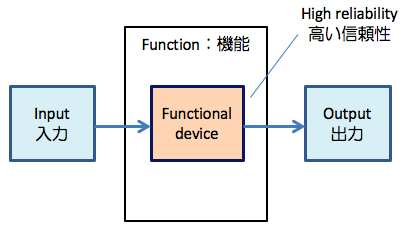
Normally, the desired function can be realized . (Level at which the safety function operates)

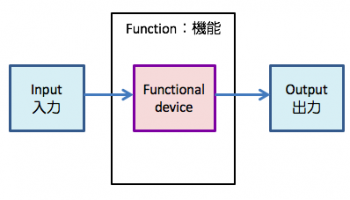
It becomes a series of flow with “input → function → output”.

If something happens, the function will be a level category that stops the operation.
Therefore, category B does not hold as a circuit for maintaining safety functions.
Let’s design it as intrinsically safe (safety is fundamentally established before safety functions are necessary) as safety.

Category B can not be used to maintain safety function

Category 1

カテゴリ1 吟味された構成要素を使用する

satisfy the condition of category B and using the examined component , safety is obeying the safety principle .

Just like Category B, “Input -> Function -> Output” and flow will be together.

What are the examined components
· High reliability and reduced fault possibility
· Certainly operating in the safe direction in case of failure
· Things that have been widely used for safety

Category B + It is a way of thinking of using reliable parts.

Category 1 is to use the examined components

Category 2

カテゴリ2はカテゴリB+点検機器が取り付いている

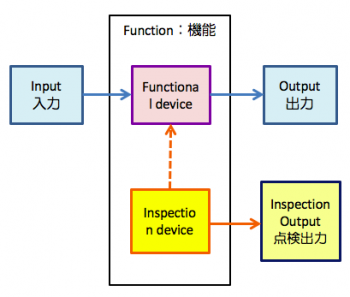
satisfy the condition of category B and have inspection function , safety is safety It follows that principle .

“Input -> function -> output” and the flow of flow are the same.
Moreover, “inspection function” is added form.

Inspection function is a function to check manually or automatically whether the function is maintained at an arbitrary timing.
Based on the inspection result, we decide whether to operate.

Category 2 added inspection function

Category 3

カテゴリ3、4 冗長化により2重回路を組み常に監視をする
または、
カテゴリ3、4 冗長化により2重回路を組み常に監視をする

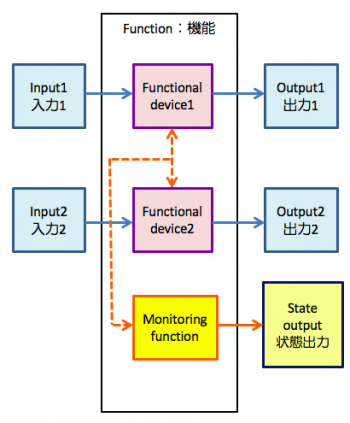
satisfy the condition of category B and have monitoring function , redundancy Dual circuit) , safety is Safety principle .

“Input 1 → Function 1 → Output 1”, “Input 2 → Function 2 → Output 2” and the flow of operation is divided into two lines.
Both functions are the same.

From category 3, it is considered as a very important part and thus it is necessary to make it “redundant” (duplicated).

“Redundancy” is a circuit or system that operates without problems even if one of the functions is duplicated and the other remains even if one of them fails.
This is a very good method as a way to increase functional reliability.
However, the cost is double that amount.

Also, since there is a monitoring function, it can detect when a failure occurs.
Category 3 does not guarantee until multiple duplicate failures (accumulation of failures).

Category 3 redundancy and monitoring function

Category 4

It is the same as Category 3 as a circuit.

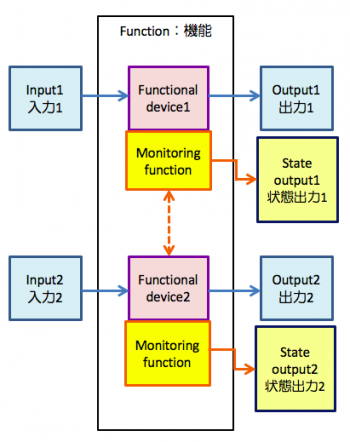
satisfy the condition of category 3 and tolerance to failure accumulation .

As with category 3, the flow of operation is divided into two lines as “input 1 → function 1 → output 1”, “input 2 → function 2 → output 2”.
The function of both systems is the same.

What is tolerance to failure accumulation
· Detect if a single fault occurs when the function is executed or when a fault occurs
· The function is not compromised by multiple duplicate failures (accumulation of failure)

Categories 3 and 4 are constructed in the same way in important parts such as airplane system and bank system system.
Think about similar places where you can not miss as a function.

Category 4 further improves resistance to category 3

Like these, the same idea as the safety category is very useful for maintaining the function.
It is necessary to think about how to maintain the function at design time.
Please respond according to the situation.

Categories
Mechanical design

Mechanical design 2 Characteristics and selection of copper for mechanical parts

Characteristics and Selection of Copper for Machine Parts

Like Aluminum, I think that it is always touched copper (Cu) related products as much as I can say everyday.
I would like to explain how to select when actually using it in development design, together with the characteristics this time.

Chemical properties

Copper is widely used in general and its usage is various considering chemical properties.
But because of its features, I would like to talk about its chemical properties compared to the materials used for mechanical parts here.

Weight

The specific gravity of copper is about 120% of iron, about 200% of titanium, about 330% of aluminum and about 460% of carbon fiber.
Specific gravity of copper: 8.8 g / cm 3

In terms of weight, it is the heaviest among these, and there is no merit.

In order of specific gravity:
copper> iron> titanium> copper> carbon fiber

Weight is about 120% heavier than iron

Conductivity / thermal conductivity

It has high conductivity and thermal conductivity under normal circumstances.
It depends on the condition, but as you know it is very expensive.
I will compare and explain.

Conductivity
The electrical resistivity of copper is about 0.0003% of carbon fiber, about 4% of titanium, about 18% of iron and about 60% of aluminum.
Copper electric resistivity: 16.8 nΩ · m

Among the metals commonly used under normal temperature environment, copper has good electrical conductivity after silver.
Therefore, copper is used for general electric cables and electric wires.

Electrical resistivity order:
carbon fiber> titanium> iron> copper> copper

· Thermal conductivity
The thermal conductivity of copper is about 80% of carbon fiber, about 170% of aluminum, about 500% of iron, about 1900% of titanium.
Copper is used in many products that efficiently convey heat.
Copper thermal conductivity: 400 W / (m · K)

The order of thermal conductivity:
carbon fiber> copper> copper> iron> titanium

Of the metals that are normally used, the electrical conductivity and thermal conductivity are the best.

Chemical properties

· Corrosivity
Copper has low ionization tendency after gold, silver and is relatively strong against acid and alkali.
In the air, a copper oxide film gradually forms on the surface and the inside is protected, so there is no further corrosion progression.

In order of ionization tendency
copper> titanium> iron> copper

Magnetic
Copper is a diamagnetic body and when it applies a magnetic field, it is weak, but it will be the opposite magnetic only then at that time to repel its magnetic field.
Even if a magnet is attached, it is not magnetized.
Therefore, it is often used around sensors such as measuring instruments.

High corrosion resistance. There is no magnetism.

Mechanical properties

Copper is an essential part of mechanical parts by using mechanical properties.
I will explain what it is like.

Strength

Copper strength is somewhat inferior to iron.
Depending on the alloy, the specific strength of copper is the same as that of iron.
Therefore, considering the same volume, heavier copper will weaken the strength.

Processability

It is very soft and processability is bad with copper alone.
By making it a copper alloy, the processability is improved while taking advantage of the goodness of copper, and the application is wide. In the case of
Because of high thermal conductivity, warping and deformation are more likely to occur when processing than iron.
It is almost impossible in cutting, cutting and die punching, such as drawing, grinding, bending, welding, etc.

Copper can be easily cast.
Its melting point is lower than that of iron, so castability is high like iron.
However, since the coefficient of thermal expansion is a little high, distortion is likely to occur due to welding or the like.
Moreover, it is hard to heat local heating because of high thermal conductivity.

Processability is high, casting is relatively easy, but caution is also required for processing requiring heat

Price

It depends on circumstances and alloys, not everything applies, but it will be below.

In order of price per weight
carbon fiber> titanium> copper> aluminum> stainless steel> iron

Copper is widely used in various fields than features.
For that reason it is relatively expensive than others.

Copper is relatively expensive

Other

· Antibacterial
Copper is said to have antimicrobial properties.
It is said to inactivate a wide range of microorganisms by oxide film and chlorine compound generated on the surface.

· Color changes with aging
When placing copper in the air for many years, the color changes with time due to the influence of the oxide film generated on the surface.
It turns reddish brown → green and blue in about ten years.
Merits / Demerits Although it can be caught in either case, copper has a distinctive hue.

· Easy to recycle
Like aluminum, copper is easy to recycle.
It is easy to extract as copper alone, so it is recycled a lot.

· Very strong under low temperature environment
Copper does not become brittle even under low temperature environments.
Therefore, it is also used for superconducting materials and so on.

However, for copper and copper alloys that are usually used, let’s not use it in an environment where the temperature is high because its maximum temperature is about 300 degrees.

easy to recycle

At what time did you choose copper?


· I want to pass a lot of electricity per volume
Among the metals commonly used under normal temperature environment, copper is often used for electric cables and the like because it has good electrical conductivity next to silver.
However, when comparing per weight, aluminum conducts electricity.
I think that it is necessary to think by weight or volume.

· I want to convey fever efficiently
Copper has very good thermal conductivity as well as conductivity.
It is also often used for heat sinks and heat exchangers.

· I want to use it for parts of measuring equipment
Copper has diamagnetism, but it is not magnetized by the magnet.
Therefore, it is suitable for parts of measuring instruments that affect magnetic force.

· Want to use materials that can be maintained in low temperature environment
As I mentioned earlier, copper does not become brittle in very cold environments.
Therefore, it is strong even at low temperature.
However, let’s notice how to use because it is relatively weak in places like high temperature.

There are many others, too.

Copper is used in a wide variety of applications.
Please try variously in consideration of the situation depending on the situation.
It is the third most widely used material after iron and aluminum.
Because quality is stable, replacement design can be done comparatively easily.

Usage is diverse. Easy to replace

Below is a tumbler using the thermal conductivity characteristic of copper.
The cold thing is cold, and it is more tasty with the coldness feeling on the lip just before drinking.
和平フレイズ ラウンドロックタンブラー 380ml 燕三 純銅 EM-9606

Standard (alloy)

Copper alloy is copper based alloy.
Copper alloys are very common, for example Japanese coins other than 1 yen coin will be copper alloys.

Because copper is soft, it can be alloyed with manganese, tin, magnesium, zinc, nickel or the like to improve the properties as a metal material.
Copper alloys can roughly be roughly divided into a rolling (drawing) method and a casting method, as with aluminum, and are material specifications for each application.

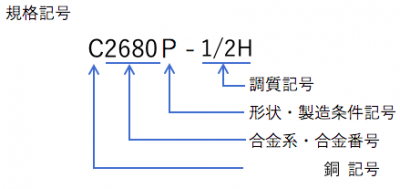
銅の規格で、銅記号、系統記号、形状記号、調質記号からなります。

· Copper sign
It will be the initial letter C.
· Alloy · Alloy number
It will be the number of the alloy. The type of alloy is determined by the number at the head of this number.
· Shape · Manufacturing condition code
P: Plate, disc
PC: laminating board
H: Foil
FD: Die forged wrought goods
FH: Free dedicated goods
Such
– Condition symbol
F: Production as it is
O: Annealing
H: Work hardening
Such

Alloy of rolling (drawing) method

Here, we will explain the standard of “rolling (drawing) method” which is particularly frequently used.
Among the alloys of the rolling (drawing) method, there are non-heat treated alloys and heat treated alloys.

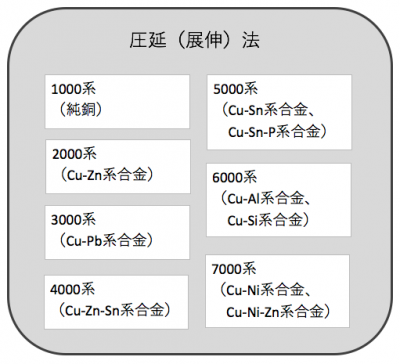
銅の延伸法では1000系-7000系まであります。マンガン、すず、マグネシウム、亜鉛、ニッケルなどと合金にして、金属材料としての特性を向上させます。

Copper alloy of the rolling method uses the name of the international copper alloy with a four-digit number.
Commercially available plate thickness is 0.3, 0.8, 1.0, 2, 3, 4, 5, 6, 8, 10, 12, 15, 16, 18, 20, 22, 25, 30, 35, 40, 45, 50 mm is.
There are other board thicknesses, but it is easy to design, considering this too.

• 1000 series (pure copper)
When the copper purity is 99.9% or more, the electrical conductivity and thermal conductivity are good but the strength is low.
It is used as a conductive material or an aluminum foil, and it is not suitable as a structure or machine part.

C1020: Core wire of electric wire

· 2000 series (Cu – Zn alloy)
It becomes an alloy of copper and zinc.
Also referred to as brass or brass, it is most widely used among copper alloys.
Because of its good processability and beautiful, it is widely used, and it is also used for hardware.
Cracking may occur due to the residual stress at the time of processing, just by placing the alloy processed and so on.
This is a type of stress corrosion cracking, let’s design with internal stress taken into account during processing.

C2600: Connection terminal
C2680: Wiring equipment parts

• Series 3000 (Cu – Pb alloy)
It will be a copper alloy with lead added to improve workability.
It is also called free cutting brass.

C3560: Gear gear etc.

4000 series (Cu – Zn – Sn alloy)
2000 series (brass) with tin added.
Therefore, the resistance to corrosion in sea water has been increased more than brass.
Besides, it becomes an alloy which is resistant to stress corrosion cracking and abrasion.

C4250: Relays, switches
C 4621: Part for marine use

• 5000 series (Cu – Sn alloy, Cu – Sn – P alloy)
It is made by adding tin and phosphorus.
Also called phosphor bronze, it has strong strength and excellent spring properties.
Moreover, it is used for various things because it has good workability such as bending and drawing and high electric conductivity.

C 5191: wiring equipment parts etc.

• 6000 series (Cu – Al alloy, Cu – Si alloy)

6000 series such as C 6161 and C 6191 are made of aluminum bronze or brass for instrument valves, high strength brass

• 7000 series (Cu – Ni alloy, Cu – Ni – Zn alloy)
It becomes nickel plus it, it is also called white copper.
Also nickel plus zinc is also called western silver.
Since these colors become whitish, they are used as a substitute for silver from the appearance.
It is used for ornaments and tableware for beautiful things.
It also has strong corrosion resistance and seawater resistance.

C7351: Musical instrument

Copper has different characteristics in terms of color, corrosivity and conductivity depending on the alloy

Alloy of casting method

Below is the alloy standard of the casting method.
As a characteristic, it is almost the same as the alloy of the rolling (drawing) method, so it only lists the name.

“CAC” is attached to the name

CAC 101: pure copper system
CAC 201: Cu-Zn series
CAC 301: Cu-Zn-Al type
CAC 401: Cu-Sn series
CAC 502 A: Cu – Sn – P system
ACAC 602: Cu – Sn – Pb type
CAC 701: Cu-Al series
CAC 801: Cu – Zn – Si series
CAC 901: Cu-Sn-Bi type

Copper is used very much in various fields.
I think that a better copper alloy will be produced in the future.

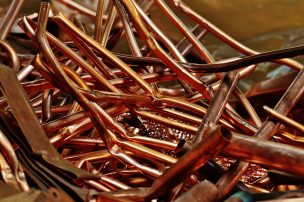
Copper products are used as various processed products as follows.

Categories
Mechanical design

Mechanical design1 Aluminum characteristics and selection for mechanical parts

Characteristics and Selection of Aluminum for Machine Parts

I think that I touch things related to aluminum so much as to say always in everyday life everyday.
I would like to explain how to prune with the characteristics when actually using it in development design.

Chemical properties

Aluminum is widely used in general and there are various ways of using it considering chemical properties.
Here I would like to talk about its chemical properties compared to the materials used for mechanical parts.

Weight

The specific gravity of aluminum is about 30% of copper, about 35% of iron, about 60% of titanium and about 140% of carbon fiber.
Aluminum specific gravity: 2.7 g / cm 3

Replacing high-speed rotating parts with iron to aluminum will also reduce inertia and improve efficiency.
It is often used to simply lighten the weight.

In order of specific gravity:
copper> iron> titanium> aluminum> carbon fiber

Weight is about 1/3 of iron and copper

Conductivity / thermal conductivity

It has high conductivity and thermal conductivity under normal circumstances.
It depends on state and alloy, but we will explain in roughly.
Conductivity
The electrical resistivity of aluminum is about 170% of copper, about 30% of iron, about 7% of titanium and about 0.001% of carbon fiber.
Aluminum electrical resistivity: 28.2 nΩ · m

Copper has better electrical conductivity, but because of its specific gravity the aluminum has better electrical conductivity per weight.
Therefore, the higher the voltage, the more aluminum is used

Electrical resistivity order:
carbon fiber> titanium> iron> aluminum> copper

· Thermal conductivity
The thermal conductivity of aluminum is about 60% of copper, about 300% of iron, about 1000% of titanium, about 50% of carbon fiber.
Aluminum products are used in many of the heat transfer products.

The order of thermal conductivity:
carbon fiber> copper> aluminum> iron> titanium

Electrical conductivity is better than copper per weight. Thermal conductivity is also good next to copper.

Chemical properties

· Corrosivity
Aluminum has a high ionization tendency and is susceptible to acid and alkali.
However, it is said that corrosion resistance is generally high, because an oxide film (alumite) is formed on the surface in the air and the inside is protected.

In order of ionization tendency
aluminum> titanium> iron> copper

Magnetic
Aluminum is a weak magnetic material, but you can think that it is almost none.
Therefore, it is also adopted in many measuring instruments.

High corrosion resistance in the air. There is no magnetism.

Mechanical properties

Aluminum is a necessity for mechanical parts by using mechanical properties.
I will explain what it is like.

Strength

The strength of aluminum is low, but the aluminum alloy improves the strength while making good use of lightness and processability, and the application is wide.
It does not show a yielding phenomenon (a phenomenon that the relation between strain and stress does not become proportional and a strain remains even if stress is removed) when deformed when stress is applied. In the case of
The specific strength per unit weight is large, the tensile strength is not large.

Processability

Aluminum has high processability.
It is almost impossible in cutting, cutting and die punching, such as drawing, grinding, bending, welding, etc.

Aluminum can be easily cast.
The melting point is about half that of iron, so castability is high.

High processability, easy casting

Price

It depends on circumstances and alloys, not everything applies, but it will be below.

In order of price per weight
carbon fiber> titanium> copper> aluminum> stainless steel> iron

Due to the difference in specific gravity, the volume per stainless steel is higher than aluminum.

Aluminum is relatively inexpensive

Other

High radio reflection performance
Aluminum is also good at mirror finishing.
Therefore, it easily reflects electromagnetic waves and visible light.

· No toxicity
Aluminum is said to be non-toxic.
Many foods are also adopted in the field.

· Easy to recycle
Aluminum is easy to recycle.
We use a lot of electricity when making from raw materials, but when recycling

– Powder is inflammable
Aluminum powder may cause dust explosion.
When water is applied to extinguish at the time of burning, hydrogen is generated and damage is increased, so it is strictly prohibited to apply water.
It is designated as a dangerous good under the Fire Law.

It is not toxic and easy to recycle

At what time did you choose aluminum?


· Want to lighten
Iron, stainless steel, because it is lighter than titanium, it is very good if you simply want to lighten it. Because the specific strength per weight is also high, replacement design with light weight can be achieved.

· Want to convey heat as cheaply as possible
Although the thermal conductivity is inferior to copper, the merit as a price is often used for heat sink etc. because it exceeds copper.

· Want to lighten electric cable
Conductivity per weight is better than copper.
However, since it is weak in pulling etc., it can only be used fixed.

There are many others, too.

The use of aluminum is diverse and this is not the limit.
Please try variously in consideration of the situation depending on the situation.
As the material is generalized and the quality is stable, replacement design can be done comparatively easily.

Usage is diverse. Easy to replace

Below is detailed about aluminum as a metal material.
Please refer to those who want to know more detailed contents.
Recycling by Material: Aluminium Recycling, Concrete Recycling, Ferrous Metal Recycling, Glass Recycling, Refrigerant Reclamation, Timber Rec

Standard (alloy)

Aluminum alloy is an alloy containing aluminum as a main component.
Aluminum is characterized by being light, but it is soft, but it can be alloyed with copper, manganese, silicon, magnesium, zinc, nickel or the like to improve its properties as a metal material.
Aluminum alloy can roughly be roughly divided into the rolling (drawing) method and the casting method, and it is a material standard for each application.

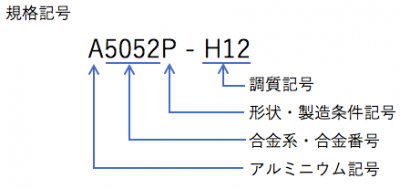
The standard symbol is as follows.
Aluminum symbol, alloy type / alloy number, shape · Manufacturing condition symbols and conditioning symbols are available
· Aluminum symbol
It becomes the initial letter A.
· Alloy · Alloy number
It will be the number of the alloy. The type of alloy is determined by the number at the head of this number.
· Shape · Manufacturing condition code
P: Plate, disc
PC: laminating board
H: Foil
TW: welded pipe
FD: Die forged wrought goods
FH: Free dedicated goods
Such
– Condition symbol
F: Production as it is
O: Annealing
H: Work hardening
W: Liquefaction treatment
Such

Alloy of rolling (drawing) method

Here, we will explain the standard of “rolling (drawing) method” which is particularly frequently used.
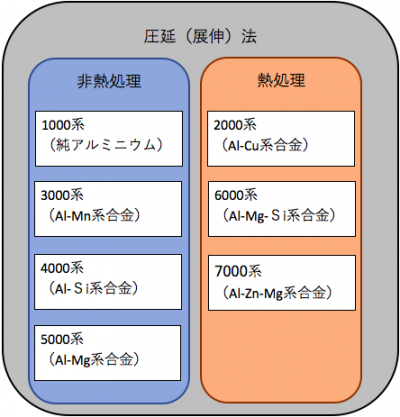
Among the alloys of the rolling (drawing) method, there are non-heat treated alloys and heat treated alloys.
圧延(展伸)法には非熱処理合金と熱処理合金があります

Aluminum alloy of the rolling method is a four-digit number of international aluminum alloy name used.
Commercially available plate thickness is 0.8, 1.0, 1.2, 1.5, 2, 3, 4, 5, 6, 7, 8, 10, 12, 15, 16, 18, 20, 22, 25, 30, 35, 40 , 45, 50 mm.
It is easy to design if you also consider this.

• 1000 series (pure aluminum)
Aluminum purity 99.00% or more Although processability, corrosion resistance, electrical conductivity, thermal conductivity are good, strength is low. It is used as a conductive material or an aluminum foil, and it is not suitable as a structure or machine part.

· 2000 series (Al – Cu alloy)
Duralumin, super duralumin etc. are famous. High strength material comparable to steel material. It is used as a structural material or a forged material but contains copper and is inferior in corrosion resistance.
Weldability is also inferior to others.
It is used in cutting etc. In the case of

A2017: Duralumin
A2024: Ultra duralumin
7000 series with stronger strength and smaller internal stress is used more often than 2000 series which distortion occurs by processing.

3000 series (Al – Mn alloy)
It is the position of the thing raised the strength of 1000 series by adding Mn. A 3003 added Mn slightly increased the strength without reducing the workability and corrosion resistance of pure aluminum. A3004, A3104 further enhance the strength.

• Series 4000 (Al – Si alloy)
Low coefficient of thermal expansion, good heat resistance and abrasion resistance. In the case of
We will process with forging etc.
There are mainly A 4032, A 4043.

• 5000 series (Al – Mg alloy)
It has good corrosion resistance and weldability, and it is also used for cutting work.
The application is very much, it becomes the most balanced alloy among aluminum alloys.

A 5052: It is the aluminum alloy most widely used for mechanical parts.

• Series 6000 (Al – Mg – Si alloy)
It has good strength and corrosion resistance, is widely used for structural materials, and is used for cutting and other purposes.
It is mainly A 6063, A 6061.

• Series 7000 (Al – Zn – Mg alloy)
It is the highest strength in aluminum alloy. Good machinability, but also corrosion resistance weldability is difficult. In the case of
It is used in cutting etc.

A7N01, A7N01: Alloys for welding construction. Relatively high strength and weld strength are restored close to the base metal at normal temperature.
 A 7075: Ultra duralumin

The 2000 series, 5000 series, 4000 series, 6000 series, 7000 series used for the structure and machine parts

Alloy of casting method

Below is the alloy standard of the casting method.
As a characteristic, it is almost the same as the alloy of the rolling (drawing) method, so it only lists the name.
It is classified for sand mold type casting and for die casting.

· For sand mold type castings
“AC” is attached to the name

AC1C: Al-Cu alloy

AC2A: Al-Cu-Si alloy

AC3A: Al-Si alloy

AC4A: Al-Si-Mg alloy

AC4B: Al-Si-Cu alloy

AC4D: Al-Si-Cu-Mg alloy

AC5A: Al-Cu-Ni-Mg alloy

AC7A : Al-Mg alloy

AC8A: Al-Si-Cu-Ni-Mg alloy

AC9A: Al-Si-Cu-Mg alloy

· For die casting
“ADC” is attached to the name

ADC1: Al-Si alloy

ADC3: Al-Si-Mg alloy

ADC5: Al-Mg alloy

ADC6: Al-Mg-Mn alloy

ADC10: Al-Si-Cu alloy

ADC14: Al-Si-Cu-Mg alloy

Aluminum is used in many fields in many fields.
I think that better aluminum alloy will be produced in the future.

Below is detailed about aluminum.
Also, as future materials as materials are listed, please try it.

Categories
Flow of development

Flow of development ~ Development process of system and flow of process ~

Development flow – System development process and process flow –

I would like to explain in a general example how to follow the flow (phase) in product development etc.
The development act requires a lot of resources. For details, please see before developing design.
The content to be described is a development process that can be used for both software and hardware.

First of all, why is there a trend in development activities is to “improve efficiency”. It is better to create the best one while keeping resources as low as possible. It is a common example to explain from now on. I think that there are also better ways depending on the contents that can be easily done without actually proceeding with such development, the size of development and the items to be developed. Please check it in each development.

Development overview

It is not necessary to go through the development process by taking steps in content developed at the individual level and development in a small scale / short term.
As I said, there is a development process as a way to keep the resources as low as possible while not mistaking the direction.

Even as a method of development, if there is no problem at all from the beginning of development to the completion of development, various things will not come out.
Although it is not limited to this, the following part comes out as you develop it, so you need the opportunity to consider the design itself.

· Unknown part if you do not try
· Parts that you do not know unless you test and evaluate
· Part that you do not know unless you actually use it
· Parts that can not be realized in principle after evaluation
· Part where customer ‘s request changed

Before the development process

PDCA cycle

The PDCA cycle is very important in improving it.
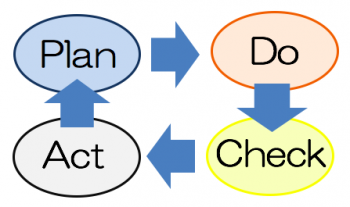
PDCA Loop PDCA Plan: Combine the plan, Do: Execute , Check: Evaluate and Act / Action: Feedback
It is one of the methods for smoothly advancing the administrative work, but it can also be used at the personal level.
I repeat the following 1 to 4, improve and improve and repeat spiral up.

By doing these, we can feed back the content that came up next, which is very useful for improvement and improvement.
It will become better by repeating the number of times.

1.Plan (plan / design)
2. Do (implementation and execution)
3.Check (inspection and evaluation)
4. Act / Action (treatment / improvement)

I will explain the flow of development, but it is no exaggeration to say that all parts of the loop are PDCA cycles.
This cycle can be used at any point in development and demonstrates its effectiveness in development.
Let’s make plans properly, execute, review and make improvements.

The PDCA cycle is not only for development, but also for a very important cycle to make it better

DR (design review)

Although I have said it several times, the development acts very much use resources (people, things, money, time). It will be very exhausted if you go forward in the wrong direction. For that, we need to stop once and see if the direction is right. We call it DR (design review).
We will work on collective intelligence to find out what we can not find in individuals or specific groups.

It is heavily used in the waterfall model development which is difficult to return to development.
However, in Agile development, we may also consider development direction by gathering non-members and developing members as a whole.
Let’s have the opportunity as much as possible because it will be an important point to confirm.

What is DR (Design Review)
Planning, development, design, manufacture, quality, purchasing collectively gather in the next step as to whether the criteria are met at the point of each development (before going to the next step of the development process) or the direction is wrong It is deciding whether to proceed.

The timing of the holding is mostly at the end of each development (before the next step), but there are places where the holding is skipped depending on importance.

Content to be determined by DR
Does the content that you did in that process fulfill the criteria at the point?
Is the remaining problem crushed as much as possible?
Direction and purpose are not wrong?

Especially the remaining task will be doubled if you postpone it, the next process will correct the problem.
Let’s proceed with completion of our process as much as possible.

Points to advance DR
I said the point to advance DR, but the points are the same at any meeting.
The meeting is very expensive as a company. (Because man-hours for the number of people is necessary for the meeting time)

There is also a thesis that the conference rate declines by 10% at every conference when there are more than seven at any conference.
The decision rate will also decrease, but the participants’ sense of responsibility will also fall.
It is abnormal that some people do not speak.
You have to speak some thought and find the best policy and compromise among them.

We also collect specialists from several departments.
Whether there is no problem in progressing development, we will reconfirm whether there is any problem in the relation item of the participating department in the point that it changed from before.

· Decide who is the decision-makers and responsible person and immediately make a decision during the meeting.
· Understand the contents in advance, give a problem in advance.
· It is necessary to keep as many as 10 people or less as possible (list the problems in advance materials).
· Collect multiple departments

Points above materials
Although data tends to be more frequent, it is necessary to keep a minimum amount of materials necessary.
It is impossible to understand even if it is too much, and it is the purpose of the material to convey information accurately.
Also, it is a place to judge whether to proceed next, so if you set it up with lie materials you may cause serious damage to the company.
Please note the neighborhood and make the material, please announce it.

· Do not lie to the contents of documents
· Presentation of concerns and problems that the speaker thinks

Issues Points in remarks / suggestions
People who make statements that take fried legs (people are good at taking a fault) inevitably tend to become inevitably, but as the first voice is positive as to make a constructive discussion in as short a time possible Let’s try something else.
For details, please read DESC talk .

DR is an important point.
The direction of decision and the way the company should go will differ if the attendees do not desire to have the necessity of holding itself.

DR (design review) stops once and really develops what you need development review point

It also describes the development process in detail.
DESIGN REVIEW〈2016〉

Development method

I will explain three kinds of development process as a development method.
It can not be said that this is generally good, each has its own characteristics.

Recently, I stressed the testing process very much and I am in the direction to avoid rework as much as possible.
Therefore, it has been said that Agile type is better than Waterfall model.
However, development of V, W model incorporating the test process into the waterfall model is also frequently conducted.

· Waterfall model development (V-shaped model development) (W-shaped model development)

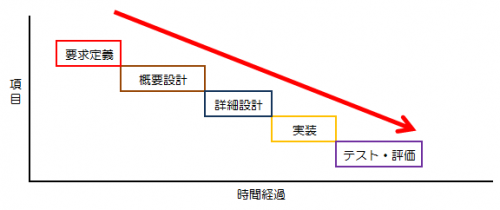
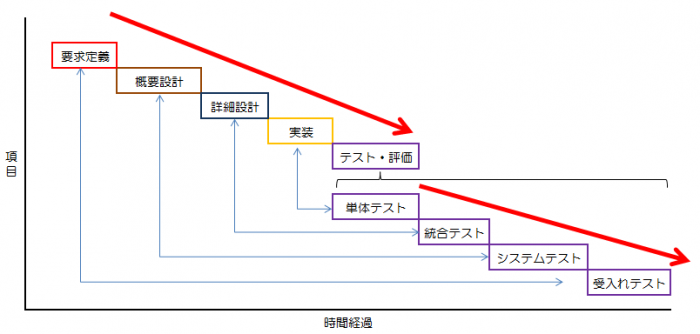
We divide top-down into work processes such as “request definition” “overview design” “detailed design” “development” “test and evaluation”.
In most cases there is no specific customer or customer interaction is only the first.
Waterfall Model_Request Definition _Overview Design_Details Design_Development_Test and Evaluation_etc

Since the flow of development through the stage is very easy to manage, it is a flow of development that has been used since a long time ago.
If there is no specification change in resources and duration, it will be estimated on a rough estimate.

· V character model development
V-shaped model development, W-shaped model development will be a variation of waterfall model development.
These are development processes, but strictly speaking, they are trying to incorporate the testing process to reduce backtracking.
I will explain that.

“Request definition” “overview design” “detailed design” “implementation” “test and evaluation” flow.
It is to carry out “test and evaluation” which makes pairing of “test and evaluation” here more concretely upper process.
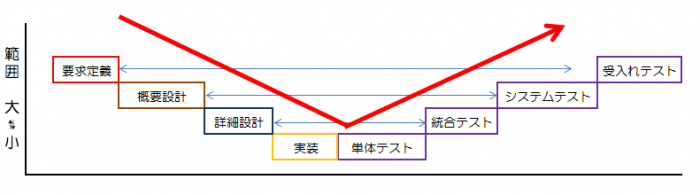
It is called a V model or V character model because it seems that development process is going backwards, as we go through “test and evaluation” to move from small test to large flow as a flow.

As a flow of development here
“Request definition” → “overview design” → “detailed design” → “implementation” → “unit test” → “integration test” → “system test” → “acceptance test”
It will be like a shape. (Items change according to development)
Vモデル開発 流れとして小さなテストから大枠に移るように「テスト・評価」を行なっていく形が、開発プロセスの逆行しているように見える、VモデルまたはV字モデルと呼ばれます。

If this is sorted by the size of the range it will be V shaped as below.
In addition, as each test process is used to confirm the operation of consideration contents up to implementation, they are almost paired.
V If you divide the influence range of the 2 model items by size , In the part to be test progressed gradually going towards the larger range will be in the form of V

· W-shape model development
As I mentioned earlier, development of W-shaped model is a variation of waterfall model development.
Unlike the V type, the test process is further divided.

As a reason, even if there is an error in the examination contents prior to implementation and implementation in the V-shaped model, actual confirmation will be considerably later, so returning becomes very difficult.
It is a development / testing process that takes a lot of effort and takes the idea of ​​crushing them beforehand.

As an example of the flow of V-shaped model development up to the previous
“Request definition” → “overview design” → “detailed design” → “implementation” → “unit test” → “integration test” → “system test” → “acceptance test”
was.

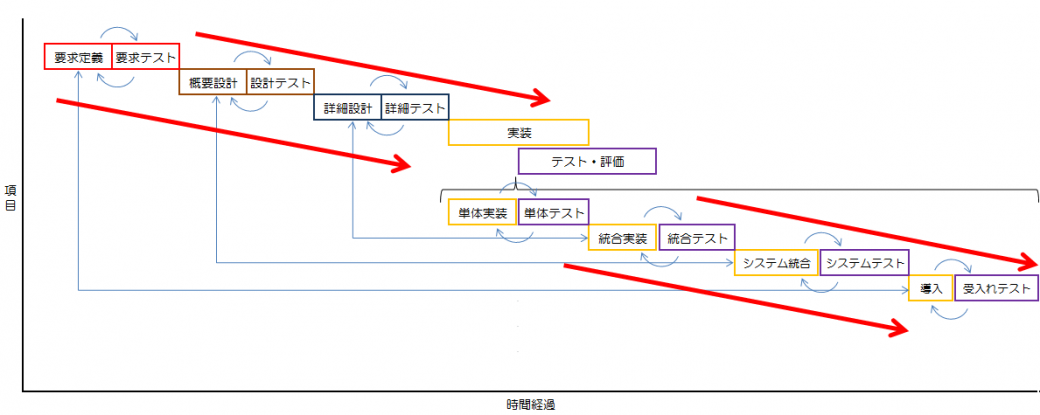
As an example of the flow of W-shaped model development
“Request definition” ⇆ “Request test” ➝ “Overview design” ⇆ “Design test” ➝ “Detailed design” ⇆ “Detailed test” ➝ “Single implementation” ⇆ “Unit test” ➝ “Integrated implementation” ⇆ “Integration test” → ” System integration “⇆” System test “→” Introduction “⇆” acceptance test ”
It will take the form of examination in the form like the examination content and implementation range. (Items change according to development)

Repeated parts circulate in the PDCA cycle and feed back.
We will increase the accuracy by that.

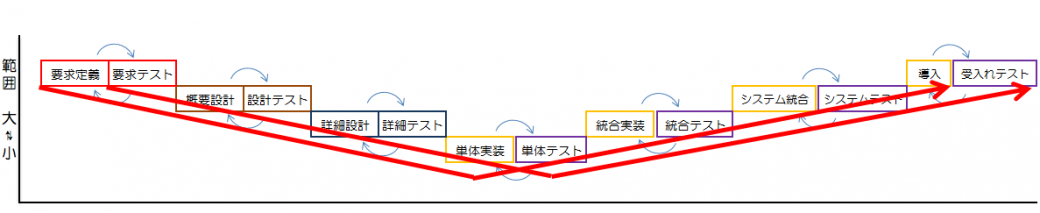
Like the V-shaped model, rearranging it by the size of the range will result in W shape as shown below.
In addition, as each test process is used to confirm the operation of consideration contents up to implementation, they are almost paired.
Sort by the size of the range as well as the V character model And it becomes W shape as follows.In addition, it is almost paired because it confirms the operation of consideration contents up to each implementation by each test process.

Benefits

· Since the end of the process is clear, it is easy to manage the deliverables
· Management-friendly model from the management point of view
· Customer request and development functions are clear at the initial stage
· The product is completed according to the original requirements
· Since the experts are divided for each process, there is little difference in quality within the process

Disadvantage

・各上位の工程で間違いがない事が大前提
· If there is a mistake in each higher-level process, the problem gradually increases
· You tend to need more resources
· It is difficult to respond when customer’s request is changed
· Products can not be released until completion of development

A form that the product embodies from the design drawing at once

・Spiral model development

It is a model of the development process taking advantage of the top down design and the bottom up design.
It is a method to develop by repeating design and prototyping.
However, unlike Agile type, we will develop PDCA throughout the present while covering overall functions.
Communication with customers is often done closely so that they become gradually clear from the overview.
One loop period is relatively frequently about 6 months to 2 years.

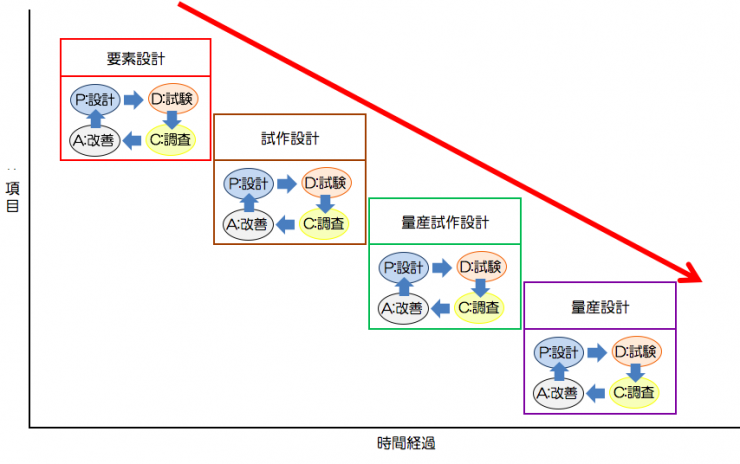
As an example of the flow of spiral model development here
“Element design” → “Prototype design” → “Mass production prototype design” → “Mass production design”
It will be like a shape. I will cycle through each one. (Items change according to development)
In the development process that took advantage of the advantages of top-down design and bottom-up design It is a model that develops by repeatedly designing and prototyping

Benefits

· Easy to predict program size and schedule.
· Easy to respond to customer’s request specification change.
· It is unlikely that the design process will increase and the time spent on mounting will be shortened.
· It is easier to manage on a relatively large scale than Agile model.

Disadvantage

· Quality for functions tends to be ambiguous
· Products can not be released until completion of development

Form that gradually embodies products that were blurred

· Agile development

It is a generic name of a development method group that develops software so that it adapts quickly.
However, not only software but also hardware is quite effective.
We will try to minimize the risk by turning PDCA (design → test → survey → improvement) in a short term called iteration and dividing into functions and parts.
 The period of one iteration is relatively many times from one week to one month.

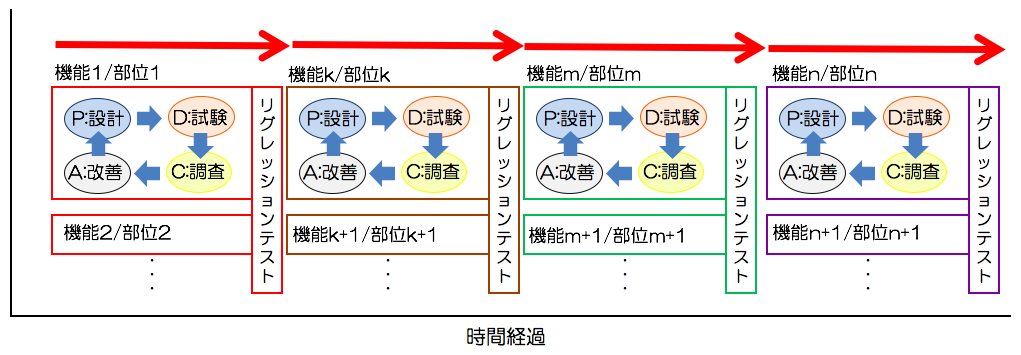
As an example of the flow of agile development here
“Function / Site” → “Function / Part” → “Function / Part” → “Function / Part”
It will be like a shape. I will cycle through each one. (Items change according to development)
Among them, interaction with customers is often done quite closely for each function / part.
When doing a combination, you must do a regression test (regression test: confirm a bug where usable functions can not be used).

Below is a flow of agile development while doing multiple simultaneous in parallel.
In the case of a single unit, it becomes one line in this figure.

In a short period called an iteration, divide it into small functions and parts PDCA ( We try to minimize the risk by turning design → test → investigation → improvement) The period of one iteration is relatively many times from one week to one month

Benefits

· Reduce man-hours for returning trouble etc.
· Quality for product function can be preserved
· It tends to be customer’s request or street product
· Specification change to modification is quick to respond
· Can be released while limiting functions according to the delivery date

Disadvantage

· Progress is difficult to understand and overall management is difficult
· Individuals are required to respond to changes in specifications
· Consciousness to maximize products including customers is required
· We can not cope unless communication is tightly taken
· If the test (test) method is lame, quality can not be maintained
· You must do a regression test for each combination
· It is often different from the original requirement specification
· Teams are divided for each function when the scale becomes large.
Therefore, since process experts are dispersed, the quality of each process tends to differ.

Form in which products gradually add functions and parts

Which one should be used in the development method?


It is not limited as explained below.
Because it is a development process after all, considering our company’s strengths, priorities, etc., it may be quite different from the contents described here.

· When you can restrict functionality from customer’s request
(Delivery time · Cost priority, but when it is required for quality to the introduced function)
→ Agile development

· When you can limit the delivery date / cost from customer’s request
(Introduction function priority, delivery time and cost tend to be different from the original estimate)
→ Spiral model development

· If you want to raise the company’s own technology and develop a new product
(If there are many resources, the development scale is large, if you want to manage well, there is no specific customer)
→ Waterfall model development (including V character and W shape model)

The development process will be an example of the flow of development after all.
Because each has their own features, let’s step on the development process so that we can make the most of the strengths of development method and company development method according to it.

The development process is an example of the flow of development after all. It is best to find out how to develop our strengths

This is also a reference for the development process.

Categories
Control design

Control design 2 Sequence control and foundation and idea of ladder program

Sequence control of factory automation (FA) and foundation and ingenuity of ladder circuit

Many factory automation (FA: production factory) facilities use sequence control. The control device that controls that is called PLC (Programmable Logic Controller: commonly known as sequencer) is used, and many of them are described by ladder circuits (some language description is also included). I would like to explain sequence control and ladder circuit.

What is sequence control?


Sequence control is a control for performing sequence operation, “control that advances through each step of control with a predetermined order and exchange”.
“It is extremely used in production plants with control that moves all the way by faithfully observing a predetermined series of movements.”
Also, in production factories, there are many PLCs of the type to describe with ladder circuits which are relatively easy to describe because there are many cases where specification changes and control of control are required, as it is necessary to make facilities and movements peculiar to that production.

What is a ladder circuit?


As I mentioned earlier, factory automation (FA) is often required to change specifications and versatility.
Meanwhile, The ladder circuit is a kind of visual program that made it possible to program the program visually.

As an example, we will create a circuit by combining the following pictures to sequence operation.
However, detailed settings and functions of this visual also differ depending on PLC manufacturer.
· A contact (ON when passing)
a接点
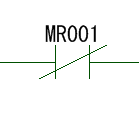
· B contact (OFF when passing through circuit)
b接点
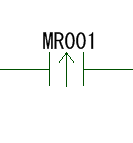
· Rising pulse contact (Pass only ON cycle)
立ち上がりパルス
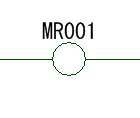
· Coil (ON when circuit is connected)
コイル
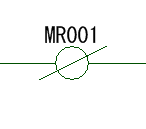
· NOT coil (OFF when the circuit is connected, ON if the circuit is not connected)
NOTコイル

Before creating a ladder circuit

There are a couple of things you want to be aware of when creating ladder circuits, and we will explain it based on that because there are a lot of merits to describe ladder circuits.

Input and output

Basically, PLC is sequenced as input and output as relay as externally exchanged.
Therefore, each PLC has a hardware connection destination.

· Input: Sensor, switch, encoder, etc.
· Output: Valves, lamps, motors, etc.

In the ladder circuit, input and output are used with the ladder circuit name.
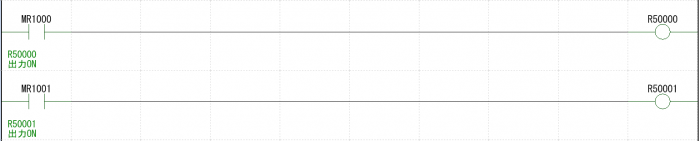
In this article
 Input: R2000, R2001
 Output: R50000, R50001
I will do that.
Other than that, MR001 etc. are used, but the internal switch (control inside the PLC).

These differ depending on the manufacturer of the PLC and the software of the ladder circuit.
Behavior of input and output is related to control of direct operation.

Although it is basic to make a program, please keep the simple part as much as possible as much as possible with the outside part.
It becomes easy to understand, and human error can be reduced.

How to use the input and output in the ladder circuit as simple as possible

Flow of operation of ladder circuit

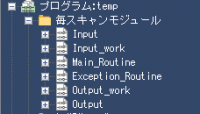
Depending on PLC and creation software, recent trend is to have more than one program drawing describing ladder circuit.
You can change the order by setting, but we will execute the program according to that order. Also, we will execute the ladder circuit in the program drawing in order from the top.

The following is an example of a program drawing.
program order
· Input: Program of receiving process from external input
· Input_work: Program of conversion from input
Main_Routine: Main control program
· Exception_Routine: Exception handling program
· Output_work: conversion program to output
Output: Processing program for external output
It was made.
In this case, in order from the top
“Input” → “Input processing” → “Main control” → “Exception control” → “Output processing” → “Output”
It has become.

Since it is flowing from input to control via control, if there is input, we will process immediately and go out. (Processing ends within one cycle)
If this order is ambiguous, it takes several cycles from control to output and takes time to output.
(The cycle depends on the PLC and the program amount, one cycle: several μs to several tens of ms)

In the order of “output processing” → “output” → “main control” → “exception control” → “input” → “input processing”
If there is input
“Input” → “Input process” “Main control” → “Exception control” “Output process” → “Output”
It will become.

described in the program drawing The ladder circuit runs from the top to the bottom of the program.
(When execution is completed to the bottom, it will run from the top of the next program drawing)

Therefore, let’s write from the top like ladder circuit description order like “input” → “control” → “output” .
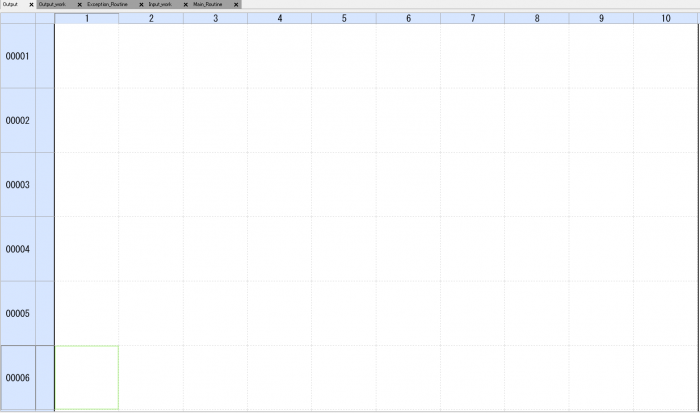
The following is a program drawing, and a space describing a ladder circuit
In the program drawing

It is also possible to divide the scan cycle (program execution cycle) by program drawing unit.
By dividing it, it is possible to reduce the load on the control unit and to make the scan cycle faster.
Because it depends on the manufacturer, please confirm with the instruction manual of the control device.

Setting and describing in consideration of program order and program cycle can prevent cycle delay etc

Basic ladder circuit

I will explain basic usage of the ladder circuit.

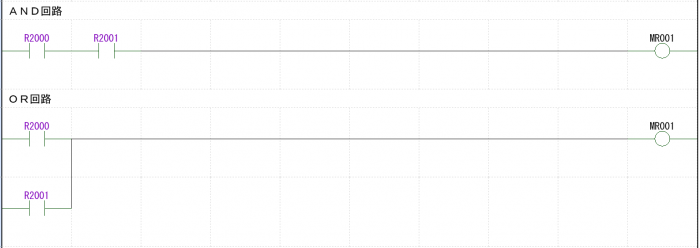
AND circuit and OR circuit (series circuit, parallel circuit)

It becomes the basic circuit in the basic.

· AND circuit (also called serial circuit)
Connect a contact to the coil side by side.
If all the conditions are not completed, the circuit will not be connected to the end.
In this case, only “R2000: ON”, “R2001: ON” is “MR001: ON”.

Switch1
(R2000)
Switch2
(R2001)
Coil
(MR001)
OFF OFF OFF
ON OFF OFF
OFF ON OFF
ON ON ON

· OR circuit (also called parallel circuit)
Connect vertically and a contacts to the coil.
If one condition is met, the circuit will be connected.
In this case, it is “MR001: ON” if “R2000: ON” or “R2001: ON”.

Switch1
(R2000)
Switch2
(R2001)
Coil
(MR001)
OFF OFF OFF
ON OFF ON
OFF ON ON
ON ON ON

And回路Or回路

The operation is complete with the condition and the operation is an AND circuit, the operation of any one is OR circuit

NAND circuit and NOR circuit

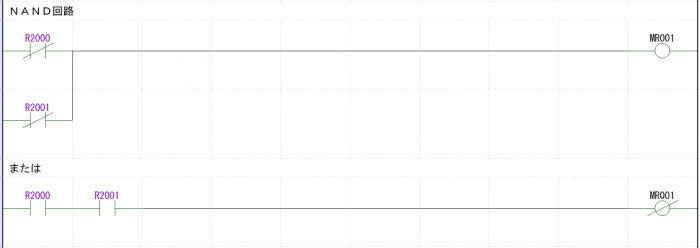
The NAND circuit and the NOR circuit mean the opposite of the AND circuit and the OR circuit (NOT), respectively.
Therefore, the operation of the coil is completely opposite.
First, I will explain the NAND circuit.

· NAND circuit
As you can see from the table below, the coil turns off when all the switches are ON.
Therefore, it can be made by setting the switch to b contact in parallel.
It is the reverse of the operation of the AND circuit. Therefore, it is also possible to make an AND circuit and make the coil NOT circuit.

Switch1
(R2000)
Switch2
(R2001)
Coil
(MR001)
OFF OFF ON
ON OFF ON
OFF ON ON
ON ON OFF

Nand回路

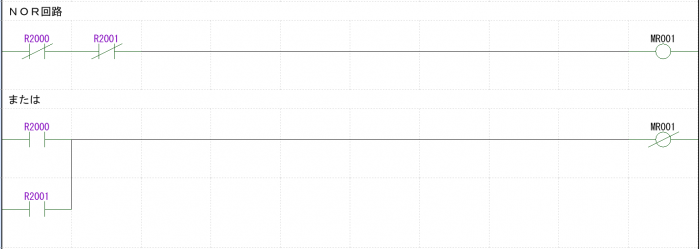
· NOR circuit
As you can see from the table below, the coil turns ON only when all the switches are OFF.
Therefore, you can make it by turning the switch to b contact in series.
It is the reverse of the operation of the OR circuit. Therefore, it is also possible to make an OR circuit and make the coil NOT circuit.

Switch1
(R2000)
Switch2
(R2001)
Coil
(MR001)
OFF OFF ON
ON OFF OFF
OFF ON OFF
ON ON OFF

NOR回路

The NAND circuit is the reverse of the AND circuit, the NOR circuit behaves in the opposite direction of the OR circuit

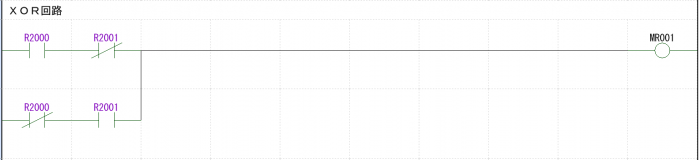
XOR circuit

It is also called exclusive OR circuit.
Although it may not be used much, you can express the behavior as shown in the table below.
When either switch 1 or 2 is ON, the coil turns ON (exclusive) circuit.

Switch1
(R2000)
Switch2
(R2001)
Coil
(MR001)
OFF OFF OFF
ON OFF ON
OFF ON ON
ON ON OFF

Xor回路

The XOR circuit is used with exclusive control.

Self-holding circuit (self-hold circuit)

I will explain the self-holding circuit.
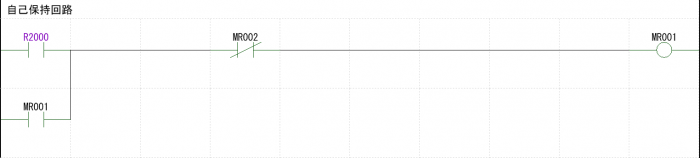
Also called a self-hold circuit, A circuit that continues to turn on the coil regardless of releasing the switch (switch OFF) once it is pressed .
Self-Holding Circuit

I will explain the flow of movement.
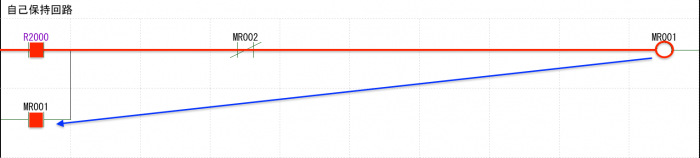
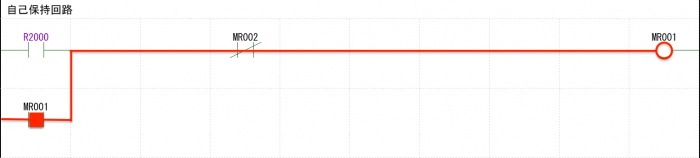
When the switch is pressed, the coil is connected and the coil turns ON. Then turn on the coil switch.
Self-holding circuit 2

Since the coil was ON at the previous cycle at the next cycle, the coil switch is turned ON.
The switch will be connected to the coil and the coil will continue to turn ON.
The ON / OFF of switch R20000 does not matter at this cycle.
Self-holding circuit 3
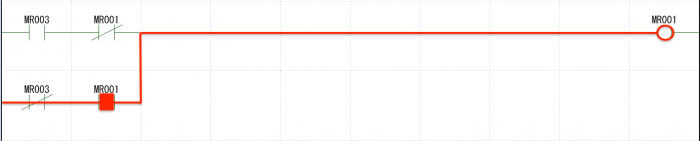
In the self-holding circuit, once the coil turns ON it can not be turned OFF, so here the switch MR002 for coil OFF is put in the circuit with b contact.
When turning ON MR002 while the coil is ON, the coil turns OFF.
Be careful not to be unable to control with deadlock (the coil can not be turned off).

Also, in terms of using coils, be careful with double coils.
If there are two or more coils with the same output name, it will not work properly.

The coil can be kept ON with a single switch operation. However, note Deadlock

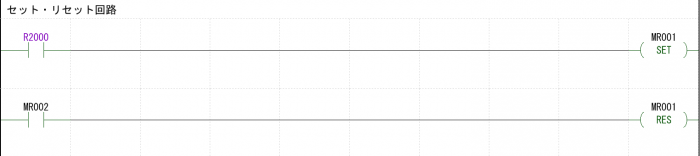
Set / reset circuit

The set / reset circuit is a circuit that holds itself. Therefore, ON is set and OFF is reset.
It is the same as the self-holding circuit and how to draw it is different.
set reset circuit
Let’s take care with resetting so that you can not control due to deadlock (the coil can not be turned off).

When using the set / reset output, let’s make the reset output at the same time after putting the set output.
Doing so prevents deadlocks. Moreover, it can prevent forgetting to move.

The same drawing method as self-maintenance is different. Likewise, note deadlock

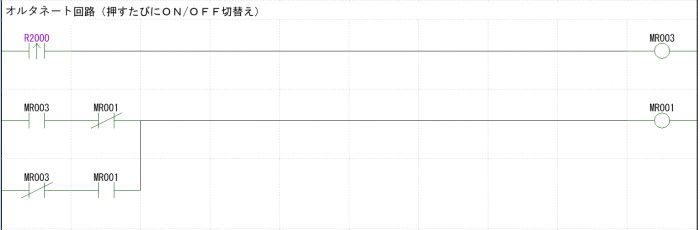
Alternate circuit (flip-flop circuit)

The alternate circuit repeats ON / OFF alternately each time you press the switch.
It is also called a flip-flop circuit.
Alternate circuit

I will explain the move from OFF → ON.
Turning ON the switch turns ON only one cycle scan pressed with the rising pulse. Coil turns ON at that timing.
Alternate circuit 2

The rising pulse of the switch is cut off at the next cycle.
However, because the coil is ON at the previous cycle, the coil switch turns ON and self-holding is applied.
Alternate circuit 3
Coil ON / OFF switches each time the

switch is pressed

The following books are easy to understand in detail as sequence control.
Please refer if you do not mind otherwise.
図解入門よくわかる最新シーケンス制御と回路図の基本 (How‐nual Visual Guide Book)

Basic stage circuit

I think that sequence control will be done step by step when program is written by ladder circuit.
By controlling step by step, control will progress one after another.
I will briefly explain the stepwise sequence movement at that time.

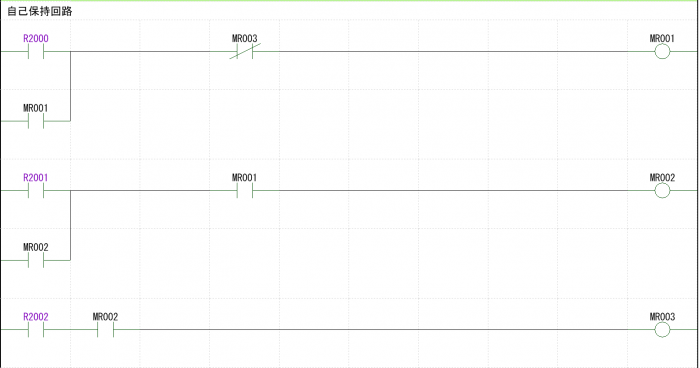
Step circuit of self-holding circuit

I put an example as a step circuit of a self-holding circuit below.
There are various patterns for making, so I think that you should make it easier for yourself to do.
As a flow of control,
“R2000 switch ON” → “first step processing” → “R2001 switch ON” → “second step processing” → “R2002 switch ON” → “processing end”
.

If you want to process with only the first stage processing, you can connect it next to move with AND circuit of “MR001: a contact” and “MR002: b contact”.
Self-holding circuit stage circuit

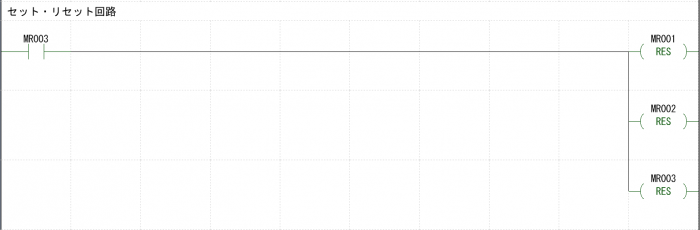
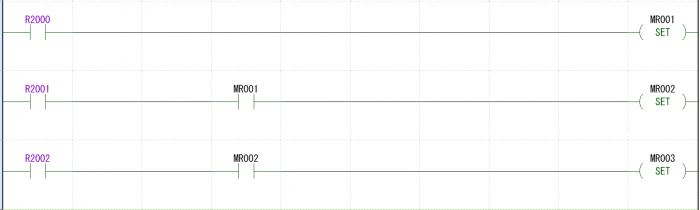
stage reset circuit stage circuit

It becomes an equivalent circuit made by set reset of the self-holding stage circuit earlier.
It is the same as the control flow,
“R2000 switch ON” → “first step processing” → “R2001 switch ON” → “second step processing” → “R2002 switch ON” → “processing end”
.
If you also want to process with just the first step processing, you can connect it next to move with the AND circuit of “MR001: a contact” and “MR002: b contact”.
Step circuit of set reset circuit
Step circuit 2 of set reset circuit

Proceed with control in the step circuit and make a series of actions

Devices of ladder circuit

I will explain a little bit about what I am careful about when I draw a ladder.
· Reduction in the visibility of parallel circuits
· Separate from command, interlock, output
· In case of solenoid valve control by output

Reducing the visibility of parallel circuits

Write a parallel circuit as follows.
However, as the number of switches in the parallel circuit increases more and more, the circuit grows vertically and it becomes very hard to see in the visual program.
ingenuity of parallel circuit

In that case, you can create an equivalent circuit as follows.
To make the parallel in series The AND circuit and the NOT circuit make it the same circuit.
It will be a little hard to understand, but as a program it will be very easy to see.
ingenuity of parallel circuit

Reduce mistakes by making ladder circuits as easy as possible

Malfunction prevention

I said basic is to make inputs and outputs as simple as possible. (Human error, prevention of bugs)
Besides that, there are caveats, basically we will draw in mind the prevention of malfunction.

· Do not use the input as it is.
Instead of leaving the input as it is, use it based on the prevention of malfunction.
I think that there is no problem even if you use the place where malfunction does not occur as it is.

When the sensor is on the standby side, when two points on the operating side are taken, it judges the standby side and the operating side from the state of the two sensors and uses it for the program.
It can not be said that sensors, switches, etc. will not break.
This is because we will not let the program advance in case of breakdown.

• Do not use motion commands as output.
I think that there is no problem even if you use the place where malfunction does not occur also as it is.
Use interlock (monitor / judge the state where operation is possible).

Always monitor and judge the condition for the output operation.
Pass it to the output with command + interlock.

Use input / output for preventing malfunction

In case of solenoid valve control in output

It is a point of improvement when using single solenoid or double solenoid in output.
When controlling the double solenoid valve, I think that 2 point output is connected.
Depending on the control state, both OFF and ON one way ON, but normally both ON can not be done.
Therefore, it is a method not to make both ON as control.

Also, if you program the double solenoid valve to control the single solenoid valve, it will be easier to correct the program when changing from single to double.

· Self-holding circuit
As a feature, R50000 and R50001 are not turned ON at the same time.
For example, when MR000 (MR010, MR011 is ON) turns ON MR1000 turns ON once.
At that cycle, R50000 does not turn on, and the circuit of R50001 is turned off. (R 50000, R 50001 turn OFF)
R50001 turns on at the next cycle.

Here, MR 100 (both output OFF) is making switch when you want to cut both.
double solenoid circuit

• Set reset circuit
It becomes the equivalent of the self-holding circuit the previous time.
Likewise, R50000 and R50001 are not turned ON at the same time.
However, when MR000 or MR001 (when MR010, MR011 is ON) turns ON, there is no cycle of both R50000 and R50001 OFF.
It turns ON / OFF immediately (at that cycle).
double solenoid circuit

With solenoid valve control, making a circuit with a double solenoid makes it possible to respond to changes immediately

The following books are easy to understand in detail as sequence control.
Please refer if you do not mind otherwise.

Categories
Electrical and electrical / electronic design

Electrical design 1 Electrical and electrical design corresponding to heat

Font size = “6”> Electrical and electrical design corresponding to heat

I will think about the influence of control board and temperature of electrical equipment / electric equipment as electric / electric design corresponding to heat.
I think that the safety factor etc. at the time of design will differ depending on the company, so I would be pleased if you read it with reference level.

Influence of control components and electronic components given by heat

There are three possible influences:

·lifespan
·safety
·function

· Longevity

Life span reduction can be expressed by “Arrhenius equation” which is an expression for predicting the rate of chemical reaction at a certain temperature.
Degradation of grease and oil deteriorates the life of parts that use it.
Moreover, its lifetime is not proportional to temperature, and its lifetime shrinks acceleratingly with temperature rise.
Especially for capacitors in electronic components talks.

· Safety

Basically it comes in contact with the skin as heat, it becomes whether the thing by heat in the atmosphere is safe.
Low temperature burns (contact with skin for about 40 ° C for a long time)
Rapid temperature rise
Contact in hot state and unaware
Besides this, when harmful gas is generated due to temperature rise, it needs to be taken into consideration.

– Function

In particular here I would like to explain ‘migration’ .
Migration has elements other than fever. In the first place, migration means that metal used as wiring or electrode moves over insulation, insulation resistance value decreases and failure / function degradation occurs due to insulation failure.
Migration has three types.
In the case of
Stress Migration
· Migration by metal being subjected to stress under temperature change environment
· Phenomena resulting in resistance increase and disconnection of wiring due to voids due to impurities or the like

Electromigration
· Migration by electron movement
· Easy to put on when the temperature is high
· Easy to handle when the current density is high

Ion Migration
· Electrochemical (accompanying electrolytic phenomenon) migration
· Easy to keep when the humidity is high

It is necessary to consider “life”, “safety”, “function” for control parts and electronic parts against heat

It will be helpful for books that are written in detail as thermal design.
Please refer to those who want to know more.
エレクトロニクスのための熱設計完全入門

Temperature design in control unit / control panel

I think that the way of thinking of heat itself is explained by the story of “The way of thinking of fever”.
This time we will explain the relation between the heat generation of the equipment and the heat dissipation of the electrical panel / control equipment box as an example.
The same way of thinking can be used in various places.
The contents to be considered in the temperature design inside the control device / control panel are

Calculation of calorific value
Calculation of heat dissipation

Calorific value calculation, heat radiation amount calculation.
The flow of design is as follows.
Design flow 1

For flow, calculate “calorific value” → “Calculate heat dissipation amount of (box)”.
Here, in the case of “calorific value”> “heat dissipation amount”, “ventilation opening” is provided as “radiator design” to calculate “natural ventilation heat radiation amount”.
Consider whether there is heat dissipation in ventilation (taking safety factor into account) more than “calorific value – heat dissipation amount”.
If it is still not enough, we will do “Calculate forced ventilation heat radiation amount” with fans etc. in the ventilation opening.

Then let’s consider the calculation of “calorific value” and “heat release amount”.
Below is an image diagram of heat generation and heat dissipation.
Box heat dissipation

· calorific value calculation

It is the sum of the calorific value of the equipment itself.
If the calorific value is unknown, please obtain the power consumption [W] from the current consumption of the equipment itself and the loss current.
I will give it as an example of a control panel.

· heat dissipation calculation

It will be the temperature to radiate to the surroundings from the box itself.
Board heat radiation
Board heat value
Here, we use the heat passage rate U [W / m 2 / K].
General control equipment box (iron · painted) is about 4 ~ 6 [W / m 2 / K], but it changes somewhat depending on the environment.
The target temperature inside the box here is set to the temperature at which the control life of the control equipment is calculated.
If there is more than one control device, set the lowest temperature among the temperatures that the device calculates in life calculation.
The effective heat radiation area is the surface area of ​​the box.

For example, assuming that the target inside temperature is 55 [° C.], the atmospheric temperature is 40 [° C.], the effective heat radiation area is 2 [m 2], and the heat amount is 1000 [W], when the heat passage rate is 5 [W / m 2 / K]
Qr = 5 * 2 * (55 – 40) = 150 [W]
Heat radiation design from the box itself Qr For heat generation quantity Q of the equipment, heat radiation design is required.
In this example, (1000-150) = 850 [W] further heat dissipation is required.
If you do not need estimate of heat transfer rate please skip to “heat radiation design”.

When the calorific value slightly exceeds the heat radiation amount (multiplied by the safety factor), it is necessary to respond to changes such as changing to a material with a high heat passage rate, increasing the effective heat radiation area with a heat sink or the like.
If the calorific value is still exceeded, it is necessary to consider the “heat dissipation design” described below.

Estimating Heat Transfer Ratio
If you do not know the heat transfer rate please estimate from the following.
Below is the cross section of the inside and the outside of the box.
Flow chart that heat flows through the wall
Heat Passing Ratio
. As a way of transferring heat, internal temperature T → board surface Th 1 → external plate surface Th 2 → external temperature (atmospheric temperature) T 0 will be transmitted.
The heat transfer coefficient h1 [W / m2 · K] inside the box, the heat transfer coefficient h2 [W / m2 · K] outside the box, the plate transfer rate is the plate thickness t [m] of the box, the box It is derived from the thermal conductivity λ [W / m · K].

To obtain this we need the following
heat transfer coefficient
The heat transfer coefficient h1 is obtained from the convective heat transfer coefficient ha inside the box and the heat transfer coefficient h2 is obtained from the convective heat transfer coefficient hb of the box outside and the radiative heat transfer coefficient hε.
The convective heat transfer coefficients ha and hb vary with the flow velocity of the fluid.

Below is a table of air heat transfer coefficient and wind speed.
Air heat transfer coefficient
In addition, radiative heat transfer coefficient h ε is heat dissipation due to radiation heat generated from the plate.
radiative heat transfer coefficient

5.67 * 10 ^ 8 is what is called the Stefan Boltzmann constant.
Ε is the emissivity and I think that it should be around 0.6 to 0.9. Also, I use Th1, Th2.
Although it is not accurate, I think that it is good at the middle (T – T 0) / 2 + T 0 inside and outside the box in estimation.

Example: emissivity 0.8, Th 2, 47.5 [° C], flow rate of the atmosphere in the box 1 [m / s], flow rate of atmosphere outside the box 0.5 [m / s], box thickness 0.003 [m] When the rate is 50 [W / m · K]
Atmospheric flow velocity 1 [m / s] → Convection heat transfer coefficient 8 [W / m 2 · K]
Atmospheric flow velocity 0.5 [m / s] → Convection heat transfer coefficient 4.5 [W / m 2 · K]

H 1 = 8 [W / m 2 · K]
(47.5 + 273.15) ^ 4- (40 + 273.15) ^ 4) / (47.5-40) = 4.5 + 5.78 = 10.28 [W / m 2 · K]
T / [lambda] = 0.003 / 50 = 0.00006 [W / m <2> K]
U = 1 / (1/8 + 0.00006 + 1 / 10.28) = 4.50 [W / m 2 · K]
I think that I will explain the way of thinking in the concept of fever.

If heat radiation can not be made in time, it is necessary to consider heat dissipation in “natural ventilation” “forced ventilation”

Heat radiation design inside the control device / control panel

We also made calculations for the amount of heat dissipation in the box.
In case of “calorific value”> “heat dissipation amount”, we will adopt the method to be described from now.
The amount of heat dissipation in the ventilation to speak under this should be “(heat release by ventilation)”> “calorific value” – “heat dissipation amount of (box)”.

Calculation with natural ventilation “Calculation of natural ventilation heat radiation”

Natural Ventilation Thermal Diagram
It is an example of natural ventilation heat radiation. In natural ventilation heat dissipation, there is a method to set the ventilation port so that the temperature inside the box approaches the ambient temperature. I will leave the movement of the gas to nature.
Calculation of heat radiation amount is as follows.
Natural ventilation heat radiation

natural ventilation value
I think that the atmosphere is usually air. The density of air is 1.154 [kg / m 3] and the specific heat of air is 1018 [J / kg ℃].

For example, the target inside temperature is set to 55 ° C., the temperature near the ceiling in the box is set to 58 ° C., the ambient temperature is set to 40 ° C., the area of ​​the ventilation opening for execution is 0.05 m 2, the height of the intake port-exhaust port is 0.3 m ] And
Heat radiation amount Q = 1018 * 1.154 * 0.05 * √ ((2 * 9.8 * 0.3 * (55 – 40)) / (273.15 – 40)) * (58 – 40) = 561.12 [W]

Heat generation amount 1000 [W]> heat radiation amount of box 150 [W] + natural ventilation heat radiation amount 561.12 [W] = 711.12 [W], so further heat radiation is required.
When the calorific value slightly exceeds the heat release amount (multiplied by the safety factor) like this, it is necessary to increase the effective ventilation area, increase the difference between the exhaust port and the intake port height, and so on. In some cases it is necessary to think about how to set the limit of ambient temperature (temperature limit on use). If we can not respond, we will consider heat dissipation in the next forced ventilation.

Calculation with forced ventilation “Calculation of forced ventilation heat radiation”

Forced ventilation heat dissipation
An example of forced ventilation heat dissipation. In forced ventilation heat radiation, unlike natural ventilation heat radiation, it is a method to forcibly move a gas with a fan or the like to bring the temperature inside the box close to the ambient temperature.

Calculation is as follows.
強制換気放熱風量

強制換気値

Normally, I think that the atmosphere is air. In that case the air density will be 1.154 [kg / m 3] and the specific heat of air will be 1018 [J / kg ℃].

For example, if the remaining required heat radiation amount is (heating value 1000 [W] – total heat radiation amount 711.12 [W]) = 288.88 [W], the in-box target temperature is 55 [° C.], and the ambient temperature is 40 [
V = 288.88 / (1.154 * 1018 * (55 – 40))
 = 0.0164 [m3 / min] and so on. (This value is the air volume)

When selecting, please find a fan more than this with the safety factor multiplied by this.
If there is no fan to be selected or if the heat exceeds the ventilation opening, it is necessary to limit the temperature within the design range by limiting the ambient temperature (temperature limit in use).

If heat radiation can not be made in time, it is necessary to consider heat dissipation in “natural ventilation” “forced ventilation”

In this way, it is necessary to solve the heat problem beforehand on the design.
It is invisible and inaccessible, but if you do not do it you will encounter serious eyes later.
Let’s raise the design accuracy as compared with what we did.


It will be a reference for books written as thermal design from various angles than what we have talked about until now.
It becomes a book of thermal design that can be used for electrical designers.

Categories
Control design

Control design1 Image control camera selection ~ control

画像制御 カメラ選定〜制御

From now on, products and facilities by image recognition and image control will increase more and more.
Accuracy and design method will also change accordingly. Here I would like to explain how to use in an easy-to-understand manner.

Inspection by imaging equipment, measurement example:
Keyence_CV-Xシリーズ参考
©Keyence/CV-Xseries

I was thinking of writing in the order of development, but I especially wanted to write it earlier, as there was a request for this topic.

Flow of image control and design

In order to incorporate and use the imaging device, it is necessary to easily consider the following as a design.

· What to do (measurement, recognition)
· Where do you want to see?
· Work distance
· Required precision
· How to maintain

· What to do (measurement, recognition)

Compare with model image (pre-registered image)
→ OK / NG or presence / absence judgment
→ Measure model image position
Specify measurement range from image and measure
→ Detect edge and measure position
→ Detect circle and measure position

· Where do you want to see?

Only the shape of the edge of the work
→ Transmission lighting · Backlight lighting
→ gray or black and white camera
(Grayscale, binarization process)
(Projection of shape: It will be like a shadow picture)

I want to suppress disturbance light and diffused reflection against a work
→ dome lighting · ring lighting
(Lighting surrounding the camera)

I want to increase the amount of light to work, I want to add lighting
→ Bar lighting
→ Spot lighting
(When you want to increase partial illumination, shutter speed, etc.)

I want to see fine scratches, shallow grooves
→ blue lighting color, camera color filter

I want to ignore a specific color
→ Color filter of camera
→ color camera

I want to judge by color
→ color camera
(Judged from hue, saturation, brightness)

Color filter (I want to ignore a specific color)
Grayscale (contrast only)

– Work distance

→ Work distance
(Distance between work and lens, field of view range)
→ depth of field
(Variation in distance to workpiece)

Required accuracy

→ Direct Accuracy
(Lens magnification, area to be received (imaging area), number of pixels)
→ accuracy and range that you need to think
(Distortion of lens (distortion), allowable focus blur amount (permissible circle of confusion))

How to maintain

→ White balance
(Gray card (reflectance 18%))
→ Work reference position
→ Calibration of camera coordinate system and work coordinate system

Let’s put these in one corner of the head and take it into consideration in the selection.

Prior to selection (pixel, idea of ​​camera)

pixel

A pixel or pixel is the smallest unit that can display image information.
It means that you can represent an image with 2 million pixels (2 megapixels) ≈ 2 million points (image information). Simply put, it is resolution.
The size of the light receiving element of the camera itself is relevant. The range of the field of view is determined by the area to be received (imaging area) and the magnification that can be captured by the lens.
Since the field of view can be displayed by the number of pixels, the precision that can be represented by one pixel can be obtained.
Therefore, accuracy and viewing range change with combination of “number of pixels”, “area to receive (imaging area)” and “magnification of the lens”.

subpixel processing

It is a method to virtually calculate between a pixel and a pixel. It is judged as a numerical value intermediate between the value acquired by the pixel and the value acquired by another pixel and displayed.
Although it is not actually captured values, the ambiguity of the image (extremely small change is unlikely to occur in a very small range)
It is a method that complements the value as. Suppress errors when measuring edges from images.
However, I think that it is better not to set the tolerance of the resolution to be the minimum.
(Resolution of camera = number of pixels, number of pixels * 2 not to be taken)

サブピクセル処理の考え方

Bayer array

In the case of a color camera, elements arranged through filters of red, green and blue (RGB) are arranged side by side.
Although it recognizes color, actual pixel size does not become the tolerance of camera resolution.
(It will be doubled.)
Therefore, when importing with grayscale, it may be better to capture with a black and white camera.
Some manufacturers complement their resolution by subpixel processing.
Depending on the camera, if you want to know more, please contact each manufacturer.

ベイヤー配列の考え方

Accuracy and field of view change with combination of “number of pixels” “area to receive (imaging area)” “magnification of lens”

How to select camera / lens

Field of View and Accuracy

In considering accuracy, you need to pay attention to the following points.
Direct Accuracy: “Lens magnification” “Area to receive (imaging area)” “Number of pixels”
Accuracy that needs to be considered, range: “Distortion of lens (distortion)” “Amount of blurred focus (permissible circle of confusion)”

“magnification of the lens” “area to receive (imaging area)” = field of view
The range of the field of view is determined by the combination of the camera and the lens. Where the camera and lens sell together, I think that the distance (working distance) from the lens to the workpiece and the graph of the field of vision are provided as follows.

The following is a view of the table as an example.
ワーキングディスタンス確認

Select the camera and lens at the point of intersection from the distance from the lens to the work (working distance) and the field of view.
In this graph, the working distance is 110 mm and the field of view (long axis) is 11 mm.

“Number of pixels” “Viewing range” = Direct precision
Consider the case of 2 million pixels (in the case of 1600 x 1200, exactly 1.92 million pixels) and the field of view 11 mm x 8.25 mm.
11 [mm] / 1600 [pixel] = 0.00688 [mm / pixel] = 6.88 [μm / pixel]
. However, this can not be used as it is as precision.

lens distortion (distortion)

Distortion always exists in the lens Especially distortion is likely to occur at the edge of the lens. Therefore, when you use it, the range becomes narrower, or you need to think based on examination. Some applications convert to a coordinate system without distortion.
As the end of the lens is distorted, it can not be used accurately like other parts of the lens.

Below is the image of distortion aberration.
歪曲収差のイメージ

Here, the range without distortion is within the range of the red frame in the figure below.
ディストーション

There are optical distortion ratio or TV distortion ratio in lens specification. The relational expression in this case is as follows.
Optical distortion
光学ディストーション式

TV distortion
TVディストーション式

As an example, we will explain it as optical distortion 0.1% in the case of the field of view (11 mm x 8.25 mm).
The calculation is omitted, but Y = 6.875 mm, y ‘= 6.868 mm.
Therefore, it is necessary to limit the actual field of view (usage range) to 10.99 mm x 8.24 mm, or to make correction calculation that takes distortion into account.

– Allowable out-of-focus blur amount (permissible circle of confusion)
The amount of blurred focus that is allowed when it is regarded that the subject is in focus
If it is not specified, I think that it is one pixel worth.
許容錯乱円の考え方
Here, as an example from the previous example, considering 5.5 [μm] x 5.5 [μm] per pixel, the accuracy becomes worse accordingly.

· To what extent does accuracy need to be considered after all?
“Direct Accuracy” + “Accuracy, range that needs to be considered” is the accuracy and range when images are acquired with the camera.

Considering the 2 million pixel camera so far, and the field of view range 11 mm × 8.25 mm, “direct accuracy” is 6.88 [μm / pixel].
“Accuracy necessary to think” is 5.5 [μm] of permissible circle of confusion
Total accuracy = 6.88 [μm] +5.5 [μm] = 12.38 [μm]
You can detect more than 24.76 [μm] from the idea of ​​sampling (more than twice) from this camera and lens.
However, it is assumed that the subject is in focus.
The usable range is 10.99 mm x 8.24 mm.

· Mounter shape of lens and camera
At the end of the selection of the camera and lens, there are many types of mounters with lenses and cameras attached.
There are various kinds such as C mount, CS mount, M12 mount, etc. It will differ in diameter, screw pitch and so on.
I think that there is no particular problem when purchasing a camera and a lens that are compatible with the same manufacturer.

Selection of the camera is done by finding the precision desired to see from the lens and the camera

Selection of lighting

Lighting selection becomes very important.
It depends on the shutter speed, the depth of field, and how to recognize the image.
If you actually try using the image and trying it out, a case may arise that is different from your mind.

Difference in light application by material

Work image on metal (engraved on metal)
Since light reflection is strong, regular reflection (direct reflected light) is used
→ Apply light from the front

Work image under film (work under reflective object)
Halation (reflection of lighting) is strong, so diffuse reflection (not directly reflected light)
→ Apply light at an angle

· Work image under the thin paper etc.
Since the reflectivity of the paper itself is bad, it is difficult to see the underlying paper
→ Apply light from the bottom of the paper (Transparent illumination)

Functional lighting differences

· Only the shape of the edge of the work
→ Transmission lighting · Backlight lighting

· I want to suppress the disturbance light and the diffused reflection against the work
→ dome lighting · ring lighting
(Lighting surrounding the camera)

· I want to increase the amount of light to the work, I want to add lights
→ Bar lighting
→ Spot lighting
(When you want to increase partial illumination, shutter speed, etc.)

· I want to see fine scratches, shallow grooves
→ blue lighting color, camera color filter

· I want to ignore specific colors
→ Color filter of camera

Lighting also affects camera image recognition depending on position, strength, color

Pint setting / way of thinking

If focusing is best, it is best that the distance between the lens and the workpiece varies depending on the workpiece.
It is also possible to expand the range of focus.
It is possible to adjust the amount of light.

F value

 People who have used cameras at the border are the part of the aperture. I think that you can understand Brightness is adjusted by this aperture.
An indicator showing the brightness of the lens. The smaller the F value is, the brighter it is.
The brightness through the lens is 1 / (F value * F value)

depth of field

Even if the workpiece surface moves back and forth with respect to the lens, it will be in a range where the focus can be clearly received without blurring.
Let’s examine how much the work varies with the lens first.

I will explain the calculation as an accurate range.
First of all, optical magnification is necessary.
Please stop it from the lens or the following formula.
Optical magnification M = one side of the receiving surface (one side of the imaging surface) / one side of the field of view range
Example: (H of imaging surface) 8.8 mm / (field of view H) 11 mm = 0.8

Next, execution F is necessary, and the calculation formula is obtained from F value.
Execution F is a value representing brightness in distance.
実行F値式
Execution F = (1 + optical magnification) * F value
FNO: F value, M: optical magnification
Example: (1 + 0.8) * (F value) 2 = 3.6

We will calculate the depth of field.
被写界深度式

Depth of field = 2 * (permissible circle of confusion * execution F) / (optical magnification * optical magnification)
C: permissible circle of confusion, F: execution F, M: optical magnification
Example: 2 * (0.01 * 3.6) / (0.8 * 0.8) = 0.11 [mm] width

The larger the F value, the darker the depth of field becomes wider. I will briefly explain the features.
Characteristic:
The larger the F value is, the larger the depth of field becomes. (The more the focus value is blurred, the more it is focused)
When the focal length is short, the depth of field decreases
The depth of field decreases if the work is nearby

Selection of the camera is done by finding the precision desired to see from the lens and the camera

The image detection method (mechanism of edge detection method) etc. uses the method of each control device, so we will skip this time.
From here, I will tell you how to devise how to relate an image to an actual work (how to control from an image).
Therefore, please refer to this book if you would like to know more about the mechanism of image processing method.
図解入門よくわかる最新画像処理アルゴリズムの基本と仕組み (How‐nual Visual Guide Book)

Image control method

On the control of the image, it is better to consider the content described below as a minimum.

· Difference in coordinate system
· Setting method of detection range
· Devices for model search
· Devices for edge detection

Difference in coordinate system

I am taking pictures with the camera, but what I want is the original coordinate system of the workpiece.
It is not necessary to judge OK / NG etc, but it is necessary when using position or measurement.

The image is as follows.
座標系の違い

In the case of a moving work, move at least two points on the screen and if there are mechanical standards, calibrate it by also taking two or more points on the screen so that you can know the position on the screen based on it. If there is no calibration of the coordinate system, tilt from the 2 point position, multiply the intercept of the work coordinate by sending an intercept can convert from the camera coordinate system to the work coordinate system. Please do this calculation and figure out the position.

This time I will show the conversion from the angle difference of the axis easily. As a method there is not limited to this, please consider it because there are various ways.
Let’s say that the axis (x, y) of the coordinate system of the camera and the axis (X, Y) of the coordinate system of the workpiece are tilted (angled) as shown below. At that time, compare the value when only one axis of the coordinate system of the work is changed with the coordinate system of the camera.
座標変換1

At this time angle θ can be expressed as follows.
座標変換1

The converted ratio of the coordinate system of the workpiece from the coordinate system of the camera is as follows.
変換比率

Once we find the conversion constant like this. (The X side will do the same.)
From there, expand the transformation formula to arbitrary coordinates as below and consider it as work coordinates.
任意座標に展開

y変換式

x変換式
A: Conversion ratio of work coordinate Y axis
B: Conversion ratio of work coordinate X axis

How to set detection range

The range will be minimized if the actual work is repeated at the same position each time.
Therefore, let’s design to come to the same position as much as possible. However, I will not go that far.
Even if you try to come to the same position, let’s consider the following.

· Machine stacking tolerance, machining tolerance, assembly tolerance (generated by reassembling, negligible by calibration)
· Processing tolerance of work (variation of work)
· Other design considerations

Let’s set the detection range beyond the maximum design tolerance which adds all these.

ingenuity at model search

It is a method of finding the actual work position / work presence / absence from the reference model image (reference work figure).
It depends on the manufacturer, but I am looking for with the appearance of edge and color recognition.
Therefore, you may not be able to detect without paying attention to the following.

· Do not make models too small
· Do not give model recognition sensitivity (correlation value level: consistency) too high
· Shape and color similar to model do not exist in detection range

The model search compares and identifies the position and orientation of the work in any state.
However, it takes time to detect if the detection range is too wide or if the direction corresponds to 360 °.
It is better to regulate the detection range as much as possible and regulate the detection orientation (direction of comparison of model images).

ingenuity at edge detection

Here, we will explain in particular the points to note when using images as measurements.
For the majority of model comparisons and measurements, we will extract the change part of color (gradation derivative) as an edge.
In the model comparison, since it is judged to what extent it is close to the model image, it is not necessary to stick to detection much, but in case of measuring from the edge (measured at the change portion of the shading), caution is necessary.

The center of gradation change (the original edge) and the place the image recognizes as an edge are somewhat different.
In addition, edge sensitivity needs to be changed depending on the material. (Because metals have high reflectance and papers have low reflectance)

Below is the image image.
We set the sensitivity to recognize as an edge (here 50 is slightly different in position)
エッジ検出時の誤差

In this way, the center and difference of the actual change come out. If we take the “center of the range captured as an edge” (the center of the place where the edge sensitivity is 50% or more here), will it match “the center of change”? I think that some degree of error comes out because the degree of change (sensitivity) of the image does not change uniformly depending on the color. Therefore, calibrate the position of the image and the real thing, or devise the measurement method.

As a measure of the measuring method, not extracting the position from one edge but extracting the other edge, and using the center of that edge and edge as the measurement point.

Although the figure above was “White → Black”, I will try to detect the edge from the reverse direction in another place (another edge) where it changes to “Black → White” as it is.
By doing so, it prevents a difference from occurring due to focus blurring etc.

I will explain with a simple figure.
エッジ検出の工夫の仕方

The edge is detected with the same edge sensitivity from the opposite direction. The center of the position of the edge in the forward direction and the center of the position of the edge in the opposite direction is the center of the actual work. By doing so, the criteria detected from the work center and the edge are the same.

These “image control methods” are just a part of the control. It can be applied to many things and can be utilized. Please try it.

It can be applied to considerable precision and various things depending on the ingenuity.

trend of recent image processing device

The image processing device was mostly that maintenance and adjustment were very difficult.
Recently, simple image processing devices (sensors) similar to tuning-less, fiber sensor, photoelectric sensor are coming out.
I think that it will gradually increase from now on.
It seems that it will become mainstream not only as FA (factory automation) but also as a technology addition product.

Image processing technology gradually becomes widely used in various fields

Was it helpful? There are various other methods, and each maker is changing to a method that can be done more easily.
However, there are things such as precision and speed unless you consider it, so let’s design firmly there.

The image detection method (the mechanism of edge detection method) etc. uses the method of each control device, so we omitted this time.
If you want to know more about the mechanism of image processing method, this is easy to understand.

Categories
Flow of development

Avoid the danger! Risk assessment

Avoid danger! Risk assessment

Risk assessment is a way to grasp whether the dangers of products and equipment made are not hidden as logical thinking.
Therefore, the risk here is not a risk of product strategy or product quality, simply speaking as a risk as “safety”.

リスクアセスメント注意ラベル

1. Why is there a need to think about safety?


1. Manufacturer responsibility has been questioned for safety against products.
→ It can be said that designing with risk taken into account in product design is made even when it comes to a situation where responsibility is required

2. It is time to question CSR (corporate social responsibility).
→ International standards It is stipulated that manufacturing competition will be done with safety ensured as ISO

3. Large damage amount
→ It can be a civil lawsuit without having to be a criminal case. In that case, it will expand from tens of millions to billions of yen yen at the compensation responsibility

4. Can not sell overseas
 It is asked whether the risk assessment was carried out even overseas certification such as CE and CCC.

It is becoming an era where supplier liability is strictly questioned

2. Why are you making noise in Japan?


Japan is still country under risk aversion ! It is!

As for what it means, there are two ways of thinking about safety design.

· Danger detectable
When it becomes dangerous, send a signal and control and display
→ In the event of a sensor malfunction or the like, it does not detect danger and it operates.

· Safety confirmation type
Only when safety is secured, signal transmission control.
In case of sensor failure or the like, it does not operate because it does not detect safety.

Japan is rather dangerous sense type of the former.
In Europe and the United States, the latter safety confirmation type is mainstream.
Because it will not move unless it is safe,

Japan is a country undergoing security measures

3. What should the designer do?


First of all, we have to make products with intrinsically safe design (not dangerous, not approaching danger, not making danger).

Nevertheless, when the danger can not be avoided by any means, the designer must make efforts to reduce the danger according to the level of the risk.
It is a risk assessment that leaves them as a form.
The level of risk in this case is as follows.

Risk level = magnitude of injury + contact frequency + probability of injury

As I will explain in detail later, it is to judge correctly whether this risk level can be accepted as a company.
It is the designer’s job to use the judgment to do the following.

· Minimize risk
· Make the user recognize the risk
· Present usage without risks

Essentially it does not have risks without making risks

4. Risk assessment flow

Risk assessment is done by multiple people so as not to miss as much as possible.
I will explain the flow easily.

Below is a diagram of the flow of risk assessment from safety design.
安全設計からリスクアセスメントの流れ。最大限に安全を見つめ直す

We will consider as early as possible in the design stage.
Because, if it is retrofitted, it will only protect the safety guards.
→ Cost rises, maintainability, operability is affected.

1. Intrinsically safe design

· It is not dangerous
· Do not approach danger
· Do not make danger
Is it supposed to be

“1. Intrinsic Safety Design” will not be explained as it will vary depending on the product, but let’s design it so as not to be dangerous.

2. Clarification on Product Usage

· Who, when and how to handle

“2. Clarification on Product Usage” becomes important in conducting risk assessment.
· Who is the product user?
· Are there any changes in hazards depending on the operating environment?
· How do I use it?
· Is there a possibility of encountering danger other than usage?
· Who maintains the product?
· Do you encounter maintenance danger?
· Hazards do not appear as synergies when using tools and other instruments?
· Are there any risks encountered by other third parties?
As we use it, we will identify the hazards along the flow of work.

3. Identify hazards and hazardous conditions

· Type of danger: impact, entanglement, noise, vibration, electric shock etc.
· Danger status: size of disorder, frequency of contact, avoidance from danger

“3. Identification of hazards and hazardous conditions” will correctly describe the situation of hazards sources from the contents that were done in 2..
Here, the same hazards of the same part that spans use can be summarized.
However, even if it is the same part, if the type and state of danger differ, it should not be summarized.

4. Risk Estimate

  · Estimate the risk level

For “4. Risk Estimation”, we will quantify each risk level from the type and state of the danger done in 3.
By numericalization, we will visualize the priority of improvement against danger.
However, since it may be influenced by the values ​​of each designer in setting this risk level,
I think that it is better to decide certain rules in advance.

5. Evaluation of risk itself

· Determine whether it is acceptable or not for risk level
· If there is a range where the risk is unacceptable, repeat it from the beginning

“5. Evaluation of Risk itself” will decide how to respond from the risk level quantified in 4 in the future.
Depending on the value of the level, we will classify “unacceptable levels”, “remaining risk” and “acceptable levels”.
· If it is “unacceptable level”, review the design and lower the level or eliminate hazards.
· If it is “residual risk”, we will rethink the design and lower the level or notify the user of the risk and leave it as a user’s responsibility.
· If it is “acceptable level”, we will promote product design by notifying the user of the risk depending on the situation.

It is best if there is no risk to the product, but it seems that it can not be done anything to make it zero.

The following books are helpful for details of the flow of risk assessment and how to respond at the manufacturing site.
製造現場等におけるイラストで学ぶリスクアセスメント 第1集

5. Identify hazards and hazardous conditions

As I mentioned briefly earlier, after extracting hazards, we will consider risk levels one by one for hazards.
The following are the main items to look for hazards.
· Mechanical
Crushing, shearing, cutting or cutting, entanglement, retraction, impact, rubbing or scuffing, injection or ejection of high pressure fluid
· electrical
Direct contact, indirect contact, electrostatic phenomenon, thermal radiation or thermal phenomenon · short circuit, external influence on electric device
· Thermal
Burns caused by fire or explosion, burns and other disasters, causing health problems
· noise
Hearing loss, other physiological malfunction
· vibration
Hazard source by vibration
· light
Diminished vision and health problems due to light
· Failure of power source
Failure of energy supply, unexpected operation, loss of safety

危険源特定
These contents are not all.
Depending on the content you need to add. Also, depending on the company, I think that the contents to be prioritized and details to be viewed in detail are different.

Identifying hazards sources can lead to activities of risk reduction

6. Risk level thinking

As I explained a little bit earlier, the risk level can be expressed as follows.

Risk level = magnitude of injury + contact frequency + probability of injury

However, this is one of the risk assessment methods.
As a method
· Addition method (add risk element)
The above method, the most used in Japan
· Integration method (accumulate risk factors)
Sometimes the effect of risk reduction seems to be large
· Matrix method (expression with risk as a table)
Can not be reflected in fragmented risk
· Lithograph method (Risk expressed as chart)
Risk comparison is easy. But I can not do much classification to evaluate
there is ………, ………, etc.
I will explain with addition method.
Other methods will be omitted.
Let’s explain each item of the addition method.

o Size of injury

The size of the injury will be based on “magnitude of force”, “space to escape” “range to be covered” and will create standards.
Size of force: impact, thrust, speed
Space to escape: space to relieve force
Area covered: Number of people, range of body at risk
It becomes important.
For example, “I pulled my arms in a place that was crushed to 2 mm of clearance at a speed of 5 mm / s with a force of 20000 N”
If you think, your arms will break.
But, “I got my fingers in the place where the force of 20,000 N, crushed to the gap of 300 mm at a speed of 5 mm / s”
It seems that it will not get caught when becoming. (I think impact will be added)
The concept of “escape space” and “range to be covered” is also included in the JIS standard.
As an example, the minimum clearance for avoiding crushing (JIS B 9711)
Body: 500 mm or more
Leg: 180 mm or more
Toe: 50 mm or more
Arm: 120 mm or more
Hands: 100 mm or more
Finger: 25 mm or more
押しつぶし回避の最小隙間。この場合はうでで、120mm以上必要です。
I think that it is good to refer to.

Based on these assumptions, we will classify the following.
· mortal wound : injuries leading to death or permanent labor inability
· Severe : serious injury (injury requiring long-term care) and injuries remaining
· minor injuries : accidents involving lost work and injuries (injuries that can be recovered at all)
· minor injuries : injury injuries that can return to the original work immediately after the allowance
This is an example and I think that strict numerical values and standards are different for companies, but it will look like this.

Some companies assign “injury class” on the assumption that injuries remain after the accident.
傷害程度・度合い。程度により致命的なものから軽微なものまで範囲があります。

○ Contact frequency

The frequency of contact is the frequency of approaching a hazard.
I will divide it as follows as a guide.
· Frequently : 3 times or more / 1 day
· occasionally : 1 to 2 times / day
· Rarely : at least 1 / week
Again as before, I think that strict numerical values and standards are different for companies, but it will look like this.
危険源に近づく頻度。週に数回程度から時間に数回など近づく頻度になります。

o Probability of injury

The probability of injury will be based on “detectability of danger” and “avoidance from danger”.
The probability of occurrence of risk depends on whether it is an easy-to-understand hazard.
Danger is perceived differently in “Blade in front of you” and “Blade in place hidden behind the shadows”. Of course it also leads to avoidability.
As avoidance from danger, consider whether you can avoid or encounter hazards.
· Safety distance to prevent reach of upper limbs / lower limbs (JIS B 9718)
Distance not reaching hazards
Arm: opening 120 mm or less, distance to hazardous source 850 mm or more
Hands: opening 30 mm or less, distance to dangerous source 200 mm or more
Fingertip: opening 6 mm or less, distance to dangerous source 10 mm or more
Leg: opening 95 mm or less, distance to hazardous source more than 1100 mm
Below is an illustration of an arm case
  腕の安全距離 この場合は腕の安全距離になります。850mm以上離れていれば安全と規格では見なしています。
· Response time of safety guards (JIS B 9715)
S = (K * T) + C
S: Distance from detection point to hazard source, K: Part approach speed (upper limb 2000 mm / s), T: Time to eliminate hazards, C:
If this is a detection device, if the safety protection device is activated or the machine is stopped and the hazards are gone, consider using this formula.

Based on these, we will divide it as follows.
· certainty : can not detect / can not be avoided
· highly likely : can not be detected unless careful / can not be avoided without expert knowledge
· There is a possibility : It can be avoided if you can recognize by noticing / knowing a method
· Almost none : Anyone can detect it / Avoid it if you notice it
I think that it is necessary to decide how to avoid and detect how to detect hazards.
Again as before, I think that strict numerical values ​​and standards are different for companies, but it will look like this.
傷害発生の確率

○ Risk level

We add the score so far and figure out the risk level.
Respond according to risk level.
· Ⅴ: unacceptable risk
 Risk points 20 – 17, Implement measures to immediately reduce the risk
· IV: serious risk
Risk points 16 – 13, prioritize measures to reduce risk
· Ⅲ: moderate risk
Risk points 12 – 9, implement measures to reduce risk.
· Ⅱ: Somewhat problematic risk
Risk point 8-5, risk reduction is desirable. Study to reduce it is necessary
· Ⅰ: acceptable risk
Risk point 4-3, implement risk reduction measures as necessary
Again as before, I think that strict numerical values ​​and standards are different for companies, but it will look like this.
By implementing these, designs that reduce risk as much as possible will be designed to approach intrinsically safe.
リスクレベル

Risk assessment can reduce risk as much as possible

Details of the flow of risk assessment and how to deal with the manufacturing site are easy to understand below.

Categories
Flow of development

Think about what you need before developing!

Before developing, think about necessary things!


Development is an act of creating new things to the world . (The design here refers to the design in terms of development activities.) Therefore, resources (human resources, funds, tools, materials) are required to be very large.

We must judge what is really necessary taking into consideration the situation / state of the organization (other than the company) and the trend of society.
Also, even if you are doing development design activities, it will be in vain due to changes in circumstances.

It is also important to establish monitoring so as to judge appropriately whether to continue or stop.

Based on these, there are some things to consider when developing and designing.


Grasp the situation and state of the company

The thing to think about when developing and designing is to first decide its own situation accurately. In other words, it is the first thing to grasp the situation and state of the company.

· Understand the situation and state of the company


  1. Check resources (human resources, funds, tools / materials)
  2.  

  3. Confirm the root cause of the problem
  4.  

  5. Standing position of developed products

1 “Checking resources” is important in checking the health condition of the company. It is also necessary to raise the success rate of development itself . For example, doing large-scale new development without considering funds is very risky.

2 “Confirmation of the root cause of the problem” means that there is a need to resolve the problem facing by doing development design.
In the case of product development, we need to know whether it can be a product leading to innovation or whether the problem will be solved in product development. Perhaps it’s a matter of sales or supply. In the case of manufacturing process / equipment development, there is no point unless the bottleneck in manufacturing is eliminated in its development, or if it is impossible to improve the efficiency of the whole manufacturing (overall optimization).

3 “Standing position of developed product” is It is necessary to know how important the product is. There is also development that wonders whether development is really necessary. There is no such thing as there is no thing to develop or you have to develop continuously. As I mentioned earlier, the act of development is very resource intensive. Sometimes it is better to divide resources into other tasks if development is wastefully done.

By grasping the current situation of own company, it is possible to know whether preparation is ready for development.


& Nbsp;

Grasping the position of the company in society

Next is to check your opponents and situation. In other words, it is to know the objective position seen from competitors and society.

· Understand the standing position of companies in society


  1. Compare competitors with companies
  2.  

  3. Will many stakeholders happy with development?


1 “Comparison between competitors and companies” means Let’s develop to become dominant over competitors and increase future sales of development requests and development products . This is not the case in the case of manufacturing development in-house, but it is very important to check trends of other companies and trends in that field will be visible.

2 “How many stakeholders will be happy with development activities?” Is to confirm whether impossible for the development act itself and not annoying to stakeholders . “Customers first principle” was seen in many companies long ago. If you force employees to give priority to “customer first principle”, productivity will fall and profit will decline. Also, if you neglect other stakeholders, the social status of the company will decline. Care must be taken for that.

I will briefly explain the stakeholders. “Stakeholders” in Japanese, people concerned with companies such as shareholders, customers, customers, regions, employees, etc.

By confirming the position in society, we can know the advantage and social position from other companies.


& Nbsp;

Consideration of social trends related to development products

· Consideration of social trends related to development

     
  1. Where products are creating new markets?

  2.  
  3. Do you satisfy the quality of people who need customers / products?

  4.  
  5. How long is the trend related to the product?

  6.  
  7. Can you draw a product roadmap?

1 “Whether it is creating a new market” is a concept that is necessary in the case where there is no orderer of the product and the product itself is offered to the world for an unspecified majority. It is necessary to know whether development activities of the product itself are not wasted .

<2> “Do you satisfy the quality of people who need customers / products?” Judge whether customers are satisfied with the quality of the products using the product It is that. If it can not be judged, this is a waste of development.

I will describe in detail in the item of quality, but “quality = customer’s request + value added” will be. This is the same as what leads to satisfaction . I will explain in detail later, but not “satisfied ⇆ unsatisfactory”, it is different from “not satisfied ⇆ satisfied” or “unsatisfied ⇆ unsatisfied”. Even if you make these mistakes, even if you make the best offer to customers, if you do not have customers offering much, they will be inconsistent.

3 “How long is the trend” is to know the content related to the product Know how long it will be done in the world . When developing in pursuit of products of other companies that can be innovation, if the product is saturated or the product becomes obsolete at the completion of development, the cost effectiveness will be diminished.

I think that the duration of the trend can somehow be judged from the trend of innovator theory and similar products, but it is very difficult to judge. The trend period is getting shorter considerably than in the past.

In order to prevent big companies from falling into the dilemma of innovation, or when not allowing SMEs to follow up as one of the Ranchestar theories, we may ignore the direct cost effectiveness of development.

Please also take into consideration that “Can you draw a product road map” in 4, leading to future product development and own technology. It would be even better if it would be technologies that take social trends into account.

By reviewing the product before development, we minimize resource waste and maximize the return on investment.


& Nbsp;

What will you do for that?


I wrote a lot, but …. specifically?

“Knowing yourself and knowing others (· world)” , “Knowing what to do” . There are different ways of doing it, there are times when you think independently. But, if you do not understand, I would like you to try especially.

· “Know yourself, know the other party (world)”

SWOT analysis : Used when your company knows what is the strength and what is weak compared to competitors. Originally it is used to seek optimization of resources in response to business change, but after deciding the development product, you can use it to confirm the extent of resources required from other companies.

& Nbsp;

· “Know what to do”

Anzov’s Growth Matrix Analysis : Understand the position of the developed product in product and market analysis and use it to decide future growth strategies. It is used here to draw a product roadmap.

I will explain in detail at that time.

These are necessary not only for development design activities but also for management management.
If you try to know more regularly than usual, these man-hours will be relatively small.

I think I understood the difficulty of development.
Next, I will explain the development in detail by development flow and development process .