Categories
Mechanical design

Mechanical design1 Aluminum characteristics and selection for mechanical parts

Characteristics and Selection of Aluminum for Machine Parts

I think that I touch things related to aluminum so much as to say always in everyday life everyday.
I would like to explain how to prune with the characteristics when actually using it in development design.

Chemical properties

Aluminum is widely used in general and there are various ways of using it considering chemical properties.
Here I would like to talk about its chemical properties compared to the materials used for mechanical parts.

Weight

The specific gravity of aluminum is about 30% of copper, about 35% of iron, about 60% of titanium and about 140% of carbon fiber.
Aluminum specific gravity: 2.7 g / cm 3

Replacing high-speed rotating parts with iron to aluminum will also reduce inertia and improve efficiency.
It is often used to simply lighten the weight.

In order of specific gravity:
copper> iron> titanium> aluminum> carbon fiber

Weight is about 1/3 of iron and copper

Conductivity / thermal conductivity

It has high conductivity and thermal conductivity under normal circumstances.
It depends on state and alloy, but we will explain in roughly.

Conductivity
The electrical resistivity of aluminum is about 170% of copper, about 30% of iron, about 7% of titanium and about 0.001% of carbon fiber.
Aluminum electrical resistivity: 28.2 nΩ · m

Copper has better electrical conductivity, but because of its specific gravity the aluminum has better electrical conductivity per weight.
Therefore, the higher the voltage, the more aluminum is used

Electrical resistivity order:
carbon fiber> titanium> iron> aluminum> copper

· Thermal conductivity
The thermal conductivity of aluminum is about 60% of copper, about 300% of iron, about 1000% of titanium, about 50% of carbon fiber.
Aluminum products are used in many of the heat transfer products.

The order of thermal conductivity:
carbon fiber> copper> aluminum> iron> titanium

Electrical conductivity is better than copper per weight. Thermal conductivity is also good next to copper.

Chemical properties

· Corrosivity
Aluminum has a high ionization tendency and is susceptible to acid and alkali.
However, it is said that corrosion resistance is generally high, because an oxide film (alumite) is formed on the surface in the air and the inside is protected.

In order of ionization tendency
aluminum> titanium> iron> copper

Magnetic
Aluminum is a weak magnetic material, but you can think that it is almost none.
Therefore, it is also adopted in many measuring instruments.

High corrosion resistance in the air. There is no magnetism.

Mechanical properties

Aluminum is a necessity for mechanical parts by using mechanical properties.
I will explain what it is like.

Strength

The strength of aluminum is low, but the aluminum alloy improves the strength while making good use of lightness and processability, and the application is wide.
It does not show a yielding phenomenon (a phenomenon that the relation between strain and stress does not become proportional and a strain remains even if stress is removed) when deformed when stress is applied. In the case of
The specific strength per unit weight is large, the tensile strength is not large.

Processability

Aluminum has high processability.
It is almost impossible in cutting, cutting and die punching, such as drawing, grinding, bending, welding, etc.

Aluminum can be easily cast.
The melting point is about half that of iron, so castability is high.

High processability, easy casting

Price

It depends on circumstances and alloys, not everything applies, but it will be below.

In order of price per weight
carbon fiber> titanium> copper> aluminum> stainless steel> iron

Due to the difference in specific gravity, the volume per stainless steel is higher than aluminum.

Aluminum is relatively inexpensive

Other

High radio reflection performance
Aluminum is also good at mirror finishing.
Therefore, it easily reflects electromagnetic waves and visible light.

· No toxicity
Aluminum is said to be non-toxic.
Many foods are also adopted in the field.

· Easy to recycle
Aluminum is easy to recycle.
We use a lot of electricity when making from raw materials, but when recycling

– Powder is inflammable
Aluminum powder may cause dust explosion.
When water is applied to extinguish at the time of burning, hydrogen is generated and damage is increased, so it is strictly prohibited to apply water.
It is designated as a dangerous good under the Fire Law.

It is not toxic and easy to recycle

At what time did you choose aluminum?


· Want to lighten
Iron, stainless steel, because it is lighter than titanium, it is very good if you simply want to lighten it. Because the specific strength per weight is also high, replacement design with light weight can be achieved.

· Want to convey heat as cheaply as possible
Although the thermal conductivity is inferior to copper, the merit as a price is often used for heat sink etc. because it exceeds copper.

· Want to lighten electric cable
Conductivity per weight is better than copper.
However, since it is weak in pulling etc., it can only be used fixed.

There are many others, too.

The use of aluminum is diverse and this is not the limit.
Please try variously in consideration of the situation depending on the situation.
As the material is generalized and the quality is stable, replacement design can be done comparatively easily.

Usage is diverse. Easy to replace

Below is detailed about aluminum as a metal material.
Please refer to those who want to know more detailed contents.
Recycling by Material: Aluminium Recycling, Concrete Recycling, Ferrous Metal Recycling, Glass Recycling, Refrigerant Reclamation, Timber Rec

Standard (alloy)

Aluminum alloy is an alloy containing aluminum as a main component.
Aluminum is characterized by being light, but it is soft, but it can be alloyed with copper, manganese, silicon, magnesium, zinc, nickel or the like to improve its properties as a metal material.
Aluminum alloy can roughly be roughly divided into the rolling (drawing) method and the casting method, and it is a material standard for each application.

The standard symbol is as follows.
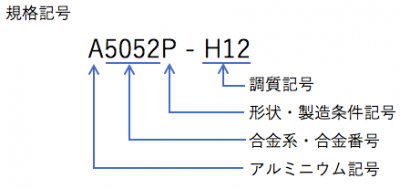
Aluminum symbol, alloy type / alloy number, shape · Manufacturing condition symbols and conditioning symbols are available
· Aluminum symbol
It becomes the initial letter A.
· Alloy · Alloy number
It will be the number of the alloy. The type of alloy is determined by the number at the head of this number.
· Shape · Manufacturing condition code
P: Plate, disc
PC: laminating board
H: Foil
TW: welded pipe
FD: Die forged wrought goods
FH: Free dedicated goods
Such
– Condition symbol
F: Production as it is
O: Annealing
H: Work hardening
W: Liquefaction treatment
Such

Alloy of rolling (drawing) method

Here, we will explain the standard of “rolling (drawing) method” which is particularly frequently used.
Among the alloys of the rolling (drawing) method, there are non-heat treated alloys and heat treated alloys.
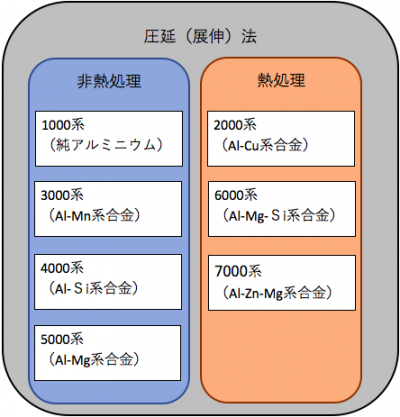
圧延(展伸)法には非熱処理合金と熱処理合金があります

Aluminum alloy of the rolling method is a four-digit number of international aluminum alloy name used.
Commercially available plate thickness is 0.8, 1.0, 1.2, 1.5, 2, 3, 4, 5, 6, 7, 8, 10, 12, 15, 16, 18, 20, 22, 25, 30, 35, 40 , 45, 50 mm.
It is easy to design if you also consider this.

• 1000 series (pure aluminum)
Aluminum purity 99.00% or more Although processability, corrosion resistance, electrical conductivity, thermal conductivity are good, strength is low. It is used as a conductive material or an aluminum foil, and it is not suitable as a structure or machine part.

· 2000 series (Al – Cu alloy)
Duralumin, super duralumin etc. are famous. High strength material comparable to steel material. It is used as a structural material or a forged material but contains copper and is inferior in corrosion resistance.
Weldability is also inferior to others.
It is used in cutting etc. In the case of

A2017: Duralumin
A2024: Ultra duralumin
7000 series with stronger strength and smaller internal stress is used more often than 2000 series which distortion occurs by processing.

3000 series (Al – Mn alloy)
It is the position of the thing raised the strength of 1000 series by adding Mn. A 3003 added Mn slightly increased the strength without reducing the workability and corrosion resistance of pure aluminum. A3004, A3104 further enhance the strength.

• Series 4000 (Al – Si alloy)
Low coefficient of thermal expansion, good heat resistance and abrasion resistance. In the case of
We will process with forging etc.
There are mainly A 4032, A 4043.

• 5000 series (Al – Mg alloy)
It has good corrosion resistance and weldability, and it is also used for cutting work.
The application is very much, it becomes the most balanced alloy among aluminum alloys.

A 5052: It is the aluminum alloy most widely used for mechanical parts.

• Series 6000 (Al – Mg – Si alloy)
It has good strength and corrosion resistance, is widely used for structural materials, and is used for cutting and other purposes.
It is mainly A 6063, A 6061.

• Series 7000 (Al – Zn – Mg alloy)
It is the highest strength in aluminum alloy. Good machinability, but also corrosion resistance weldability is difficult. In the case of
It is used in cutting etc.

A7N01, A7N01: Alloys for welding construction. Relatively high strength and weld strength are restored close to the base metal at normal temperature.
 A 7075: Ultra duralumin

The 2000 series, 5000 series, 4000 series, 6000 series, 7000 series used for the structure and machine parts

Alloy of casting method

Below is the alloy standard of the casting method.
As a characteristic, it is almost the same as the alloy of the rolling (drawing) method, so it only lists the name.
It is classified for sand mold type casting and for die casting.

· For sand mold type castings
“AC” is attached to the name

AC1C: Al-Cu alloy

AC2A: Al-Cu-Si alloy

AC3A: Al-Si alloy

AC4A: Al-Si-Mg alloy

AC4B: Al-Si-Cu alloy

AC4D: Al-Si-Cu-Mg alloy

AC5A: Al-Cu-Ni-Mg alloy

AC7A : Al-Mg alloy

AC8A: Al-Si-Cu-Ni-Mg alloy

AC9A: Al-Si-Cu-Mg alloy

· For die casting
“ADC” is attached to the name

ADC1: Al-Si alloy

ADC3: Al-Si-Mg alloy

ADC5: Al-Mg alloy

ADC6: Al-Mg-Mn alloy

ADC10: Al-Si-Cu alloy

ADC14: Al-Si-Cu-Mg alloy

Aluminum is used in many fields in many fields.
I think that better aluminum alloy will be produced in the future.

Below is detailed about aluminum.
Also, as future materials as materials are listed, please try it.


Categories
Management term

Management 6 Enchanting presentation me-we-now talking method

Enchanting presentation me-we-now talking method

Before entering a lot of people, I would like to talk as if you are dignified and that people listening to it are visible.
I think that it can not be said that suddenly a good way of speaking, but here I would like to talk about that speech.

Obama is also the way he used it during the presidential election, some of whom actually speak in front of the masses and are doing these naturally.
I would like to explain not only the me-we-now talking style (self-us-now talking method) but also the way of talking to convince other people and convincing other people and creating environments in the second half.

It is recommended for the following people as a society person.

· People who are not good at speaking in public despite being the president of the company
· Person who presents in front of many executives
· People who want to appeal products by sales
· Team leader who wants to take strong leadership
Such

me-we-now story

There is a me-we-now talking way to persuade people to persuade people.
This is also called a self-us-now talking method and it becomes a talking story when it gives a favorable impression and the opponent persuade · interest.

me: About me, my life and weakness

Talk about yourself and have a sense of affinity
Let’s talk about private rather than a superficial story and link to we and now.

By telling the private you do not know of, the listener removes the category “other people” and thinks it as being close to “friends”.
Especially, if you listen to content such as “I do not talk to others if I am an emphasis on private, the tendency to feel that way is strong.

Talk about private things and make it content that leads to we and now

we: Common point of yourself and contents of the same view

Talk about commonalities, contents of the same view and have empathy
Let’s think about the person you are listening to rather than talk about the content you want to speak unilaterally.

The content here is important.
We will make content that appeals as a common problem with our opponent who leads to the next now.
If you do not give content to sympathize to everyone, you will not be considered as your own thing.

Make the content that gives the same idea to the listeners

now: I want to tell you, I want to appeal

Let people think that they need to know what they are telling / content of complaint
After having my sympathy, I will tell you what I have to do now.

If you have the opportunity to talk about similar content several times, you can not change the direction of what you want to tell or appeal.
If the direction of what you want to tell or change is changing, let’s not talk about it.

Contents to what we have to do now, or to address problems with we

Usage example (me-we-now talking method)

me-we-now Story (self-us-this story Method)

Me – we – now speech method (self – us – now talking method) would be as follows.
 
※ Presentation in front of company executives
 Planner “I used our ZZZ product, which was the No. 1 share in this field before joining the company.”
 Planner “Because of the appeal of ZZZ products at the time, I am here now.”
 Planner “Our company was a specialty in this field, but since 5 years ago it fell from No.1, and sales have fallen to the right.”
 Planner “You know that there are sufficient technologies and abilities, just let me have a little budget turn around.”
 Planner: “With a little effort, we can regain that time, let’s regain the success of that time again!”
 Planner “Now if you do not do XXX product development, you can not recover in this field!”

Here I will break down the way of talking now and explain.
me: Yourself, your birth or weakness
→ “Because I had the appeal of the ZZZ product at that time, I am here now.”
Here it is the content that leads to “the appeal of ZZZ product” → “me now.”
Specific examples of private content and more embrace the sense of affinity.

we: Common with your opponent, contents of the same view
→ “You know that there are sufficient technologies and abilities, you only need to have a little budget turn around.”
Here, it is assumed that you talk about what the executives are aware of, “There is enough technology and abilities” “Only not budgeted”.

→ “With a little effort, we can regain that time”
Here is the content that makes the executive think about the success experience that the executives would have.

now: What I want to tell you, I want to appeal
→ “Now that we do not do XXX product development, we will not be able to recover in this field!”
I will tell you what I’d like to say at the end.
It will be the content that “XXX product development” wanted to say.

By talking in the me-we-now step you get a sense of affinity and sympathy, and the talk is conveyed to the listener


Benefits and Disadvantages

I briefly summarized the advantages and disadvantages.

Benefits

· The person listening thinks like himself
· People listening have a sense of affinity

Disadvantage

· We need to grasp contents to be sympathized beforehand
· Do not be awkward in your way of speaking (practice required)
· I can not change the direction of telling

Me-we-now It becomes a book that explains concretely not only the talk but also the contents to be explained next.
Please try it if you do not mind.
How to Design TED Worthy Presentation Slides: Presentation Design Principles from the Best TED Talks (How to Give a TED Talk Book 2) (English Edition)

Talking manner and persuading other popular people to persuade and environment

There is a worst dictator who used to persuade the public to persuade and persuade the public in history, using techniques of manipulation and manipulation.
As you know, it is “Hitler”. It was wonderful if used for good people, but I used it for the worst one.

Why did German people agree with Hitler at that time?
I would like to explain it as a manner of speaking and persuading the public to persuade them.

There are not a few parts that will overlap with the previous me-we-now talking method.
Also, please be careful not to mistake the usage and use.

Talking way

By persuading from now on to speak, it increases persuasive power.
I strongly set my thoughts to the listeners and can make me think that “that idea is also there?”

· Use simple phrases many times
Simple phrases are easy to remain in your ears.
Especially the one that can be called a catch phrase of the content to persuade is the best.
By using it many times, from the person who is listening “the content which the speaker can not be removed” is transmitted firmly.

· Use between spaces successfully
It is also related to “to make me think that it is a special space, magnificent” in “creating an environment” to talk later.
If those who listen at the time of starting to speak are squatting, waiting until it gets quieted, the scene changes, · Before talking about the core of the story, I will open up the space and produce a special feeling.
Although the speaker is in front of me, the unnatural state of “silence silently” gives the idea of ​​”what it is” of the listener.

· Present common enemies and problems, expressing anger against it and getting sympathy
Human feelings tend to be strong against repulsion.
Therefore, you can sympathize with those who have something strong discontent by showing their dissatisfaction.
It is no exaggeration to say that it is said that a spokesman appeared if people with dissatisfaction to express “anger” in public in response to the dissatisfaction.
If you do so, you can become a leader of those who are dissatisfied at that point.

· Overreaction
Like “anger” it is important to make it appear emotional.
Therefore, I use gesture hand gestures to think that it is overreaction.

· Keep acting practice and rehearsing
By doing this, it may be the strongest to eliminate anxiety.
It is because you can say that you are acting speaking in words that are useful instead of your own words.
Without further anxiety, we can also control emotional expressions and gestures and hand gestures, so we can respond to the situation of people listening.

Even if you can not get empathy from everyone, you push through
Even those who originally thought that “This person is upset with this with such things” will change to “This is important and I must have that idea.”

Lift pride
Everyone has a lot of pride.
For those who have injured pride, you can pull into pride by lifting pride.
Never say to people who are not like things that hurt their pride.

Creating an environment

Creating an environment to persuade people is also very important.
What you can not do with individuals will also increase your persuasive power by creating that situation for groups.

Time zone during which people ‘s judgment slows down
As a way to change the way people are listening, we will talk at a time when their judgment becomes dull.
It is said that there is a limit to the will of a person. It will be consumed if you use it and will recover if you go to bed.
As a result, ordinary people are exhausted to some extent in the time zone after the afternoon.
The part which those people have not handed down and the part to judge are dull.

Using cherry
If an enthusiastic group to listen is around, the speaker is easy to talk.
If those who are not like are enthusiastic group around, “Why are you so enthusiastic?” I will be interested.
People who are not will listen and start listening.

· make you think special space, magnificent
The heat directed to one thing, such as live and concert, is contagious.
Even people with different mindset will get overwhelmed by ideas like collective hypnosis if they enter the group.
Directions such as live and concert lighting are necessary in some cases.

– Increase sense of solidarity with clothes and other
For example, suppose you saw someone who has the live goods at a place far away from the live venue on your way back to the live.
Although I am quite a stranger, I think that I feel a sense of affinity somewhat.
Even if you use other special gestures or signs as well, it feels like that.

I am explaining, but I can not do these.
I think that my daily efforts and reading skills are very important.
Since it is to be in contact with people, I think that it will not be all right if you do according to the manual.

Please try it and change to the method that suits yourself and try using it.

Me-we-now I talked about how to talk and persuade the public, including the speech, and environmental creation.
The following is a book that explains these concretely. Please try it if you do not mind.

Categories
Flow of development

Flow of development ~ Development process of system and flow of process ~

Development flow – System development process and process flow –

I would like to explain in a general example how to follow the flow (phase) in product development etc.
The development act requires a lot of resources. For details, please see before developing design.
The content to be described is a development process that can be used for both software and hardware.

First of all, why is there a trend in development activities is to “improve efficiency”. It is better to create the best one while keeping resources as low as possible. It is a common example to explain from now on. I think that there are also better ways depending on the contents that can be easily done without actually proceeding with such development, the size of development and the items to be developed. Please check it in each development.

Development overview

It is not necessary to go through the development process by taking steps in content developed at the individual level and development in a small scale / short term.
As I said, there is a development process as a way to keep the resources as low as possible while not mistaking the direction.

Even as a method of development, if there is no problem at all from the beginning of development to the completion of development, various things will not come out.
Although it is not limited to this, the following part comes out as you develop it, so you need the opportunity to consider the design itself.

· Unknown part if you do not try
· Parts that you do not know unless you test and evaluate
· Part that you do not know unless you actually use it
· Parts that can not be realized in principle after evaluation
· Part where customer ‘s request changed

Before the development process

PDCA cycle

The PDCA cycle is very important in improving it.
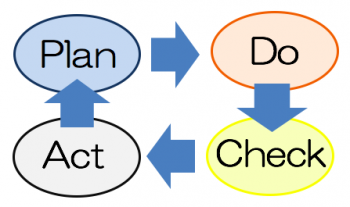
PDCA Loop PDCA Plan: Combine the plan, Do: Execute , Check: Evaluate and Act / Action: Feedback

It is one of the methods for smoothly advancing the administrative work, but it can also be used at the personal level.
I repeat the following 1 to 4, improve and improve and repeat spiral up.

By doing these, we can feed back the content that came up next, which is very useful for improvement and improvement.
It will become better by repeating the number of times.

1.Plan (plan / design)
2. Do (implementation and execution)
3.Check (inspection and evaluation)
4. Act / Action (treatment / improvement)

I will explain the flow of development, but it is no exaggeration to say that all parts of the loop are PDCA cycles.
This cycle can be used at any point in development and demonstrates its effectiveness in development.
Let’s make plans properly, execute, review and make improvements.

The PDCA cycle is not only for development, but also for a very important cycle to make it better

DR (design review)

Although I have said it several times, the development acts very much use resources (people, things, money, time). It will be very exhausted if you go forward in the wrong direction. For that, we need to stop once and see if the direction is right. We call it DR (design review).
We will work on collective intelligence to find out what we can not find in individuals or specific groups.

It is heavily used in the waterfall model development which is difficult to return to development.
However, in Agile development, we may also consider development direction by gathering non-members and developing members as a whole.
Let’s have the opportunity as much as possible because it will be an important point to confirm.

What is DR (Design Review)
Planning, development, design, manufacture, quality, purchasing collectively gather in the next step as to whether the criteria are met at the point of each development (before going to the next step of the development process) or the direction is wrong It is deciding whether to proceed.

The timing of the holding is mostly at the end of each development (before the next step), but there are places where the holding is skipped depending on importance.

Content to be determined by DR
Does the content that you did in that process fulfill the criteria at the point?
Is the remaining problem crushed as much as possible?
Direction and purpose are not wrong?

Especially the remaining task will be doubled if you postpone it, the next process will correct the problem.
Let’s proceed with completion of our process as much as possible.

Points to advance DR
I said the point to advance DR, but the points are the same at any meeting.
The meeting is very expensive as a company. (Because man-hours for the number of people is necessary for the meeting time)

There is also a thesis that the conference rate declines by 10% at every conference when there are more than seven at any conference.
The decision rate will also decrease, but the participants’ sense of responsibility will also fall.
It is abnormal that some people do not speak.
You have to speak some thought and find the best policy and compromise among them.

We also collect specialists from several departments.
Whether there is no problem in progressing development, we will reconfirm whether there is any problem in the relation item of the participating department in the point that it changed from before.

· Decide who is the decision-makers and responsible person and immediately make a decision during the meeting.
· Understand the contents in advance, give a problem in advance.
· It is necessary to keep as many as 10 people or less as possible (list the problems in advance materials).
· Collect multiple departments

Points above materials
Although data tends to be more frequent, it is necessary to keep a minimum amount of materials necessary.
It is impossible to understand even if it is too much, and it is the purpose of the material to convey information accurately.
Also, it is a place to judge whether to proceed next, so if you set it up with lie materials you may cause serious damage to the company.
Please note the neighborhood and make the material, please announce it.

· Do not lie to the contents of documents
· Presentation of concerns and problems that the speaker thinks

Issues Points in remarks / suggestions
People who make statements that take fried legs (people are good at taking a fault) inevitably tend to become inevitably, but as the first voice is positive as to make a constructive discussion in as short a time possible Let’s try something else.
For details, please read DESC talk .

DR is an important point.
The direction of decision and the way the company should go will differ if the attendees do not desire to have the necessity of holding itself.

DR (design review) stops once and really develops what you need development review point

It also describes the development process in detail.
DESIGN REVIEW〈2016〉

Development method

I will explain three kinds of development process as a development method.
It can not be said that this is generally good, each has its own characteristics.

Recently, I stressed the testing process very much and I am in the direction to avoid rework as much as possible.
Therefore, it has been said that Agile type is better than Waterfall model.
However, development of V, W model incorporating the test process into the waterfall model is also frequently conducted.

· Waterfall model development (V-shaped model development) (W-shaped model development)

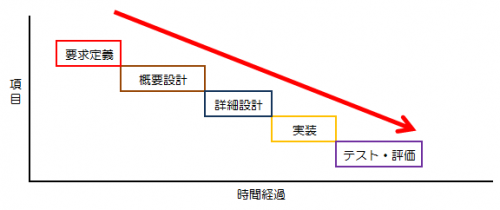
We divide top-down into work processes such as “request definition” “overview design” “detailed design” “development” “test and evaluation”.
In most cases there is no specific customer or customer interaction is only the first.
Waterfall Model_Request Definition _Overview Design_Details Design_Development_Test and Evaluation_etc

Since the flow of development through the stage is very easy to manage, it is a flow of development that has been used since a long time ago.
If there is no specification change in resources and duration, it will be estimated on a rough estimate.

· V character model development
V-shaped model development, W-shaped model development will be a variation of waterfall model development.
These are development processes, but strictly speaking, they are trying to incorporate the testing process to reduce backtracking.
I will explain that.

“Request definition” “overview design” “detailed design” “implementation” “test and evaluation” flow.
It is to carry out “test and evaluation” which makes pairing of “test and evaluation” here more concretely upper process.
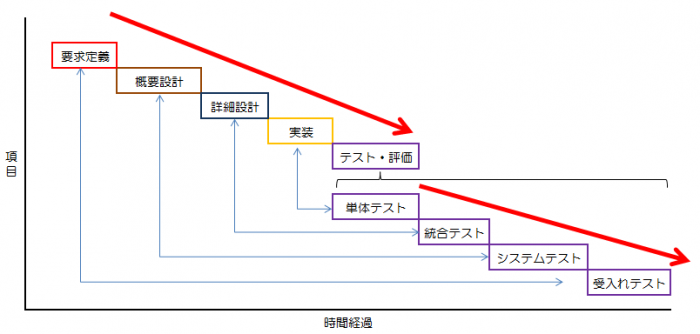
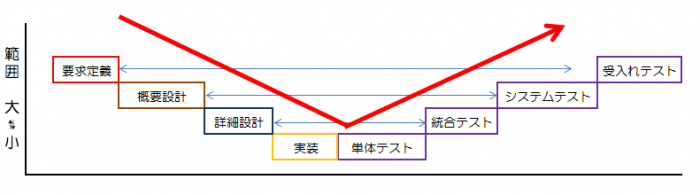
It is called a V model or V character model because it seems that development process is going backwards, as we go through “test and evaluation” to move from small test to large flow as a flow.

As a flow of development here
“Request definition” → “overview design” → “detailed design” → “implementation” → “unit test” → “integration test” → “system test” → “acceptance test”
It will be like a shape. (Items change according to development)
Vモデル開発 流れとして小さなテストから大枠に移るように「テスト・評価」を行なっていく形が、開発プロセスの逆行しているように見える、VモデルまたはV字モデルと呼ばれます。

If this is sorted by the size of the range it will be V shaped as below.
In addition, as each test process is used to confirm the operation of consideration contents up to implementation, they are almost paired.
V If you divide the influence range of the 2 model items by size , In the part to be test progressed gradually going towards the larger range will be in the form of V

· W-shape model development
As I mentioned earlier, development of W-shaped model is a variation of waterfall model development.
Unlike the V type, the test process is further divided.

As a reason, even if there is an error in the examination contents prior to implementation and implementation in the V-shaped model, actual confirmation will be considerably later, so returning becomes very difficult.
It is a development / testing process that takes a lot of effort and takes the idea of ​​crushing them beforehand.

As an example of the flow of V-shaped model development up to the previous
“Request definition” → “overview design” → “detailed design” → “implementation” → “unit test” → “integration test” → “system test” → “acceptance test”
was.

As an example of the flow of W-shaped model development
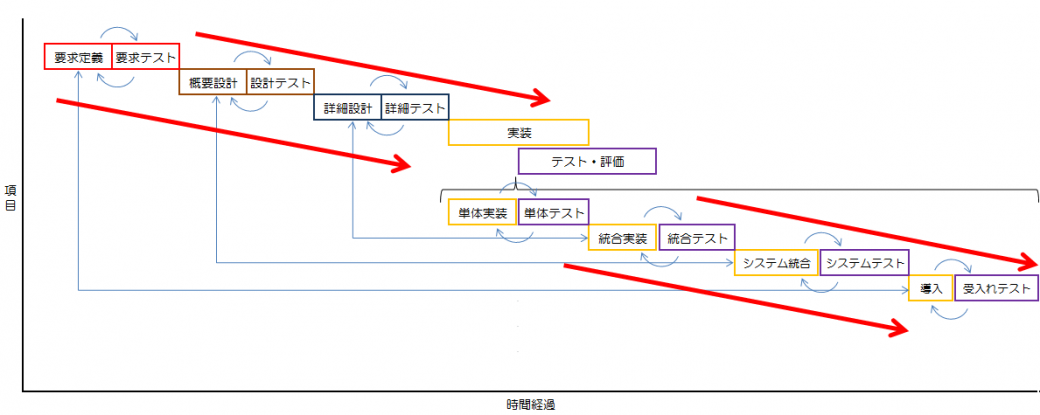
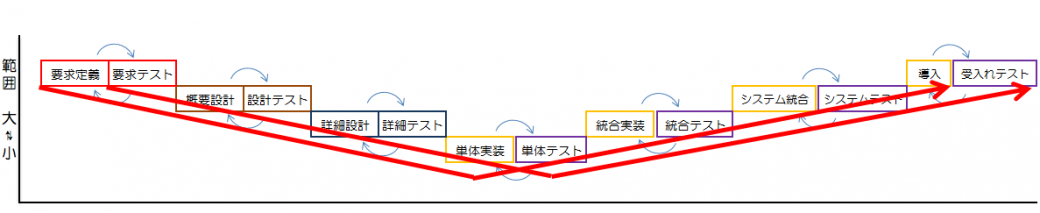
“Request definition” ⇆ “Request test” ➝ “Overview design” ⇆ “Design test” ➝ “Detailed design” ⇆ “Detailed test” ➝ “Single implementation” ⇆ “Unit test” ➝ “Integrated implementation” ⇆ “Integration test” → ” System integration “⇆” System test “→” Introduction “⇆” acceptance test ”
It will take the form of examination in the form like the examination content and implementation range. (Items change according to development)

Repeated parts circulate in the PDCA cycle and feed back.
We will increase the accuracy by that.

Like the V-shaped model, rearranging it by the size of the range will result in W shape as shown below.
In addition, as each test process is used to confirm the operation of consideration contents up to implementation, they are almost paired.
Sort by the size of the range as well as the V character model And it becomes W shape as follows.In addition, it is almost paired because it confirms the operation of consideration contents up to each implementation by each test process.

Benefits

· Since the end of the process is clear, it is easy to manage the deliverables
· Management-friendly model from the management point of view
· Customer request and development functions are clear at the initial stage
· The product is completed according to the original requirements
· Since the experts are divided for each process, there is little difference in quality within the process

Disadvantage

・各上位の工程で間違いがない事が大前提
· If there is a mistake in each higher-level process, the problem gradually increases
· You tend to need more resources
· It is difficult to respond when customer’s request is changed
· Products can not be released until completion of development

A form that the product embodies from the design drawing at once

・Spiral model development

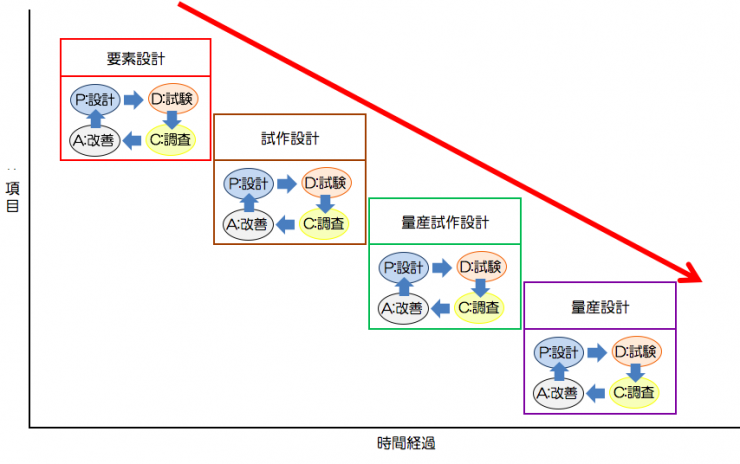
It is a model of the development process taking advantage of the top down design and the bottom up design.
It is a method to develop by repeating design and prototyping.
However, unlike Agile type, we will develop PDCA throughout the present while covering overall functions.
Communication with customers is often done closely so that they become gradually clear from the overview.
One loop period is relatively frequently about 6 months to 2 years.

As an example of the flow of spiral model development here
“Element design” → “Prototype design” → “Mass production prototype design” → “Mass production design”
It will be like a shape. I will cycle through each one. (Items change according to development)
In the development process that took advantage of the advantages of top-down design and bottom-up design It is a model that develops by repeatedly designing and prototyping

Benefits

· Easy to predict program size and schedule.
· Easy to respond to customer’s request specification change.
· It is unlikely that the design process will increase and the time spent on mounting will be shortened.
· It is easier to manage on a relatively large scale than Agile model.

Disadvantage

· Quality for functions tends to be ambiguous
· Products can not be released until completion of development

Form that gradually embodies products that were blurred

· Agile development

It is a generic name of a development method group that develops software so that it adapts quickly.
However, not only software but also hardware is quite effective.
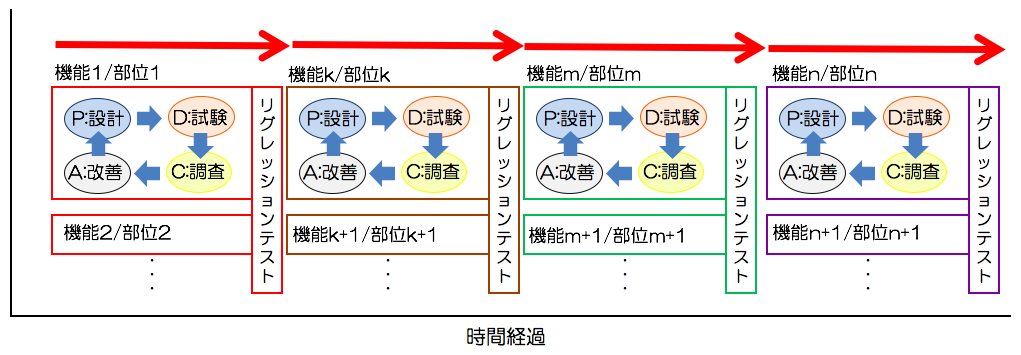
We will try to minimize the risk by turning PDCA (design → test → survey → improvement) in a short term called iteration and dividing into functions and parts.
 The period of one iteration is relatively many times from one week to one month.

As an example of the flow of agile development here
“Function / Site” → “Function / Part” → “Function / Part” → “Function / Part”
It will be like a shape. I will cycle through each one. (Items change according to development)
Among them, interaction with customers is often done quite closely for each function / part.
When doing a combination, you must do a regression test (regression test: confirm a bug where usable functions can not be used).

Below is a flow of agile development while doing multiple simultaneous in parallel.
In the case of a single unit, it becomes one line in this figure.

In a short period called an iteration, divide it into small functions and parts PDCA ( We try to minimize the risk by turning design → test → investigation → improvement) The period of one iteration is relatively many times from one week to one month

Benefits

· Reduce man-hours for returning trouble etc.
· Quality for product function can be preserved
· It tends to be customer’s request or street product
· Specification change to modification is quick to respond
· Can be released while limiting functions according to the delivery date

Disadvantage

· Progress is difficult to understand and overall management is difficult
· Individuals are required to respond to changes in specifications
· Consciousness to maximize products including customers is required
· We can not cope unless communication is tightly taken
· If the test (test) method is lame, quality can not be maintained
· You must do a regression test for each combination
· It is often different from the original requirement specification
· Teams are divided for each function when the scale becomes large.
Therefore, since process experts are dispersed, the quality of each process tends to differ.

Form in which products gradually add functions and parts

Which one should be used in the development method?


It is not limited as explained below.
Because it is a development process after all, considering our company’s strengths, priorities, etc., it may be quite different from the contents described here.

· When you can restrict functionality from customer’s request
(Delivery time · Cost priority, but when it is required for quality to the introduced function)
→ Agile development

· When you can limit the delivery date / cost from customer’s request
(Introduction function priority, delivery time and cost tend to be different from the original estimate)
→ Spiral model development

· If you want to raise the company’s own technology and develop a new product
(If there are many resources, the development scale is large, if you want to manage well, there is no specific customer)
→ Waterfall model development (including V character and W shape model)

The development process will be an example of the flow of development after all.
Because each has their own features, let’s step on the development process so that we can make the most of the strengths of development method and company development method according to it.

The development process is an example of the flow of development after all. It is best to find out how to develop our strengths

This is also a reference for the development process.

Categories
Control design

Control design 2 Sequence control and foundation and idea of ladder program

Sequence control of factory automation (FA) and foundation and ingenuity of ladder circuit

Many factory automation (FA: production factory) facilities use sequence control. The control device that controls that is called PLC (Programmable Logic Controller: commonly known as sequencer) is used, and many of them are described by ladder circuits (some language description is also included). I would like to explain sequence control and ladder circuit.

What is sequence control?


Sequence control is a control for performing sequence operation, “control that advances through each step of control with a predetermined order and exchange”.
“It is extremely used in production plants with control that moves all the way by faithfully observing a predetermined series of movements.”
Also, in production factories, there are many PLCs of the type to describe with ladder circuits which are relatively easy to describe because there are many cases where specification changes and control of control are required, as it is necessary to make facilities and movements peculiar to that production.

What is a ladder circuit?


As I mentioned earlier, factory automation (FA) is often required to change specifications and versatility.
Meanwhile, The ladder circuit is a kind of visual program that made it possible to program the program visually.

As an example, we will create a circuit by combining the following pictures to sequence operation.
However, detailed settings and functions of this visual also differ depending on PLC manufacturer.
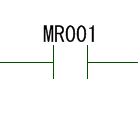
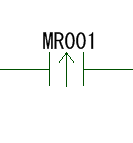
· A contact (ON when passing)
a接点
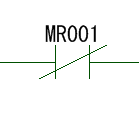
· B contact (OFF when passing through circuit)
b接点
· Rising pulse contact (Pass only ON cycle)
立ち上がりパルス
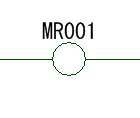
· Coil (ON when circuit is connected)
コイル
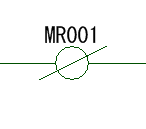
· NOT coil (OFF when the circuit is connected, ON if the circuit is not connected)
NOTコイル

Before creating a ladder circuit

There are a couple of things you want to be aware of when creating ladder circuits, and we will explain it based on that because there are a lot of merits to describe ladder circuits.

Input and output

Basically, PLC is sequenced as input and output as relay as externally exchanged.
Therefore, each PLC has a hardware connection destination.

· Input: Sensor, switch, encoder, etc.
· Output: Valves, lamps, motors, etc.

In the ladder circuit, input and output are used with the ladder circuit name.
In this article
 Input: R2000, R2001
 Output: R50000, R50001
I will do that.
Other than that, MR001 etc. are used, but the internal switch (control inside the PLC).

These differ depending on the manufacturer of the PLC and the software of the ladder circuit.
Behavior of input and output is related to control of direct operation.

Although it is basic to make a program, please keep the simple part as much as possible as much as possible with the outside part.
It becomes easy to understand, and human error can be reduced.

How to use the input and output in the ladder circuit as simple as possible

Flow of operation of ladder circuit

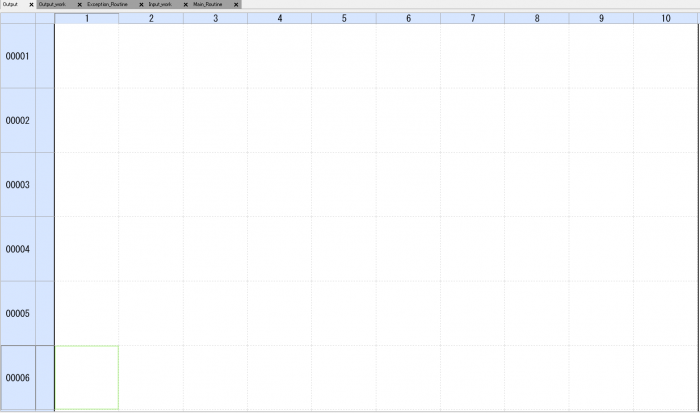
Depending on PLC and creation software, recent trend is to have more than one program drawing describing ladder circuit.
You can change the order by setting, but we will execute the program according to that order. Also, we will execute the ladder circuit in the program drawing in order from the top.

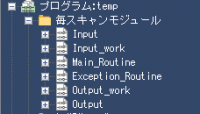
The following is an example of a program drawing.
program order
· Input: Program of receiving process from external input
· Input_work: Program of conversion from input
Main_Routine: Main control program
· Exception_Routine: Exception handling program
· Output_work: conversion program to output
Output: Processing program for external output
It was made.
In this case, in order from the top
“Input” → “Input processing” → “Main control” → “Exception control” → “Output processing” → “Output”
It has become.

Since it is flowing from input to control via control, if there is input, we will process immediately and go out. (Processing ends within one cycle)
If this order is ambiguous, it takes several cycles from control to output and takes time to output.
(The cycle depends on the PLC and the program amount, one cycle: several μs to several tens of ms)

In the order of “output processing” → “output” → “main control” → “exception control” → “input” → “input processing”
If there is input
“Input” → “Input process” “Main control” → “Exception control” “Output process” → “Output”
It will become.

described in the program drawing The ladder circuit runs from the top to the bottom of the program.
(When execution is completed to the bottom, it will run from the top of the next program drawing)

Therefore, let’s write from the top like ladder circuit description order like “input” → “control” → “output” .
The following is a program drawing, and a space describing a ladder circuit
In the program drawing

It is also possible to divide the scan cycle (program execution cycle) by program drawing unit.
By dividing it, it is possible to reduce the load on the control unit and to make the scan cycle faster.
Because it depends on the manufacturer, please confirm with the instruction manual of the control device.

Setting and describing in consideration of program order and program cycle can prevent cycle delay etc

Basic ladder circuit

I will explain basic usage of the ladder circuit.

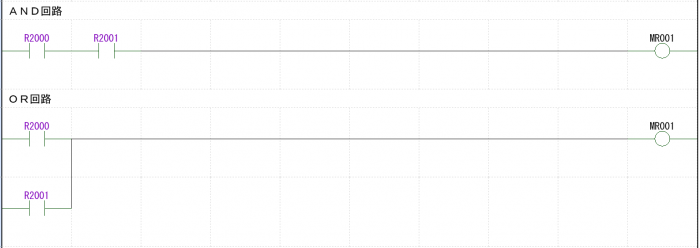
AND circuit and OR circuit (series circuit, parallel circuit)

It becomes the basic circuit in the basic.

· AND circuit (also called serial circuit)
Connect a contact to the coil side by side.
If all the conditions are not completed, the circuit will not be connected to the end.
In this case, only “R2000: ON”, “R2001: ON” is “MR001: ON”.

Switch1
(R2000)
Switch2
(R2001)
Coil
(MR001)
OFF OFF OFF
ON OFF OFF
OFF ON OFF
ON ON ON

· OR circuit (also called parallel circuit)
Connect vertically and a contacts to the coil.
If one condition is met, the circuit will be connected.
In this case, it is “MR001: ON” if “R2000: ON” or “R2001: ON”.

Switch1
(R2000)
Switch2
(R2001)
Coil
(MR001)
OFF OFF OFF
ON OFF ON
OFF ON ON
ON ON ON

And回路Or回路

The operation is complete with the condition and the operation is an AND circuit, the operation of any one is OR circuit

NAND circuit and NOR circuit

The NAND circuit and the NOR circuit mean the opposite of the AND circuit and the OR circuit (NOT), respectively.
Therefore, the operation of the coil is completely opposite.
First, I will explain the NAND circuit.

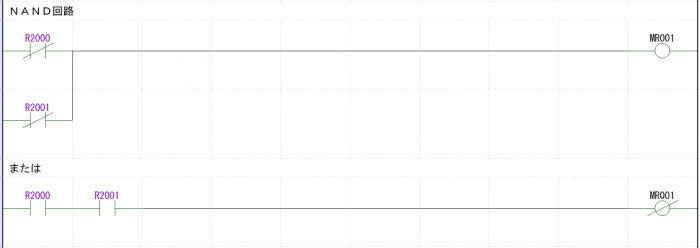
· NAND circuit
As you can see from the table below, the coil turns off when all the switches are ON.
Therefore, it can be made by setting the switch to b contact in parallel.
It is the reverse of the operation of the AND circuit. Therefore, it is also possible to make an AND circuit and make the coil NOT circuit.

Switch1
(R2000)
Switch2
(R2001)
Coil
(MR001)
OFF OFF ON
ON OFF ON
OFF ON ON
ON ON OFF

Nand回路

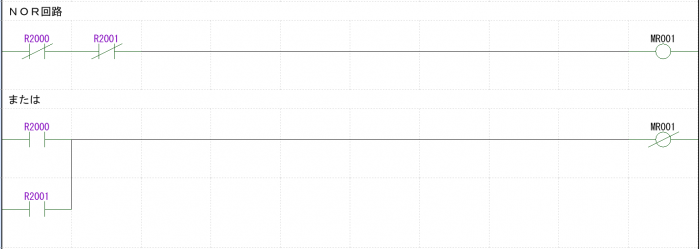
· NOR circuit
As you can see from the table below, the coil turns ON only when all the switches are OFF.
Therefore, you can make it by turning the switch to b contact in series.
It is the reverse of the operation of the OR circuit. Therefore, it is also possible to make an OR circuit and make the coil NOT circuit.

Switch1
(R2000)
Switch2
(R2001)
Coil
(MR001)
OFF OFF ON
ON OFF OFF
OFF ON OFF
ON ON OFF

NOR回路

The NAND circuit is the reverse of the AND circuit, the NOR circuit behaves in the opposite direction of the OR circuit

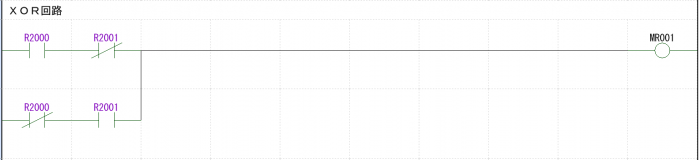
XOR circuit

It is also called exclusive OR circuit.
Although it may not be used much, you can express the behavior as shown in the table below.
When either switch 1 or 2 is ON, the coil turns ON (exclusive) circuit.

Switch1
(R2000)
Switch2
(R2001)
Coil
(MR001)
OFF OFF OFF
ON OFF ON
OFF ON ON
ON ON OFF

Xor回路

The XOR circuit is used with exclusive control.

Self-holding circuit (self-hold circuit)

I will explain the self-holding circuit.
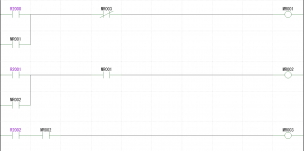
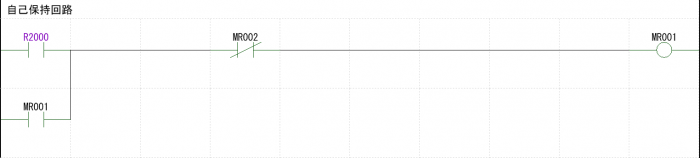
Also called a self-hold circuit, A circuit that continues to turn on the coil regardless of releasing the switch (switch OFF) once it is pressed .
Self-Holding Circuit

I will explain the flow of movement.
When the switch is pressed, the coil is connected and the coil turns ON. Then turn on the coil switch.
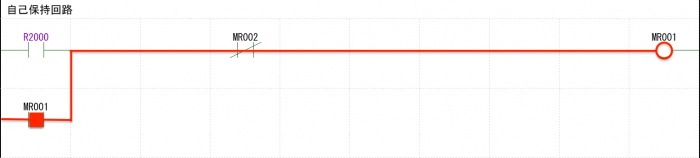
Self-holding circuit 2

Since the coil was ON at the previous cycle at the next cycle, the coil switch is turned ON.
The switch will be connected to the coil and the coil will continue to turn ON.
The ON / OFF of switch R20000 does not matter at this cycle.
Self-holding circuit 3
In the self-holding circuit, once the coil turns ON it can not be turned OFF, so here the switch MR002 for coil OFF is put in the circuit with b contact.
When turning ON MR002 while the coil is ON, the coil turns OFF.
Be careful not to be unable to control with deadlock (the coil can not be turned off).

Also, in terms of using coils, be careful with double coils.
If there are two or more coils with the same output name, it will not work properly.

The coil can be kept ON with a single switch operation. However, note Deadlock

Set / reset circuit

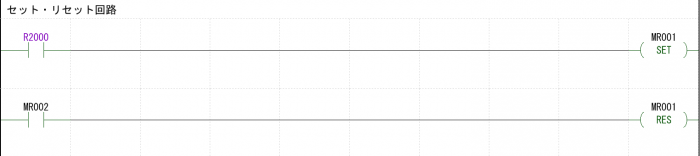
The set / reset circuit is a circuit that holds itself. Therefore, ON is set and OFF is reset.
It is the same as the self-holding circuit and how to draw it is different.
set reset circuit
Let’s take care with resetting so that you can not control due to deadlock (the coil can not be turned off).

When using the set / reset output, let’s make the reset output at the same time after putting the set output.
Doing so prevents deadlocks. Moreover, it can prevent forgetting to move.

The same drawing method as self-maintenance is different. Likewise, note deadlock

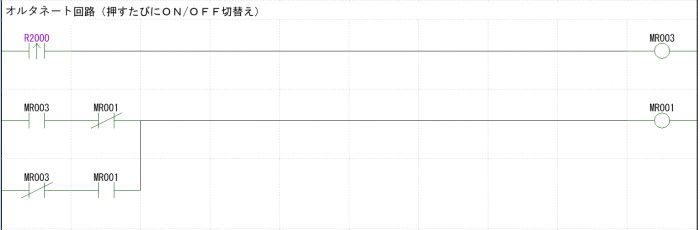
Alternate circuit (flip-flop circuit)

The alternate circuit repeats ON / OFF alternately each time you press the switch.
It is also called a flip-flop circuit.
Alternate circuit

I will explain the move from OFF → ON.
Turning ON the switch turns ON only one cycle scan pressed with the rising pulse. Coil turns ON at that timing.
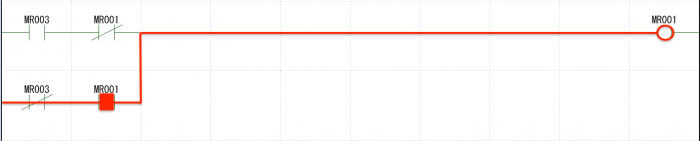
Alternate circuit 2

The rising pulse of the switch is cut off at the next cycle.
However, because the coil is ON at the previous cycle, the coil switch turns ON and self-holding is applied.
Alternate circuit 3
Coil ON / OFF switches each time the

switch is pressed

The following books are easy to understand in detail as sequence control.
Please refer if you do not mind otherwise.
図解入門よくわかる最新シーケンス制御と回路図の基本 (How‐nual Visual Guide Book)

Basic stage circuit

I think that sequence control will be done step by step when program is written by ladder circuit.
By controlling step by step, control will progress one after another.
I will briefly explain the stepwise sequence movement at that time.

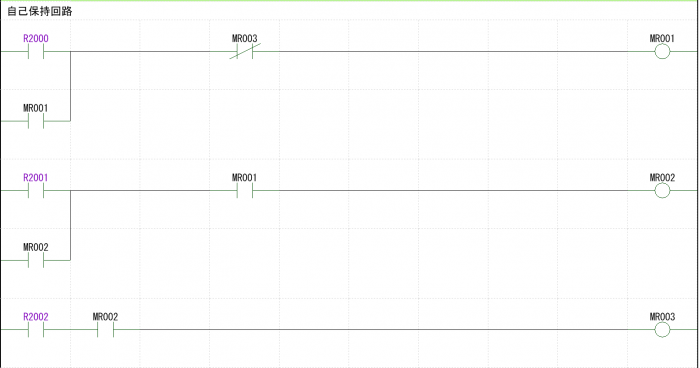
Step circuit of self-holding circuit

I put an example as a step circuit of a self-holding circuit below.
There are various patterns for making, so I think that you should make it easier for yourself to do.
As a flow of control,
“R2000 switch ON” → “first step processing” → “R2001 switch ON” → “second step processing” → “R2002 switch ON” → “processing end”
.

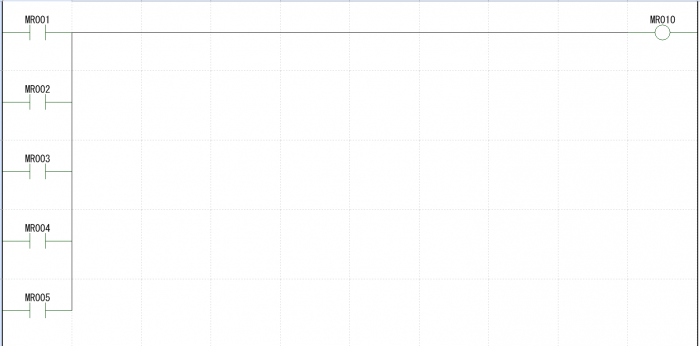
If you want to process with only the first stage processing, you can connect it next to move with AND circuit of “MR001: a contact” and “MR002: b contact”.
Self-holding circuit stage circuit

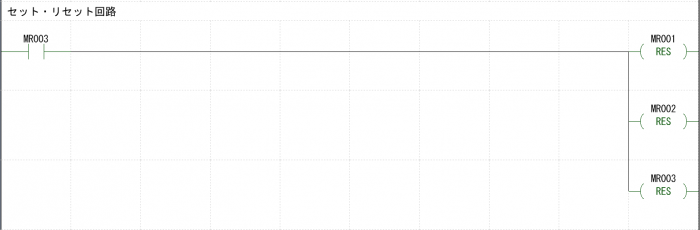
stage reset circuit stage circuit

It becomes an equivalent circuit made by set reset of the self-holding stage circuit earlier.
It is the same as the control flow,
“R2000 switch ON” → “first step processing” → “R2001 switch ON” → “second step processing” → “R2002 switch ON” → “processing end”
.
If you also want to process with just the first step processing, you can connect it next to move with the AND circuit of “MR001: a contact” and “MR002: b contact”.
Step circuit of set reset circuit
Step circuit 2 of set reset circuit

Proceed with control in the step circuit and make a series of actions

Devices of ladder circuit

I will explain a little bit about what I am careful about when I draw a ladder.
· Reduction in the visibility of parallel circuits
· Separate from command, interlock, output
· In case of solenoid valve control by output

Reducing the visibility of parallel circuits

Write a parallel circuit as follows.
However, as the number of switches in the parallel circuit increases more and more, the circuit grows vertically and it becomes very hard to see in the visual program.
ingenuity of parallel circuit

In that case, you can create an equivalent circuit as follows.
To make the parallel in series The AND circuit and the NOT circuit make it the same circuit.
It will be a little hard to understand, but as a program it will be very easy to see.
ingenuity of parallel circuit

Reduce mistakes by making ladder circuits as easy as possible

Malfunction prevention

I said basic is to make inputs and outputs as simple as possible. (Human error, prevention of bugs)
Besides that, there are caveats, basically we will draw in mind the prevention of malfunction.

· Do not use the input as it is.
Instead of leaving the input as it is, use it based on the prevention of malfunction.
I think that there is no problem even if you use the place where malfunction does not occur as it is.

When the sensor is on the standby side, when two points on the operating side are taken, it judges the standby side and the operating side from the state of the two sensors and uses it for the program.
It can not be said that sensors, switches, etc. will not break.
This is because we will not let the program advance in case of breakdown.

• Do not use motion commands as output.
I think that there is no problem even if you use the place where malfunction does not occur also as it is.
Use interlock (monitor / judge the state where operation is possible).

Always monitor and judge the condition for the output operation.
Pass it to the output with command + interlock.

Use input / output for preventing malfunction

In case of solenoid valve control in output

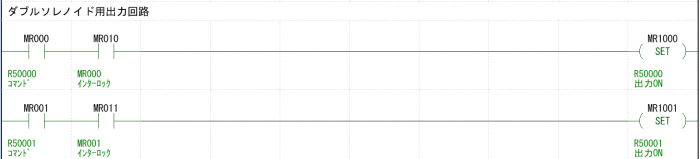
It is a point of improvement when using single solenoid or double solenoid in output.
When controlling the double solenoid valve, I think that 2 point output is connected.
Depending on the control state, both OFF and ON one way ON, but normally both ON can not be done.
Therefore, it is a method not to make both ON as control.

Also, if you program the double solenoid valve to control the single solenoid valve, it will be easier to correct the program when changing from single to double.

· Self-holding circuit
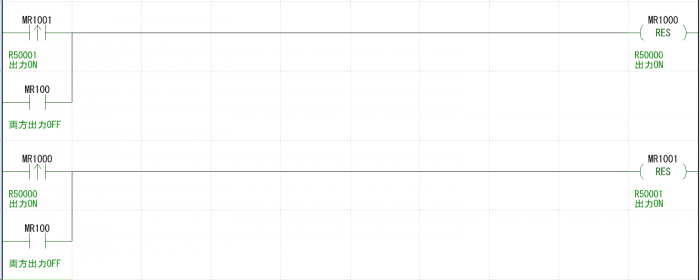
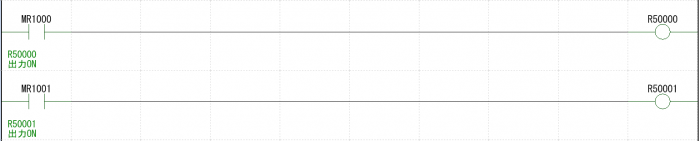
As a feature, R50000 and R50001 are not turned ON at the same time.
For example, when MR000 (MR010, MR011 is ON) turns ON MR1000 turns ON once.
At that cycle, R50000 does not turn on, and the circuit of R50001 is turned off. (R 50000, R 50001 turn OFF)
R50001 turns on at the next cycle.

Here, MR 100 (both output OFF) is making switch when you want to cut both.
double solenoid circuit

• Set reset circuit
It becomes the equivalent of the self-holding circuit the previous time.
Likewise, R50000 and R50001 are not turned ON at the same time.
However, when MR000 or MR001 (when MR010, MR011 is ON) turns ON, there is no cycle of both R50000 and R50001 OFF.
It turns ON / OFF immediately (at that cycle).
double solenoid circuit

With solenoid valve control, making a circuit with a double solenoid makes it possible to respond to changes immediately

The following books are easy to understand in detail as sequence control.
Please refer if you do not mind otherwise.

Categories
Management term

Management 5 DESC’s way of speaking making it easy to make proposals

How to make suggestions easier DESC’s way of speaking

Is there a way to talk through suggestions?
Is the proposal really transmitted to the other party?
For this time, I would like to talk about the way of talking to “proposal” “DESC talking law”.

What is DESC talking

DESC話法

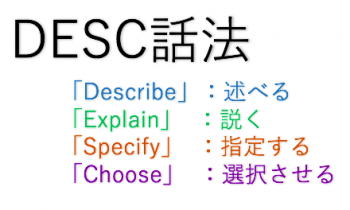
DESC talking stands for “Describe” “Explain” “Specify” “Choose”.
These are “Explain” → “Express” “Specify” → “Suggest” “Choose” → “Consequence”
It may change to. The content is the same.
As a way of speaking it is below.

“Describe”: depiction (current situation)
“Explain” “Express”: to preach, to express (sympathize)
“Specify” “Suggest”: Specific presentation, suggestion (to suggest)
“Choose” “Consequence”: selection, conclusion (to conclude)

It can be used as a method to tell the other party “proposal” “request”.
It is of great use even in negotiating scenes.

There are advantages and disadvantages, and it will be as follows.

merit

Explanation contents are conveyed concisely and clearly
The other party is easy to understand the situation (easy to feel)
You can respect the opinions of the opponent
Proposal / alternative plan is easy to pass
It tends to be constructive discussion

disadvantage

I can not push my opinion hard
We need to have multiple proposals
The right of selection and decision becomes opponent
Responsibilities become partners

Therefore, it becomes a perfect way of speaking for “suggestions” of things.
Use it when you want to tell the other party ‘Request’, or when you want to leave it to the other party’s judgment.

 
Anybody who is a member of society thinks that we must “request”, “suggest” and “negotiate”.
For me, I would like to be able to use it in various situations together with “PREP Speech” .

DESC talking method can propose suggestions and requests in various scenes

Let’s propose a great deal of time, let’s grasp the opportunity firmly.
This book is a book detailing how to talk about opportunities.
チャンスを生かせる人の話し方

Talking way to convey the proposal briefly and clearly

· Example of how to use (without DESC speech)

When not using PREP speech

If it is bad at suggesting it might be as follows.

Salesman “Chief, I would like to have one person attached.”
 Section chief “Why do you want to put on a single person?”
 Salesman “It is because there are plenty of counterparts in charge.”
 Section manager “Everyone is busy.”
 Salesman “Although it seems that sales are increasing in XXX district.”
 Chief “So? It’s just speculation, is not she?”
 Section Chief: “What are you saying, do not make your district satisfied, too?”

It will be disappointing.
Although I make a proposal, I am only interfering with my boss’ s job.
Salespeople are not bad, but this is also likely to be said from the boss (section chief) “Do more firmly!”
Even if there is good information, I will miss the opportunity depending on how you speak.

· Example of usage (DESC talking method)

When using PREP, DESC speech

If it is DESC talking it will be as follows.

  Salesman “Chief, the percentage of 7% products purchased in XXX district in the past three months is increasing.”
 Salesman “If I can, I would like to respond, but I am full of requests from the district concerned.”
 Salesman “I’d like to have a salesperson alone.”
 Section chief “I can not handle it now …”
 Salesman “If so, how about letting those who failed to meet their business goals be awarded only three days a week and trying to meet their business goals?”
 Section manager “OK, let’s do it!”

Here I will break down the way of talking now and explain.

“Describe”: depiction (current situation)
→ “The section manager, the percentage of 7% products purchased in the XXX district is increasing in the past three months.”
Here, it is a problem situation for the proposal that “7% products are increasing in the XXX area in the past 3 months”.

The important thing in the way of speaking is to “speak the problem situation objectively to the current proposal”.

“Explain” “Express”: to preach, to express (sympathize)
→ “I would like to respond if possible, but I am full of requests from the district concerned.”
Here, “I want to do” → “You can not do it” will talk about your feelings.
The boss (section chief) can also draw out the feelings of the salesperson from the situation that you can understand the back of the word (actions you have done so far).

What is important in the manner of speaking is “to feel empathy, to talk about their feelings and empathy.
However, I will not do anything to impose my own opinion.

“Specify” “Suggest”: Specific presentation, suggestion (to suggest)
→ “I’d like to have one salesperson on hand.”
Here, “to put one salesman on” is a “request” and will be “a proposal”.

What is important in the manner of speaking is “to talk about content that can be concretely realized, content that can improve the problem”.
Even if the partner is involved in the problem, I will not speak to the other party.

“Choose” “Consequence”: selection, conclusion (conclude, connect)
→ A salesperson took an alternative plan in the case of “No” taking “No” as the section manager “Now that there are no hands” … = No.
The alternative was “to add people only three days a week” or “to make it an opportunity to achieve business goals”. That will be “connected” content.

What is important in the way of speaking is “to suggest the next proposal or action to be taken regardless of whether the proposal is Yes or No”.
Let the other party tell the selection result or conclusion.
It is one of the ways to make proposals easier to have some suggestions and chosen first.
Also, bringing “what you really wanted to do” as an alternative proposal is one way to pass higher requests.

If you use the DESC speech method, you can talk proposing constructively based on the partner’s idea

Question how to make the other party easier to talk and make it easier to deepen your talk than

As mentioned earlier, as a way to make the proposal easier, I told you to “have the proposal picked up.”
The reason is because people are easy to answer “limited questions”.

Therefore, when you want to listen closely, “limited question” → “expanded question” becomes.
Although I derail a bit, I think that I will explain it because it is important content.

I will talk about the difference between “limited question” and “expanded question”.

· Limited questions

It will be a fixed question with specific answers such as “Yes” “No”, “Yes” “No”.
Easy to reply, you can know the question briefly. In the case of

· Enlarged question

It is a way of talking about “what” “like” “5W1H”, “how” “and so on.
It takes time to respond because we have to think about it. You can know the idea of ​​the partner in detail in detail.

Inquire deeply the idea of ​​the opponent by changing from the limited question to the expanded question

Let’s propose a great deal of time, let’s grasp the opportunity firmly.

Categories
Management term

Management 4 Let’s make an accurate report Talking about PREP

Let’s make an accurate report Talking about PREP

Do you know how to talk when you report?
Do you speak clearly and clearly to your partner accurately and clearly?
For this time, I would like to talk about the way to talk about “report” “PREP talking”.

What is PREP talk

PREP話法

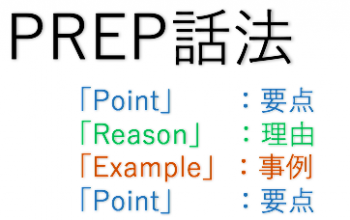
The PREP talking stands for “Point” “Reason” “Example” “Point”.
As a way of speaking it is below.

“Point”: main point (what you want to say)
“Reason”: Reason (why did you want to say)
“Example”: Case (Because there was such a thing, because it was there)
“Point”: main point (what you want to say)

It will be the way to speak with.
Although I talk about it as a report here, this method also works for presentations and others.
Also, by using an effective table etc. (Pareto chart etc) together, more convincing Will increase.

There are advantages and disadvantages, and it will be as follows.

merit

Strongly convey your opinion.
Transmitted concisely and clearly

disadvantage

I do not care about the opponent’s opinion (one-sided opinion)
Buy contention as opponent does not agree
I will be responsible for what I say

Therefore, it will be a perfect way to speak of things “reports”.
I use it when I want to penetrate my opinion or to tell the other party what I think is correct.
I believe that anyone who is a member of society must “report”.
For me, I would like to extend it from there so that it can be used in various situations.

There is another way of speaking in the case of “proposal” consulting how to respect future direction by respecting the opinion of the other party.
There is DESC talking talk how to talk about “suggestion”, but when that time is detailed I want to tell.

How to tell your opinion in a concise, easy-to-understand manner

The following books are very useful as a way to talk to people and to others.
Please try it if you do not mind.
伝え方が9割

How to use PREP talk
I will give you an example here as an example.

· Example of usage (without PREP)

For example, a salesman reports to his boss (section manager).

When not using PREP speech

Salesman “Section chief, XXX trading company is angry.”
Section manager “Why are you angry?”
Salesperson “I think that it is because complaints came from XXX trading company.”
Section Chief: “What claims were there?”
Salesman “There was a claim about our new product.”
Section manager “What specifically happened?”
Salesman “There seems to be five initial defects in 10 of the new products.”
Section manager “Did XXX trading company say something?”
Salesperson “I was told that I would take the section chief at once.”

Section chief “Why not say that before …”

It will be disappointing.
My boss (section chief) needs a lot of labor to get the point of the story.
In this report my boss (section chief) also has a hard time.
Salespeople are also not bad, but the boss (section chief) seems to say “Do more!

· Example of usage (PREP talking method)

When it is PREP speech, it becomes as follows.

When using PREP speech

Salesperson “Chief, XXX Commercials offer to see the section chief immediately.”
Salesperson “I heard that complaints came out of XXX trading company in our new product, and I would like to hear from the section chief about that.”
Salesperson “Specifically, initial failure was found in 5 out of 10 new products purchased by XXX Shoji.”
Salesman “For that reason, XXX Shoji says that he wants to meet the section chief at once.”
Section manager “I understand, I will go soon.”

Here I will break down the way of talking now and explain.

“Point”: main point (what you want to say)
→ “The section chief, XXX commercials have requested to see the section chief at once.”
Here, “I want to meet the section chief immediately with XXX trading” becomes the main point.

‘Reason’: Reason (why you wanted to say)
→ “A complaint came out from XXX trading company in our new product, and I would like to hear from the section chief about it.”
Here we are talking about “Refusing on new products” ⇨ “I’d like to hear the talk from the section chief”.

“Example”: Case (Because there was such a thing, because it was)
→ “Specifically, because the initial failure was found in 5 out of 10 new products purchased by XXX Shoji.”
Here we are talking about “complaint contents: initial failure of new product”.

“Point”: main point (what you want to say)
→ “Therefore, XXX Shoji says that he wants to see the section chief at once.”
Here again we emphasize the point “XXX commercials want to meet the section chief immediately”.

The impression of that person is totally different with one report.
As a way of speaking, “My opinion” = “Speaking is your own responsibility”
Also, if you can do this talking everyday, I think that both customers and bosses will be trusted as businessmen.
Let ‘s try it as much as possible.

Talk with “Point” “Reason” “Example” “Point” at the time of reporting and be responsible for the contents to talk about.

Before reporting

Let’s grasp the content to report before reporting.
If you can not grasp it firmly, you will not be responsible for what you talk about and will not be able to talk to PREP.

Understanding the current situation
Bottom line
(When there is a target) The heart of the opponent
(When there is an object) What the other party wants

With the intention to “tell the contents of the report responsibly”, if you gather information, nothing is afraid.
Let’s make sure of the facts.

If you try to make a report with a sense of responsibility, nothing is afraid of disgusting reports

The following is useful from a different point of view as a way of communicating to the other party.
Please try it if you do not mind.

Categories
Management term

Management 3 Revenue patterns in companies

Revenue patterns in companies

It is commonplace to think about it, but I will briefly chew and explain about the pattern of earnings in companies that I do not know unexpectedly.
It is very important to show the direction of product development and product model change.

To make money

Procuring revenue means that there is a large proportion of income (amount to be acquired) in expenditure (amount to be used) and income (amount to be earned).
We will consider by relative comparison from the present moment.

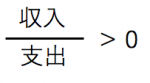
Relationship between income and expenses
(Income / expenditure)> 0
If it is, it will be profitable as a company, and there is a survival value as a company.

General companies have no survival value if they do not make profits

Below is a book which will be useful for considering corporate profits.
なぜ良い戦略が利益に結びつかないのか―――高収益企業になるための5つの実践法

Patterns of earnings in companies

There are 5 patterns as revenue.
Each will also change depending on the state and direction of the company.

· Increase in income (Up), decrease in spending (Down)

収入UP支出Down

It is the pattern I want to aim.
If precise strategies and policies and motivation of employees is not high, it is not easy to do.
It is very difficult to maintain this pattern, but it is also said that the profit is maximized efficiently.
It is this pattern, such as the rebuilding of JAL, but I think it is truly Kazuo Inamori.

· Increase in income (Up), expenditure does not change (Stay)

収入UP支出Stay

In terms of the survival of a company, it is the pattern with the least risk and effort.
There are many trends in companies in service industries where variable costs (variable costs) are small.

· Revenue increases greatly (VeryUp), spending also increases (Up)

収入veryUp支出Down

Immediately after a lot of companies start a business or many venture companies, this pattern is this pattern.
It becomes a pattern to promote the growth of companies by increasing expenditure.
Most of the fastest growing patterns are in this pattern, and if you succeed you can expect more revenue in a short period of time.

· Revenue does not change (Stay), spending decreases

収入Stay支出Down

There are such parts in Japan’s many manufacturing industries and factories in Japan.
Especially in factories that adopt the lean production method and the Toyota production method, we will gradually improve efficiency and reduce spending.
This is the case if you can return to the customer instead of making it into revenue by the amount of expenditure, leading to the next order.
And we are doing this because it becomes ideal that “Increase incomes and reduce expenditure” as the quantity of orders increases.

· Income decreases (Down), spending decreases greatly (VeryDown)

収入Down支出veryDown

This is the pattern, for example, the sale of business results of businesses with poor business performance.
(In some cases, revenue will increase, but it will decrease as corporate asset.)
This pattern is valid if it is temporary.
If this is going on, companies are in a downward trend, and unless some countermeasures are taken, it is dangerous to survive.
It is because there is a limit to greatly reducing expenditure.

If you make a mistake in the direction of earnings you are doing now, you may think that you are in the red indefinitely despite aiming for a surplus.
Let ‘s work based on the direction with the direction in mind.

General companies have no survival value if they do not make profits

Categories
Manufacturing terms

Quality barometer of product function “Function reliability”

Quality barometer of product function “Function reliability”

When designing products, we will make product specifications.
It will be expanded from the product specification to the function of the product, but as long as the quality of the function itself can not be maintained, the specification can not be satisfied as a result.
I would like to talk about how “functional reliability” is related to design.

When you want to increase functional reliability, please describe in concept of maintaining functions depending on functional reliability at design time It is necessary to make such change as it is.

Relationship between specifications and functions

Before talking about “functional reliability”, I would like to talk about the relationship between function and specification in the first place.

As an example, I think with “knock type pen”.
Examples of

As “Specification” “Take the pen tip out with just one hand’s thumb operation”
as “” feature “>” Press the upper part of the pen to tip the pen “,

“Specification” should be
“Function” is a measure to make it appear as it should be from “specification”

I think that it is a relationship.

“Specification” means what it should be. “Function” means a strategy to make it appear

What is “functional reliability”?


“Functional reliability” is simply “quality of function almost” if it says simply.

I think with the “knock type pen” of the previous example.
The function was “When pressing the top of the pen the pen tip comes out” or “Press it once again” was.

“Function reliability”
10,000 times successfully “When the pen top is pressed, the pen tip comes out” and “When pressed once again” is satisfied.
.

This is the degree of whether the function itself can satisfy after expanding the function from the specification.
“Function reliability” ≈ “quality of function” → “quality of specification”

The quality of the function is as follows.

· Grade of function
· Credit rating of function (functional confidence is strong here)

“Functional reliability” is the degree of satisfying the function developed from the specification

“Function reliability” What happens when you drop it?


As I mentioned earlier, “functional reliability” will lead to “quality of specifications”.

Degraded “functional confidence”

If it was a model change from an existing product, there should be not a few specifications that had been up to now.
Especially the specification on the extension of products up to now should have higher reliability than before.

If the reliability is low (when there are many failures that do not satisfy the specifications), customers will not be satisfied because what they thought as “what should be should be” is not satisfied.
It will not be satisfied even if there is a satisfactory part.
For the relationship between satisfaction and dissatisfaction, please see “satisfied / dissatisfied” .

“Function reliability” leads to “reliability” of the product itself.
Actually, it is only for that product, but despite the fact that customers tend to be confused with “reliability” of the whole company as a whole.

 As a result, if “functional reliability” declines, and it is notified to customers, it will be regarded that “reliability” has declined for the entire company.
Even if it’s already sold or not, we will capture the “functional reliability” low at the end of “reliability”.

Maker’s way of thinking

Even if it is a manufacturer’s probability of failure (even if it is one in one million pieces), the customer who purchased and faced the problem was 100% defective item.
Therefore, in particular, Japanese manufacturing industry tends to increase “functional reliability”.
For that reason, we also manufacture products that incorporate process capability against product standards .

– Difference in concept of functional reliability by industry

“Function reliability” follows anything.
However, depending on the industry, the size of its reliability comes out to the market.

High functional reliability
Manufacturing industry
→ Because it was recalled and it takes a huge cost to rework

Feature reliability is relatively low
Service and software industry
→ Since it can be done with upgrading etc., it will not cost much for rework

If you do not judge “functional reliability”, the value of the enterprise will also decline.

Bathtub curve (failure rate curve) grasping reliability trend

The failure rate trend is represented by a graph called bathtub curve (failure rate curve), in which the vertical axis shows “failure rate” and the horizontal axis shows “time lapse”.
Because it is a curve like a bathtub it is called a “bathtub curve”.
bathtub curve

Over time, it is divided into an initial failure period, a random failure period, and a wear failure period.

Failure rate decrease curve (DFR)
Failure rate constant curve (CFR)
Failure rate increase curve (IFR)

When the tendency of failure rate decrease curve (DFR) is large

Failure rate reduction curve
It is a failure due to defects in manufacturing.
This tendency is likely to occur even if it is due to the quality that does not have the inspection process or is missing.
This type of failure rate decreases with the passage of time.

When the tendency of the failure rate constant curve (CFR) is large

constant failure rate
It is a failure that happens by chance.
It is a related breakdown when the range of the standard is too sweet or when the use range of the product exceeds the assumed value.
It is of a type that does not relate to time and breaks down at a certain rate.

When the tendency of failure rate increase curve (IFR) is large

Failure Rate Increase Curve
The position of this curve will change due to changes in design, material etc.
It is a type of mechanical failure such as wear that increases with the passage of time.

These three graphs together form a bathtub curve.
If you are forced to take a model change or countermeasure, it is easier to respond if you judge which trend is strong and respond.

Especially it is better to judge which function will be a strong curve

It is an easy-to-understand book as a judgment of quality engineering and function. Those who want to refer about function and quality please.
これでわかった! 超実践 品質工学 ~絶対はずしてはいけない 機能・ノイズ・SN比の急所~

Measures to improve reliability

Reliability may not be improved due to various factors.
There may be cases where reliability may not be improved due to human error such as “human error” or crossing the “planning” “design” “manufacturing” department.

Contents of reliability improvement

“Elimination” not making mistakes
“Alternative” not to induce mistakes
“Simplify” not causing mistakes
Detecting mistakes “Detecting abnormalities”
“Corresponding deployment” not to disseminate mistakes

Make no mistakes “exclusion”
Do not make the cause of mistakes, if you eliminate it in any way.

Do not trigger mistakes “Alternatives”
To avoid making a mistake, it is to substitute with another thing so as not to be difficult.

Do not make mistakes “simplify”
It is to simplify work items and make the mistake as few as possible.

· Notice of mistakes “Detect anomalies”
It is a method to notice the mistake by stopping the abnormality discovery device, inspection, etc. and stop it.

· Do not disseminate mistakes “Corresponding deployment”
It is to make similar mistakes not to happen elsewhere.

Although we need to think about these, we need to do “risk assessment” on top of that.
What is the risk assessment here when it becomes unreliable? It is something to think about.
Quality standards will also vary depending on the country and purchasing layer. Therefore, the risk assessment will also differ.

These ideas are the same as risk assessment .
Let’s do risk assessment and design corresponding to it. For details, please look over there.

The risk assessment will be different as I mentioned earlier.
I think that it is good if we start out measures and investigate the contents of evaluation beforehand by the method using the tool etc. described later.

As for the function, we also have to do risk assessment

The important part is “Redundancy”

Risk assessment, but still very important parts need to be “redundant” (duplicated).

“Redundancy” is a circuit or system that operates without problems even if one of the functions is duplicated and the other remains even if one of them fails.
This is a very good method as a way to increase functional reliability. However, the cost is double that amount.

In this way, a dual circuit system with backup is used in many places.

· airplane
· Power plant
· Financial system
· Safety circuit
 etc

Depending on risk assessment, redundancy must be selected

Tool for identifying countermeasures

As mentioned in the section on measures to improve reliability, quality standards will also vary depending on the country and purchasing layer.

Relationship between product quality and function “Quality function development” (QFD)
Change point analysis for prevention (DRBFM)
Failure analysis from component failure (FMEA)
Failure cause analysis (FTA)

It will become clear if you make full use of it.
For details, I would like to explain it in the case of the contents of each item.

Use tools to clarify and lead to risk assessment

An easy-to-understand book of quality engineering is here.
Please click here if you would like to refer.

Categories
Manufacturing terms

Let’s start with a big factor Pareto chart

Let’s start with a big factor Pareto figure

As a part of quality control (Quality Control), there is a “Pareto chart” as one of display methods often used.
I would like to explain what the Pareto chart looks like, how to view it, and how effective it is to use it.

What is a Pareto chart?


The Pareto chart can be expressed as shown in the figure below.

Pareto chart normal

In this way, it is a graph showing the magnitude and quantity of the factor represented by the bar graph and the ratio (cumulative ratio) expressed by the bar graph by a line graph.
Rules are decided, and the bar graph is arranged in order of magnitude and quantity of factors (from left).

By doing this, you can see at a glance the overall percentage of factors.
By arranging them in descending order, it becomes a graph that is easy to see visually as to what kind of item is large proportion.

Pareto chart is easy to recognize visually

How to use Pareto chart

Pareto charts are often used for quality control (Quality Control), but there are reasons for that.
Especially, if you say what you want to do with Pareto chart, it will be as follows.

· When all types of factors are too many to deal with all
· When you do not know the priority order of countermeasures and countermeasures
· If you want to produce larger results with less measures
· When you want to give persuasive power to a factor by presentation etc.

Even if there are many kinds, even if they are sorted in descending order, the ratio can be found, so if you do not know the priority, you can say that you start with the item on the left of the graph.
Also, because you know the ratio to items, you can judge to what extent you should do as a percentage.

It is easy to understand at a glance visually, you can instantly judge the size and ratio.
It is often used in presentations and other presentations etc. to give persuasive power against “response / countermeasure details” “response / countermeasure order” “response / countermeasure result”.

Pareto charts can be used to prioritize and want to produce results efficiently

How to read the Pareto chart

I will explain the viewpoint according to the usage described earlier.

· “value · magnitude” can be known immediately from “ratio”
Or “ratio” immediately from “value · size”

Pareto chart view 2
As a viewpoint of the Pareto chart, “value” and “ratio” can be known immediately.
If you draw a line from the axis of “cumulative ratio” and read the value of “magnitude”, that is the value for the ratio.
Conversely, if you draw a line from the axis of “magnitude” and read the value of “cumulative ratio”, it becomes the ratio to the value.

In this example, you can see that the size becomes “526” when the ratio is “50%”.

· “value · size” and “ratio” of summation of upper items are immediately known

Pareto chart view 1
As a way of looking at the Pareto chart, you can read the “Size” value and the “Cumulative Ratio” value of the sum of the top items immediately.
Draw a line above the right side of the item of the total you want to know.
When a line is drawn from the point where the line hit the line of the cumulative ratio to the axis of “size”, the summed value of “size” becomes
If you draw a line on the axis of “cumulative ratio” you can read the “ratio” that is the sum of the top items.

In this example, we sum up the top 3 items.
The sum of the total is “791”, and the combined ratio of the three are “75.2%”.
Since there is a value on the “cumulative ratio” line here, even if you do not draw a line on the axis of “cumulative ratio”, the ratio will be that value.

· In some cases, you may notice “factor” in “size” from “common point” in upper level item

Pareto chart viewpoint 3
As a way of looking at the Pareto chart, if we can find out common points of the top items, it may be possible to know the factor of “size”.
In fact you may find common points and find the root cause to “size”.

In this example, 4 out of 5 top items of “apple”, “mandarin”, “grape”, “pear” have the same thing as “fruit”.
There are five fruits and five vegetables in all items (10).
However, fruits are biased towards the top.
In this case, you should think that there is a relationship of “fruit” in the top item, “size”.

If you can learn how to see the Pareto chart, you can make a decision instantly.

The following books are useful as a way to show graphs in presentations etc.
Please try it.
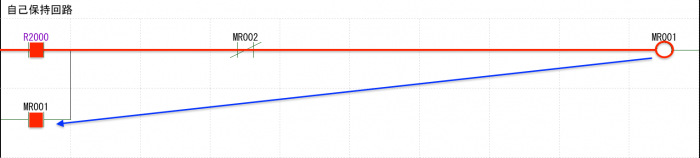
レポート・プレゼンに強くなるグラフの表現術 (講談社現代新書)

How to write a Pareto chart (Excel version)

It takes a bit of effort to draw a Pareto chart.
I would like to explain the method in Excel.

· Create a table (sort by large order of factors)

I will make a table to create a Pareto chart.
Prepare the value that you want to express in the bar graph (below, the value you want to show in the Pareto chart).
Arrange the factors in descending order.

① Specify the range you want to rearrange. (Including items)
② Select “Size” from “Home” → “Sort / Filter” → “Sort by User Setting” in the menu bar.

After this, in order to create a graph, “accumulated value” is calculated → “cumulative ratio” is obtained → “graph” is created.

Seek cumulative value
We will issue “cumulative value” for obtaining “cumulative ratio”.
cumulative

① The first of the “cumulative value” is the same as “Size”.
② From the second one we will calculate it by “previous cumulative value” + “size of the current item”.
(The cumulative value of the bottom item (last item) is the same as the total value of magnitude.)

Find cumulative ratio
We will calculate the value for making a line graph of “cumulative ratio”.
cumulative ratio

① Leave the line above the top item empty.
② Enter “0” in the cumulative ratio column there. (First value of cumulative ratio)
(You do not need to write anything in the cause.)
③ “Accumulation of items” / “Last item of accumulation” * 100 to make cumulative ratio.
(The sum of “last item of accumulation” = “size”)

The reason for putting 0 at the top is the starting position of the line graph in the Pareto chart, because we want to start the line chart of the Pareto chart from the 0 position.
The lower column divides the cumulative number by the total number and multiplies by 100. That is why I will issue the cumulative percentage [%].

“Last item cumulative” is marked with “$”, but it is a mark that prevents the value from moving when copying and pasting.
By pressing “F4”, the corresponding part is marked.

· Create bar chart (size)

Next we will create a graph.

The following is a shortcut key used in graph creation.
shortcut key

① Hold “Ctrl” and select “size” · “cumulative ratio” (including 0).
② Press “Alt” + “F1”.
(If you want to put a graph on another sheet, press only “F11”) to create a graph.

Specify the range of the graph like this. Please enter 0 for the cumulative ratio.
Designate range for graph
Of course, there is no problem even if you select a bar graph from the menu.

· Create a line chart (cumulative ratio)

Next we will change it to a line chart representing the cumulative ratio.

Change graph of cumulative ratio

① Select the bar graph of “Cumulative ratio”, right click and select “Select graph type” → “Line chart with marker”.
② “Cumulative ratio” is changed from a bar graph to a line graph.

Add axis for line chart

I think that the vertical axis is now the size.
Next we add another axis and create the vertical axis of “cumulative ratio”.

Y axis addition of cumulative ratio

① Select a polygonal line which is a line of “cumulative ratio” on the graph
② Select “Format” of graph menu of menu (red frame on the right side of the figure)
③ Select “Format setting for selection” (red frame on the left side of the figure)
④ Check the “2nd Axis (Up / Right)” in “Series Options” in the data series format setting (red frame at the center of the figure)

I think that the vertical axis for “cumulative ratio” was created on the right side of the graph.

Changing axis changes

Adjust the scale of the axis of “size” and “ratio”. (So ​​that you can visually decide immediately)

First, adjust the scale of the bar graph.
① Select the vertical axis on the left side of the graph (vertical axis of “size”).
② Right-click and select “Format Axis”.
③ Set the “minimum value” of the axis option to 0 and the “maximum value” to the total value of “size” (the last item in the cumulative column).

Set axis value

Similarly, adjust the scale of the line graph.
① Select the vertical axis on the right side of the graph (vertical axis of “Accumulation ratio”).
② Right-click and select “Format Axis”.
③ Set the “minimum value” of the axis option to 0 and “maximum value” to 100 (the maximum of the ratio is 100%).

Formatting the chart

· Change width of bar graph
Make the width wider and prepare to align the mark of the polygonal line with the corner of the upper right corner of the bar graph.

① Select the bar graph (size).
② Right click and select “Format data series”.
③ Set the interval of elements of the series option to “None”.
(If the bar graph sticks hard to see, change it to “1 to 5%”, or add a border to the bar graph.)

Change width of bar graph

· Change the position of broken line mark
Change the axis position and align the polygonal mark with the upper right corner of the bar graph.

① Select a line graph (cumulative ratio).
② Select “Graph design” → “Axis” → “Second horizontal axis” in the graph’s graph tool menu.
③ Select “Select target format”.
④ Make the axis option “None” for “scale type”, “None” for “auxiliary graduation type”, and “none” for “axis label”.
(Center of figure)
⑤ Check the “Scale” of the axis position.

Line graph alignment

·others
Please add a value above the polygonal line marker, format the graph with the title of the figure, the name of the axis etc attached.

It takes time and effort to make once, but after creating it you can copy and use the graph.
Please try various.

If you make a type of Pareto chart, you can use it in the same way

The following books are used as a way of displaying graphs in presentations etc.
As a way of expression it will be helpful.

Categories
Electrical and electrical / electronic design

Electrical design 1 Electrical and electrical design corresponding to heat

Font size = “6”> Electrical and electrical design corresponding to heat

I will think about the influence of control board and temperature of electrical equipment / electric equipment as electric / electric design corresponding to heat.
I think that the safety factor etc. at the time of design will differ depending on the company, so I would be pleased if you read it with reference level.

Influence of control components and electronic components given by heat

There are three possible influences:

·lifespan
·safety
·function

· Longevity

Life span reduction can be expressed by “Arrhenius equation” which is an expression for predicting the rate of chemical reaction at a certain temperature.
Degradation of grease and oil deteriorates the life of parts that use it.
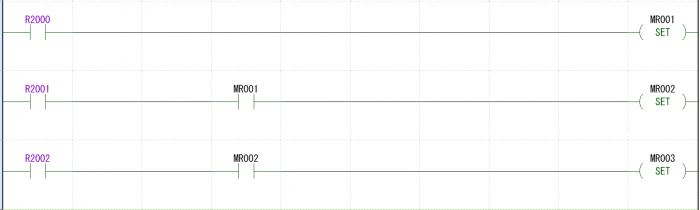
Moreover, its lifetime is not proportional to temperature, and its lifetime shrinks acceleratingly with temperature rise.
Especially for capacitors in electronic components talks.

· Safety

Basically it comes in contact with the skin as heat, it becomes whether the thing by heat in the atmosphere is safe.
Low temperature burns (contact with skin for about 40 ° C for a long time)
Rapid temperature rise
Contact in hot state and unaware
Besides this, when harmful gas is generated due to temperature rise, it needs to be taken into consideration.

– Function

In particular here I would like to explain ‘migration’ .
Migration has elements other than fever. In the first place, migration means that metal used as wiring or electrode moves over insulation, insulation resistance value decreases and failure / function degradation occurs due to insulation failure.
Migration has three types.
In the case of
Stress Migration
· Migration by metal being subjected to stress under temperature change environment
· Phenomena resulting in resistance increase and disconnection of wiring due to voids due to impurities or the like

Electromigration
· Migration by electron movement
· Easy to put on when the temperature is high
· Easy to handle when the current density is high

Ion Migration
· Electrochemical (accompanying electrolytic phenomenon) migration
· Easy to keep when the humidity is high

It is necessary to consider “life”, “safety”, “function” for control parts and electronic parts against heat

It will be helpful for books that are written in detail as thermal design.
Please refer to those who want to know more.
エレクトロニクスのための熱設計完全入門

Temperature design in control unit / control panel

I think that the way of thinking of heat itself is explained by the story of “The way of thinking of fever”.
This time we will explain the relation between the heat generation of the equipment and the heat dissipation of the electrical panel / control equipment box as an example.
The same way of thinking can be used in various places.
The contents to be considered in the temperature design inside the control device / control panel are

Calculation of calorific value
Calculation of heat dissipation

Calorific value calculation, heat radiation amount calculation.
The flow of design is as follows.
Design flow 1

For flow, calculate “calorific value” → “Calculate heat dissipation amount of (box)”.
Here, in the case of “calorific value”> “heat dissipation amount”, “ventilation opening” is provided as “radiator design” to calculate “natural ventilation heat radiation amount”.
Consider whether there is heat dissipation in ventilation (taking safety factor into account) more than “calorific value – heat dissipation amount”.
If it is still not enough, we will do “Calculate forced ventilation heat radiation amount” with fans etc. in the ventilation opening.

Then let’s consider the calculation of “calorific value” and “heat release amount”.
Below is an image diagram of heat generation and heat dissipation.
Box heat dissipation

· calorific value calculation

It is the sum of the calorific value of the equipment itself.
If the calorific value is unknown, please obtain the power consumption [W] from the current consumption of the equipment itself and the loss current.

I will give it as an example of a control panel.
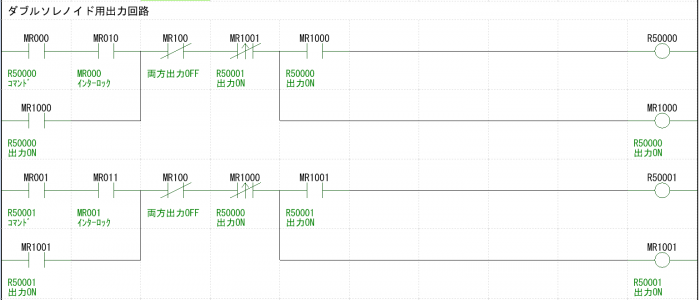
· heat dissipation calculation

It will be the temperature to radiate to the surroundings from the box itself.
Board heat radiation
Board heat value
Here, we use the heat passage rate U [W / m 2 / K].
General control equipment box (iron · painted) is about 4 ~ 6 [W / m 2 / K], but it changes somewhat depending on the environment.
The target temperature inside the box here is set to the temperature at which the control life of the control equipment is calculated.
If there is more than one control device, set the lowest temperature among the temperatures that the device calculates in life calculation.
The effective heat radiation area is the surface area of ​​the box.

For example, assuming that the target inside temperature is 55 [° C.], the atmospheric temperature is 40 [° C.], the effective heat radiation area is 2 [m 2], and the heat amount is 1000 [W], when the heat passage rate is 5 [W / m 2 / K]
Qr = 5 * 2 * (55 – 40) = 150 [W]
Heat radiation design from the box itself Qr For heat generation quantity Q of the equipment, heat radiation design is required.
In this example, (1000-150) = 850 [W] further heat dissipation is required.
If you do not need estimate of heat transfer rate please skip to “heat radiation design”.

When the calorific value slightly exceeds the heat radiation amount (multiplied by the safety factor), it is necessary to respond to changes such as changing to a material with a high heat passage rate, increasing the effective heat radiation area with a heat sink or the like.
If the calorific value is still exceeded, it is necessary to consider the “heat dissipation design” described below.

Estimating Heat Transfer Ratio
If you do not know the heat transfer rate please estimate from the following.
Below is the cross section of the inside and the outside of the box.
Flow chart that heat flows through the wall
Heat Passing Ratio
. As a way of transferring heat, internal temperature T → board surface Th 1 → external plate surface Th 2 → external temperature (atmospheric temperature) T 0 will be transmitted.
The heat transfer coefficient h1 [W / m2 · K] inside the box, the heat transfer coefficient h2 [W / m2 · K] outside the box, the plate transfer rate is the plate thickness t [m] of the box, the box It is derived from the thermal conductivity λ [W / m · K].

To obtain this we need the following
heat transfer coefficient
The heat transfer coefficient h1 is obtained from the convective heat transfer coefficient ha inside the box and the heat transfer coefficient h2 is obtained from the convective heat transfer coefficient hb of the box outside and the radiative heat transfer coefficient hε.
The convective heat transfer coefficients ha and hb vary with the flow velocity of the fluid.

Below is a table of air heat transfer coefficient and wind speed.
Air heat transfer coefficient
In addition, radiative heat transfer coefficient h ε is heat dissipation due to radiation heat generated from the plate.
radiative heat transfer coefficient

5.67 * 10 ^ 8 is what is called the Stefan Boltzmann constant.
Ε is the emissivity and I think that it should be around 0.6 to 0.9. Also, I use Th1, Th2.
Although it is not accurate, I think that it is good at the middle (T – T 0) / 2 + T 0 inside and outside the box in estimation.

Example: emissivity 0.8, Th 2, 47.5 [° C], flow rate of the atmosphere in the box 1 [m / s], flow rate of atmosphere outside the box 0.5 [m / s], box thickness 0.003 [m] When the rate is 50 [W / m · K]
Atmospheric flow velocity 1 [m / s] → Convection heat transfer coefficient 8 [W / m 2 · K]
Atmospheric flow velocity 0.5 [m / s] → Convection heat transfer coefficient 4.5 [W / m 2 · K]

H 1 = 8 [W / m 2 · K]
(47.5 + 273.15) ^ 4- (40 + 273.15) ^ 4) / (47.5-40) = 4.5 + 5.78 = 10.28 [W / m 2 · K]
T / [lambda] = 0.003 / 50 = 0.00006 [W / m <2> K]
U = 1 / (1/8 + 0.00006 + 1 / 10.28) = 4.50 [W / m 2 · K]
I think that I will explain the way of thinking in the concept of fever.

If heat radiation can not be made in time, it is necessary to consider heat dissipation in “natural ventilation” “forced ventilation”

Heat radiation design inside the control device / control panel

We also made calculations for the amount of heat dissipation in the box.
In case of “calorific value”> “heat dissipation amount”, we will adopt the method to be described from now.
The amount of heat dissipation in the ventilation to speak under this should be “(heat release by ventilation)”> “calorific value” – “heat dissipation amount of (box)”.

Calculation with natural ventilation “Calculation of natural ventilation heat radiation”

Natural Ventilation Thermal Diagram
It is an example of natural ventilation heat radiation. In natural ventilation heat dissipation, there is a method to set the ventilation port so that the temperature inside the box approaches the ambient temperature. I will leave the movement of the gas to nature.
Calculation of heat radiation amount is as follows.
Natural ventilation heat radiation

natural ventilation value
I think that the atmosphere is usually air. The density of air is 1.154 [kg / m 3] and the specific heat of air is 1018 [J / kg ℃].

For example, the target inside temperature is set to 55 ° C., the temperature near the ceiling in the box is set to 58 ° C., the ambient temperature is set to 40 ° C., the area of ​​the ventilation opening for execution is 0.05 m 2, the height of the intake port-exhaust port is 0.3 m ] And
Heat radiation amount Q = 1018 * 1.154 * 0.05 * √ ((2 * 9.8 * 0.3 * (55 – 40)) / (273.15 – 40)) * (58 – 40) = 561.12 [W]

Heat generation amount 1000 [W]> heat radiation amount of box 150 [W] + natural ventilation heat radiation amount 561.12 [W] = 711.12 [W], so further heat radiation is required.
When the calorific value slightly exceeds the heat release amount (multiplied by the safety factor) like this, it is necessary to increase the effective ventilation area, increase the difference between the exhaust port and the intake port height, and so on. In some cases it is necessary to think about how to set the limit of ambient temperature (temperature limit on use). If we can not respond, we will consider heat dissipation in the next forced ventilation.

Calculation with forced ventilation “Calculation of forced ventilation heat radiation”

Forced ventilation heat dissipation
An example of forced ventilation heat dissipation. In forced ventilation heat radiation, unlike natural ventilation heat radiation, it is a method to forcibly move a gas with a fan or the like to bring the temperature inside the box close to the ambient temperature.

Calculation is as follows.
強制換気放熱風量

強制換気値

Normally, I think that the atmosphere is air. In that case the air density will be 1.154 [kg / m 3] and the specific heat of air will be 1018 [J / kg ℃].

For example, if the remaining required heat radiation amount is (heating value 1000 [W] – total heat radiation amount 711.12 [W]) = 288.88 [W], the in-box target temperature is 55 [° C.], and the ambient temperature is 40 [
V = 288.88 / (1.154 * 1018 * (55 – 40))
 = 0.0164 [m3 / min] and so on. (This value is the air volume)

When selecting, please find a fan more than this with the safety factor multiplied by this.
If there is no fan to be selected or if the heat exceeds the ventilation opening, it is necessary to limit the temperature within the design range by limiting the ambient temperature (temperature limit in use).

If heat radiation can not be made in time, it is necessary to consider heat dissipation in “natural ventilation” “forced ventilation”

In this way, it is necessary to solve the heat problem beforehand on the design.
It is invisible and inaccessible, but if you do not do it you will encounter serious eyes later.
Let’s raise the design accuracy as compared with what we did.


It will be a reference for books written as thermal design from various angles than what we have talked about until now.
It becomes a book of thermal design that can be used for electrical designers.